





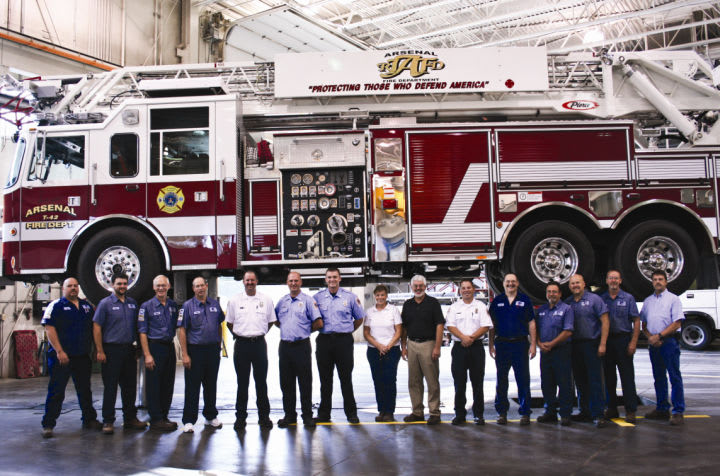
For some fleet maintenance facilities, taking on more work might seem like a nightmare. With over-stressed technicians and too-few resources, adding work to the pile might only make matters worse. However, insourcing more work from neighboring fleets can actually improve operations. The City of Moline, Ill., is one example.
Partnership Fills Maintenance Gaps
Recently, the City of Moline's neighbor, the Rock Island Arsenal (RIA), sought out the City's maintenance services for its firefighting apparatus. The partnership proved beneficial to both parties: The military installation found reliable maintenance service for emergency vehicles that met National Fire Protection Association (NFPA) standards, and the City was able to add a member to its staff, while decreasing costs and improving fleet efficiency.
The partnership began when a member of the Arsenal staff contacted one of the City's fire crew, inquiring about services the City provided its fire department. This prompted the RIA to contact the Fleet Services Division. "They were looking for a facility that had EVT-certified technicians who could perform repairs and maintenance on their equipment, that meets the NFPA standards for apparatus maintenance," said J.D. Schulte, fleet manager, City of Moline.
Realizing the City could offer the maintenance services Arsenal's Fire Department needed, the City of Moline and the Rock Island Arsenal Contracting Center established a blanket purchase agreement (BPA), renewed annually.
"The partnership created with Moline City Maintenance has been extremely beneficial for our department," said Joe Heim, deputy fire chief, Rock Island Arsenal. "Not only are we ensuring compliance with NFPA, but our apparatus downtime has been significantly reduced. Moline's facility is second to none at taking care of their customers."
Insourcing Proves Mutually Beneficial
Prior to its partnership with the RIA, the City of Moline's fleet services division had minimal staff, performed maintenance on fleet units during the day, and occasionally outsourced work, which increased vehicle downtime. With the new RIA contract, the City was able to add a technician to its staff to handle more routine maintenance jobs at a lower labor rate. This allowed the division to take on additional work and allocate resources more efficiently.
Previously, technicians with specialized skills and higher labor rates worked on a range of vehicles; now those technicians work on specialty vehicles such as Arsenal's fire apparatus, which more effectively puts their knowledge to work.
"We were already at minimum staffing before taking on the additional work, so we knew we would have to staff up," Schulte said. "Adding the additional billable hours and having a technician start at the entry level of the pay scale allows us to lower our labor rate for all our customers by nearly $5 per hour. We are also able to assign high-end work to our EVT techs, which helps keep our labor rate low."
With more work and a larger staff, the city is able to operate its maintenance facility an additional 10 hours per day — from 8 ½ hours in 2000 to 18 ½ hours today.[PAGEBREAK]
"We have the majority of our staff on 10-hour night shifts, and we are now performing nearly all preventive maintenance work on the night shift," Schulte said. "This allows us to keep our downtime to a minimum. The Arsenal staff also likes having their PM work completed at night to minimize downtime."
Reducing downtime and improving facility use are major benefits to the City. Schulte estimates insourcing will help save the City roughly $100,000 in 2011.
With additional work from the Rapids City Fire Protection District and the Hampton and Coal Valley fire departments, the total number of insourced units is now around 30.
"When you have a facility like ours with high-skilled employees, it just makes good sense, for the taxpayers, to partner and co-op when possible," Schulte said. "We have to remember the City of Moline is our first customer and our primary reason for being here, but the work we do for insourced agencies is just as important to them and their customers. We are able to lower the cost for services at both the local and federal levels."
Getting the Most out of Maintenance
Although the city provides maintenance for the Rock Island Arsenal, its own PM program is likely the most important activity the team performs, according to Schulte. His team relies on the following steps to ensure each vehicle is getting the maintenance it needs, while incurring the least downtime possible.
Inspect every unit. Schulte's team inspects every unit brought in for service, depending on the type of preventive maintenance scheduled. "The inspection and evaluation during the various PM services is geared to ensure that potential failures that may cause downtime between scheduled services are found while the unit is in for service," he said.
Create a schedule and stick to it. When a piece of equipment becomes part of the fleet, a hierarchical PM schedule is created and entered into the City's Fleet Information Management System (FIMS). Vehicles and equipment are categorized by American Public Works Association (APWA) class code, and each class code has a corresponding PM schedule to ensure timely maintenance.
Use technology wisely. Through FIMS, a client/server-based system, the City tracks vehicle and equipment maintenance and repairs. All technicians use laptops on their toolboxes, and information in the system is live, enabling support staff to track workload/schedules at all times. This system keeps information organized while allowing technicians to see real-time updates on a vehicle's PM schedule.
When it's cheaper to outsource, do it. Sometimes, it's more cost-effective to outsource jobs that don't fit the areas of maintenance in which the City specializes to an outside vendor (e.g., automatic transmissions, glass, body and paint work, heavy truck tire mounting and repair, etc.). "We have a few outboard motors in the fire department that we send to the local boat dealer for maintenance," Schulte said
Rely on the third shift. Schulte said the City's single most effective downtime-saving program is its third shift. "All of our PM work is done in the evening so it minimizes the need for a department to give up a unit for maintenance when they need it most," he said.
[PAGEBREAK]

The City of Moline's Innovative Remarketing Strategies
With limited staff and valuable dollars to recoup on disposed vehicles, the City of Moline, Ill., has employed several successful - and resourceful - remarketing techniques. Government fleets looking to revamp their own remarketing programs can glean these valuable tips from Moline's operations:
Use the Internet. In 2005, the City of Moline began aggressively using Internet auctions to dispose of used vehicles - and it worked. "eBay has been a remarkable tool for the City of Moline as well as some of the other government surplus Web sites," said J.D. Schulte, fleet manager. "Our disposal revenues increased by more than 60 percent when we moved to Internet auctions instead of using a once-a-year local auction. We sell vehicles and equipment even out of the country now, for considerably more revenue than we ever got with our local live auctions."
Provide a virtual tour. One of the downsides to remarketing vehicles online is the buyer can't assess them as he or she would on the lot. In 2007, the city found a fix: YouTube. By creating videos and posting them on auction links, potential buyers can, for instance, see if the hydraulic system works properly on a unit. City staff also walk around the unit and point out specific features or defects that might be of interest to the buyer. "By using YouTube, we have seen an increase again in our revenues from surplus equipment," Schulte noted. "It really helps with buyer confidence, letting them feel more comfortable with a sight-unseen purchase."
Let an agency handle the big jobs. Consider offloading to an agency units that may attract more attention than others. "We have very little support staff, so if we have an item we know will generate a considerable amount of e-mail inquiries and demand a lot of time, we will have the [auction] agency list that item," Schulte said.
Recycle/reuse. Fleet units that have reached their lifecycle in one capacity may still be functional in another. Before performing work to remarket units to the public, see if another agency can benefit from it. Schulte said Moline reassigns a considerable number of vehicles, which lowers labor and capital expenditures. "When a unit has exhausted its useful life in a high activity capacity, it can still be good transportation to and from the jobsite for an inspector, for example."
Acquisitions: Purchasing the "Right" Vehicle
When it comes to acquiring new units, the City of Moline, Ill., Fleet Services is ultimately responsible. The team develops specifications, acquires vehicles and equipment, places them in a replacement schedule, and upfits all new equipment as needed before putting them in service. By answering these key questions, Fleet Services can both purchase the right vehicle and foresee its lifecycle. J.D. Schulte, fleet manager, explains acquisitions for the City of Moline.
Q: What are the agency's needs and what options should be considered?
A: For example, we allow the police department to determine if they prefer keyless entry, but the fleet services division will decide what wheels provide the most longevity and whether we will select silicone hoses for the cooling system.
Q: Can units be acquired as part of a joint purchase? How do you ensure vehicle and equipment selections meet your needs?
A: About 30 percent of the time, we develop our own specification and publish an invitation to bid or a request for proposals. We look at joint purchasing options whenever possible, as there is a considerable amount of time that can be saved.
Q: What should the amortization schedule be, and what should the salvage value be upon disposal?
A: We anticipate how many years the unit will be in front-line service and put in a calculation for inflation. We then calculate an annual chargeback amount based on the number of years that unit was expected to be in service.
Q: How do you budget for replacement?
A: In Moline, a typical snow plow salt spreader that is also used for leaf and brush collection and road and street maintenance throughout the year can be placed on a 10-year schedule. This does not automatically mean that it will be replaced in 10 years, but financially, we try and prepare to fund the depreciation of this unit by the end of the 10-year period so we can purchase the replacement when the unit is no longer cost-effective to keep.[PAGEBREAK]
The Secret to the City's Success: Staffing
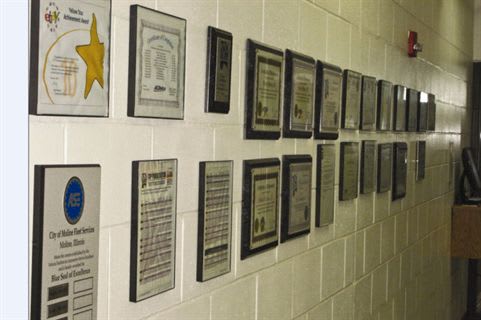
Strategic initiatives such as insourcing, diligent preventive maintenance, and creative remarketing could not operate without the City of Moline's outstanding fleet staff to keep the wheels turning. Schulte says this stems from both the City's investment in its people and each staff member's own pride in his or her work.
"We have a highly motivated staff with a great morale," he said. Seven of eight technicians in fleet are ASE certified, and six are Master Techs. Nine of the 11 total employees in fleet are ASE certified. "What makes this so unique is that the City provides no incentives for certification. These employees are true craftsmen who are driven to excellence by their own personal motivation to be the best they can be," Schulte said.
The City strives to match this commitment by investing in training for its maintenance staff. Some fleet managers may shy away from dedicating too many hours to staff development, as it risks increasing vehicle downtime. However, the City of Moline has found a way to avoid these increases, while at the same time lowering training fees and increasing attendance.
The City allows vendors to use its facility for training courses so its technicians can attend for free or at a reduced rate, said Schulte. The vendors get a higher turnout because local shops don't worry about going to a competitor's facility. This and other measures have resulted in City fleet technicians averaging over 88 hours of professional development training annually.
Schulte said his staff lives by two mottos. "The first is, 'If we don't manage the equipment, it will manage us,' which keeps us focused on making sure we find potential problems and fix them while we are in control of the schedule and not letting the breakdowns manage our time," he said. "The second is, 'The work we do is essential, but it's not essential that we do it.' This reminds us that we all have good jobs and if we don't perform them well, the City will find someone else who will."






![The OHSP Aviation Section deploys multiple aircraft, including a Gipps Aero GA-8 Airvan.[|CREDIT|]PHOTO: Ohio State Highway Patrol](https://assets.bobitstudios.com/image/upload/f_auto,q_auto,dpr_auto,c_fill,w_980,h_552/pm.6_1759887528895_aiqjew.jpg)