Use of telematics is becoming more prevalent among fleets. The ability to track vehicle location and diagnostics, driver behavior, and more can be a powerful fleet management tool. But implementation isn’t easy. Here’s what fleet managers have learned after years of telematics use.
Handling Driver Pushback
Many drivers, when they first hear about vehicle telematics, don’t like the idea. Some may think of “big brother,” and organizations may face union opposition — or even telematics devices “magically disappearing.”
The San Bernardino County, Calif., fleet has been using telematics for the past 10 years and now has it on 2,300 vehicles. While drivers are used to it now, they didn’t like it in the beginning, said Ron Lindsey, CAFS, director of fleet management. That’s when strapping down the device plugged into the OBD-II port is a good idea.
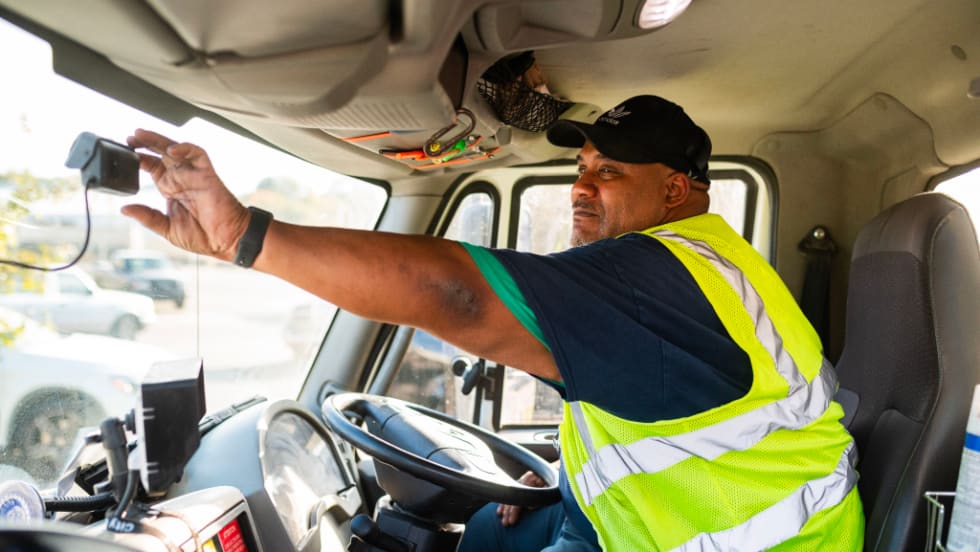
At the State of Utah, devices get zip-tied in behind the dashboard using a Y-harness that plugs into the OBD-II port. This not only helps with driver tampering and bumps that could dislodge it, but also ensures that the accelerometer in the device collects accurate information.
“If you don’t do it that way, I guarantee the accuracy of the device is not going to be up to par,” said Eric Gardner, fleet research consultant for the state, who’s working on expansion of telematics use in the fleet.
San Bernardino County Fleet Management first added decals in the vehicles that stated something like: “This vehicle is equipped with GPS and there should be no expectation of privacy.” Now, that wording is included in the county vehicle policy, Lindsey said.
Utah began using telematics eight years ago, but its recent pilot that began in January of 2017 with 1,500 vehicles is its most successful so far, Gardner reported. With this pilot, department heads volunteered for the program. At first, Gardner and the volunteer department heads didn’t tell drivers what was being tracked. This turned out to be a mistake.
Drivers, unaware of what they had done wrong, “were upset when they were called in to be reprimanded,” he said.
For the rollout to a second department, drivers were told that seat belt usage, speeding, and idling were being monitored. “You don’t want this program to be a ‘gotcha’ type of management tool,” Gardner explained.
![[|CREDIT|]](https://assets.bobitstudios.com/image/upload/f_auto,q_auto,dpr_auto,c_limit,w_684/pm.weblets_phone_1759886915669_tdvbti.jpg)
Determining What to Track
Each organization may be limited in what it can track using telematics. At San Bernardino County, the unions initially agreed to telematics only if it was used for asset management, but this has since been expanded to allow Human Resources to track speeding. It’s also used by Animal Control for dispatching.
In addition to monitoring vehicle health and idling, Fleet Management participates in California’s continuous testing program (CTP), which allows it to bypass biennial smog inspections.
For the City of Wichita, Kan., telematics use is restricted by staff availability, so user departments take the lead, said Troy Tillotson, fleet maintenance superintendent. The Fire Department is the next to install telematics on 50 of its trucks, and the system will be used for geofencing — to know when vehicles are entering and exiting their service areas — and tracking in case dispatch goes down.
Additionally, fleet staff receive reports for tracking driver behavior, such as change in speed and unauthorized device removal. The agency does not track diagnostic data.
For Utah, the goal of the current pilot was to get a return on investment (ROI) — hence, the focus on speeding, idling, and seat belt use. Gardner said the biggest factor affecting ROI was miles per gallon. The state has a no-idling policy, but there was no way to monitor it. Now, the state has real-time data on idling for one of its departments, and drivers hear a beeping sound if they’ve been idle more than three minutes.
“Ever since then, we’ve seen a dramatic difference in idling, which improved our ROI in regard to fuel savings,” Gardner said.
Overcoming Challenges: Software Integration & Data Management
Lindsey and Gardner agree that telematics has improved considerably, and data is much more accurate and reliable. Still, they face challenges with the technology.
One is odometer readings. Lindsey said he found mileage calculated by the telematics system was off by about 4-5% from actual odometer readings. To deal with this, fleet management uses odometer readings entered manually when drivers get fuel or when technicians open a work order.
Gardner uses odometer readings from his telematics system, but there are glitches with new vehicles from a specific OEM, forcing him to look up and enter the odometer data manually. He supplements this information with odometer readings taken when drivers fuel up using gas cards.
Another issue is compatibility with the fleet management information system — many don’t integrate. Lindsey is in the middle of an RFP process for a new telematics system and requested that it integrate with his FMIS. Gardner is hoping for legislative approval to roll out telematics to the entire 5,000-vehicle fleet, and once this happens, he’ll work on integration of telematics and FMIS.
A partnership between both the FMIS and telematics providers is needed, Lindsey warned.
Another problem for some fleets is data management. Because Wichita has a small fleet team, it relies on customer departments to take the lead. Lindsey plans to more actively track telematics data once a company is awarded the new telematics contract, and he does expect this to require more staff time.
At the State of Utah, Gardner works on telematics expansion, and another fleet employee handles telematics administration. While expansion might change things, Gardner said data management for the telematics ROI pilot so far has been feasible.
“We just have reports sent to us [for] those three categories — speeding, seatbelt, and idling — and we’ll go over it. We’ll talk with the drivers that need to be talked with,” he said. “It kind of runs itself, really. The hard work comes in the form of enforcing policies through driver safety committees.”