
*Special fleet knowledge series sponsored by NAFA*
At a Glance |
Some factors that may affect vehicle equivalency units (VEUs) include:
|
A vehicle equivalency unit (VEU) is a comparison measurement that can be used to normalize fleet size in terms of sedan equivalencies and annual required maintenance hours. VEUs implicitly represent an understanding that different types of vehicles, beyond the standard sedan fleet car, require different levels of attention and drive different cost ratios. Understanding this is vital to providing accurate staffing and budgeting.
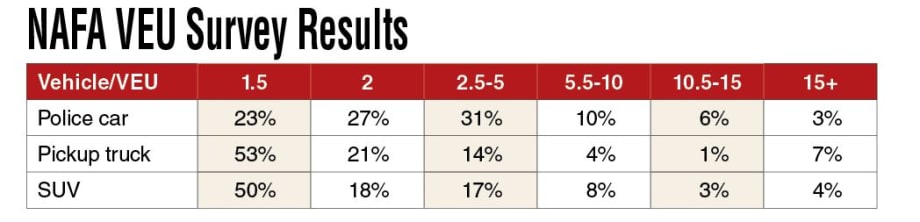
NAFA recently asked fleet managers to respond to a quick button survey on VEUs. The answers, reflected in the table below, are surprising, not because of the average VEUs but due to the range of answers given. The responses would indicate that the majority of respondents equate a police car to between 2.5 and five sedans, and a pickup truck or SUV to two sedans, in terms of annual maintenance hours required to keep that vehicle on the road. This means if an organization calculated that an average sedan required eight hours of maintenance a year, the SUVs and pickup truck would require 16. Another organization might find that it takes only six hours per year for sedans and only nine for pickup trucks. So, what accounts for the deviation in the results?
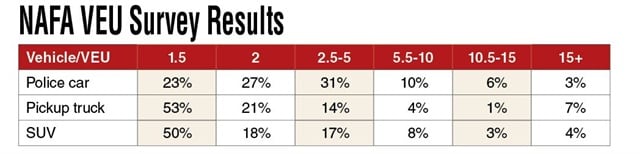
NAFA’s quick button survey shows that vehicle equivalency units (VEUs) vary widely. For example, while half of respondents assign an SUV with 1.5 VEUs, some give it as much as 15 VEUs.
Accounting for Differences
Fleet managers offer many reasons for deviating from an industry standard or benchmark when it comes to VEUs. Since a VEU is the measure of how a particular vehicle, operating in a specific fleet and in a certain geographical area, compares to a sedan in terms of annual maintenance hours expended, the most common differentiators are fleet age, operating environment, and vehicle type.
To state the obvious, there is a direct correlation between vehicle age and maintenance costs. As an example, consider a fleet where the average age of sedans is four years, and each sedan requires approximately 12 hours of maintenance. The same fleet has a number of SUVs that are kept far longer (nine years) and have an average maintenance spend of 36 hours per year, resulting in a VEU ratio of 3:1 when comparing SUVs to sedans.
Similarly, there is a relationship between the operating environment and maintainability of vehicles. While sedans are generally used in a similar fashion, vehicles that can be used off-road can have vastly different results. Using the example in the previous paragraph where it takes an average of 12 hours to maintain a sedan, a pickup truck operating in a major urban area might require 20 hours per year. That number can triple when operating in austere conditions such as in extreme weather.
Finally, vehicle type can influence the numbers. This is especially true for larger pieces of equipment such as fire trucks, where different features and components can result in significantly different maintenance requirements.
Conducting a VEU Analysis for Fleet Optimization
While all of this makes it challenging to compare VEU results across organizations, it can still be done as long as consideration is given to the three variables previously described.
VEU analysis is a valuable tool to normalize a fleet and optimize the size and composition of a maintenance staffing team. This brief description provides the basic methodology; however, additional resources are available. NAFA members can access the more detailed whitepaper from the NAFA website (www.nafa.org/whitepapers). In addition, the NAFA Fleet Maintenance Operations Guide provides detailed information plus examples; the guide is available at www.nafa.org/store.
About the Author:
Lt. Col. (retired) Katherine Vigneau, CAFM, spent almost 27 years in the Canadian Army working in transportation and logistics. She retired in 2010 to start KMVS Fleet+ Consulting, specializing in fleet management education and training. Vigneau is a former NAFA Trustee and currently serves as NAFA’s Professional Development Strategist.