




Mecklenburg County was first approached by the City of Charlotte to provide mutually beneficial maintenance services for the County’s vehicles. These vehicles included all Sheriff’s Department and administrative vehicles, light- and medium-duty trucks (including pickups and vans), landscaping/agricultural equipment, and paratransit buses and vans, totaling 1,587 vehicles and pieces of equipment.
The City of Charlotte is the largest city in the State of North Carolina and the 19th largest in the country.
"Mecklenburg County had already identified several key changes needed to enhance its fleet maintenance operation, including investing in a new fleet management information system and shifting accountability for fleet maintenance spending decisions to fleet users (County departments)," according to Equipment Management Division Manager Rudolph Payton, City of Charlotte, N.C.
Charlotte needed to prove to Mecklenburg County officials they would save money by outsourcing light-vehicle maintenance services.
"The process of proving the potential cost savings to Mecklenburg County involved a number of steps starting with determining what all would be required," said Payton.
The first step was calculating Mecklenburg’s actual fleet count, what vehicles were involved, to whom were they assigned, their replacement schedules, and the previous three years of actual maintenance cost.
Next, Payton and his team determined the proposal’s impact on current County fleet employees. For example, would the Mecklenburg employees become City of Charlotte employees or remain on the Mecklenburg County payroll?
The City also developed the process for handling employment-related issues, such as benefits coordination related to sick leave, vacation pay and scheduling, discipline, levels of compensation by classification, etc.
"Bear in mind many discussions were held between the executive management of both organizations to finalize just what the ‘landscape view’ would be," said Payton. "Resultant decisions determined the direction and the necessary steps."
The next step was for the Equipment Management Division (EMD) to develop a proposed budget in conjunction with Business Support Services’ Office of Resource Management.
EMD began applying its budget process by using vehicle equivalent units to determine required staffing needs, bay utilization and facility capacity, and technician and administrative staff skill levels.
The Office of Resource Management determined overhead and benefits costs, and applicable chargeback rates to create a "win-win" situation for the City and County.
The City of Charlotte’s Business Support Services business unit successfully submitted a proposed budget that generated a potential cost savings of $700,000 for Mecklenburg County, and significantly reducing overall costs for the City of Charlotte due to an "economy of scale."
[PAGEBREAK]
When an organization takes over the responsibility for a process from another organization, public or private, challenges will arise. Challenges experienced — and overcome — by the City of Charlotte include:
• Communication. "We had to realize communication was key to the success of this project. If any message was not conveyed properly, it could lead to miscommunication and prove costly," said Payton. "Some of the miscues experienced on both sides of this project led to loss of manpower and missed deadlines; however, the issue was quickly recognized and both parties were brought to one accord."
• Accuracy. Information and data accuracy was another hurdle. Lack of accuracy creates a loss of credibility and generates a sense of confusion and mistrust. "When accuracy is lost, all parties involved spend an inordinate amount of time re-analyzing information rather than resolving issues," said Payton.
• Terminology. Another challenge was the terminology related to understanding fleet business processes. "Both organizations operated using different methods to accomplish the same result. It was necessary to ensure terms used by one organization were understood by the other and vice-versa," said Payton.
• Lack of Clarity. A lack of clarity led to confusion and often "muddied the waters," resulting in revamping communication models, budgets, policies, and procedures to fulfill the needs of both parties, according to Payton.
• Training. "We needed to determine who would be trained, how they would be trained, who would conduct the training and when, what the syllabus would contain, and employee skill and ability levels," said Payton.
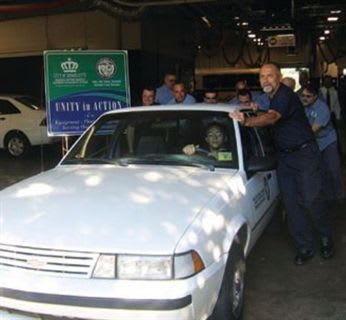
• Project Management. The City and the County used a formal project management approach in order to keep the merger on track including formation of a project steering committee, development of a project charter, creation of a communications plan, and development of criteria to manage change and acceptance that tasks were completed.
This process was instrumental in keeping the project on schedule and within budget. It also provided a mechanism for all of the various stakeholders to participate in the project.
Mecklenburg County had established a goal to reduce its maintenance cost per vehicle equivalent unit while maintaining or improving service quality. The City and County staff began developing a proposal that would be good for taxpayers, County fleet users, and County employees.
"I would have to conclude the goals of both organizations throughout this partnership have been met unquestionably," said Payton.