At a Glance |
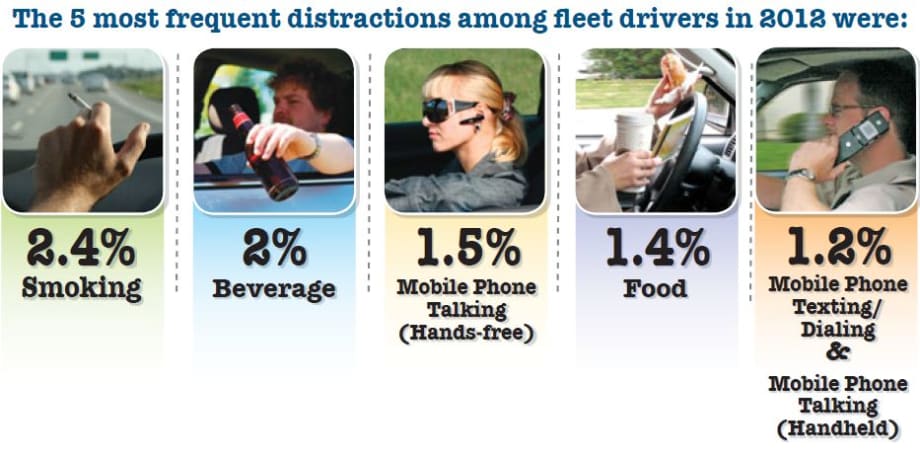
Fleet managers should be mindful of the following dangerous driving diversions:
|
As April is national Distracted Driving Awareness Month, it’s an important time for fleet managers to reevaluate methods of enforcing better driver behavior on the road.
Over the past few years, there has been a growing awareness around the issue of distracted driving. In 2009, President Obama issued Executive Order 13513, which prohibits all government employees and federal contractors from texting while driving government vehicles on official government business or while using government-supplied equipment. And as of February, 16 states have issued some type of restriction on hand-held devices on the road while 40 have banned texting while driving for all drivers.
Although the country is making significant headway on the issue of electronic distraction, studies show that it continues to impact safety within government fleets in addition to other common distractions such as drinking beverages, eating, and smoking.
Identifying current distraction trends and their impact on fleet drivers is crucial when creating agency policies, implementing enforcement capabilities, and promoting compliance.
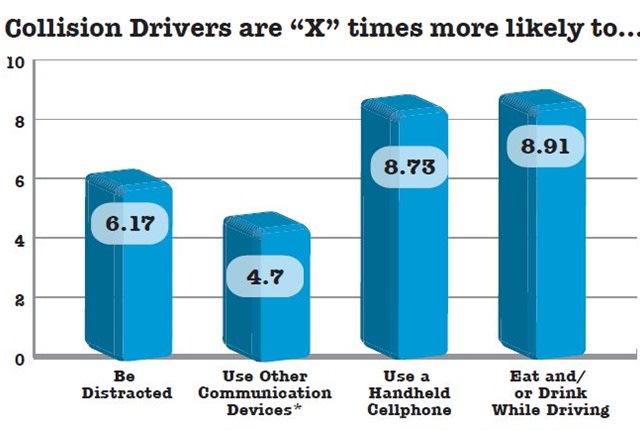
By observing more than 700 government fleet drivers between 2009 and 2010, DriveCam calculated the likelihood a driver involved in one
or more collisions would engage in certain common distractions.
*Other communication devices include but are not limited to CB radios, two-way walkie-talkies,
and Nextel/chirp devices.
Data courtesy of Drivecam Inc.
The Likelihood of Distraction
DriveCam, a driver safety company, analyzed about 700 active government fleet drivers between July 2009 and December 2010 to see the difference between collision and non-collision drivers’ conduct. Once staff members identified the major behaviors, they calculated the probability of a collision given the number of times they observed the distraction.
The study reveals that government fleet drivers involved in one or more collisions are:
6.17 times more likely to be distracted
4.7 times more likely to be using other communication devices such as CB radios, two-way walkie-talkies, and Nextel/chirp devices
8.73 times more likely to use handheld cell phones
8.91 times more likely to be eatingand/or drinking.
These issues can be tied back to cognitive distraction, an interruption to the process of thinking about and doing a task. David Teater, senior director of transportation initiatives for the safety advocacy and research organization National Safety Council (NSC), explains that drivers see visual distraction — physically taking one’s eyes off the road — as an obvious problem, whereas cognitive distraction is less recognized.
“We don’t understand that the human brain can’t do two cognitively demanding tasks at the same time. One always takes priority,” Teater said. “You can’t identify potential road hazards if you’re splitting your attention and focus on something else like the conversation you’re having.”
Upon studying distracted driving trends, Bob Rose, transport manager and editor for J.J. Keller, a company that helps clients comply with safety regulations, agrees that fleet drivers should avoid multi-tasking while driving. “We can only toggle-task, or switch focus back and forth between tasks,” said Rose. “We have limitations on how much we can process at any one second. That’s why we need to be educated on this and further remind drivers not to multi-task while driving.”
SmartDrive’s 2012 driver behavior study showed the top five distractions drivers new to the study were most likely to engage in while on the road.
Data courtesy of SmartDrive.
Current Common Distractions
A study produced by driving intelligence company SmartDrive measured the most common forms of driver distraction over 2011 and 2012. Data was distilled from about 13.5 million captured events, which observed fleet drivers from more than 117 companies and public transit (state and local) and federal fleets.
In 2012, the five most frequent distractions among drivers new to the study were: smoking; beverage drinking; mobile phone talking (hands-free); eating; and a tie between mobile phone talking (handheld) and mobile phone texting/dialing. The study also showed that the top 5% of drivers with the most distractions were distracted 67.3% of the time and were 11 times more likely to be involved in mobile device distraction.
According to Brian Kinniry, manager of risk and safety services at CEI, a collision management service provider for fleets, the other problem is that inattention increases a driver’s stopping distance. “Anything that takes your eyes off the road for more than two seconds is a distraction and doubles your chances of an accident,” said Kinniry. “At 55 MPH, you travel 161 feet in two seconds. That’s 10-15 car lengths, and if you’re closer than that to a hazard, you’re most likely going to crash.”
Creating & Enforcing Policies
More and more agencies have been adopting policies regarding distracted driving. But policies aren’t as effective without a strategy for backing them up, said Matt Howard, chief marketing officer at Ageis Mobility, a developer of distracted driving products.
“It’s one thing to have a policy on a piece of paper, but it’s entirely different to allocate the focus and budget necessary to ensure compliance,” said Howard. “Whether it’s employing consequences or compliance technology, employees need to know their agency is taking distracted driving seriously.”
[PAGEBREAK]
SAFE DRIVING TIPS
After reviewing driving trends among drivers in the city, county, state, and federal sectors, the following tips are offered for drivers and fleet and risk managers to prevent distracted driving.
TIPS FOR DRIVERS:
Invest more time planning the trip beforehand. Know the best way to get from point ‘A’ to point ‘B’ without having to make split-second decisions.
Check the vehicle before each trip to make sure it’s safe to operate. Be aware of the tire pressure or check engine lights before taking a trip.
Evaluate your own limitations. For how many hours can you drive before you start to become unsafe behind the wheel?
Whether it be a cell phone or a sandwich, don’t reach for things while driving.
Try turning off cell phones or putting them in the vehicle’s glove box if you find the inability to check the device to be too challenging.
Eliminate cognitive distractions (anything that takes your mind off a task and interrupts the process of thinking about and doing that task).
If lost, pull over before checking GPS and mobile devices for directions.
Always scan the forward roadway for potential hazards while driving.
TIPS FOR MANAGERS:
If you have an anti-distracted driving policy in writing, think about investing in some type of enforcement capability (such as surveillance or training) to promote compliance; agencies can still be held accountable if a driver doesn’t comply with policy.
Show drivers that safety policies should be taken seriously by imposing consequences, such as additional training, if they don’t comply.
Identify which drivers are the most common distracted driving offenders; keep an eye out and suggest supplemental training.
Use real-life examples and stories to explain how dangerous distracted driving can be.
Make use of repetitive communications through various media (e-mail, blog blasts, etc.)
Create posters or pocket policy cards to distribute as handy reminders.
Sources:
● Eric Cohen, senior marketing manager, DriveCam
● Matt Howard, chief marketing officer, Aegis Mobility
● Brian Kinniry, manager of risk and safety services, CEI
● Jason Palmer, president, SmartDrive.
● Bob Rose, transport manager and editor, J.J. Keller
● David Teater, senior director of transportation initiatives,
National Safety Council (NSC)