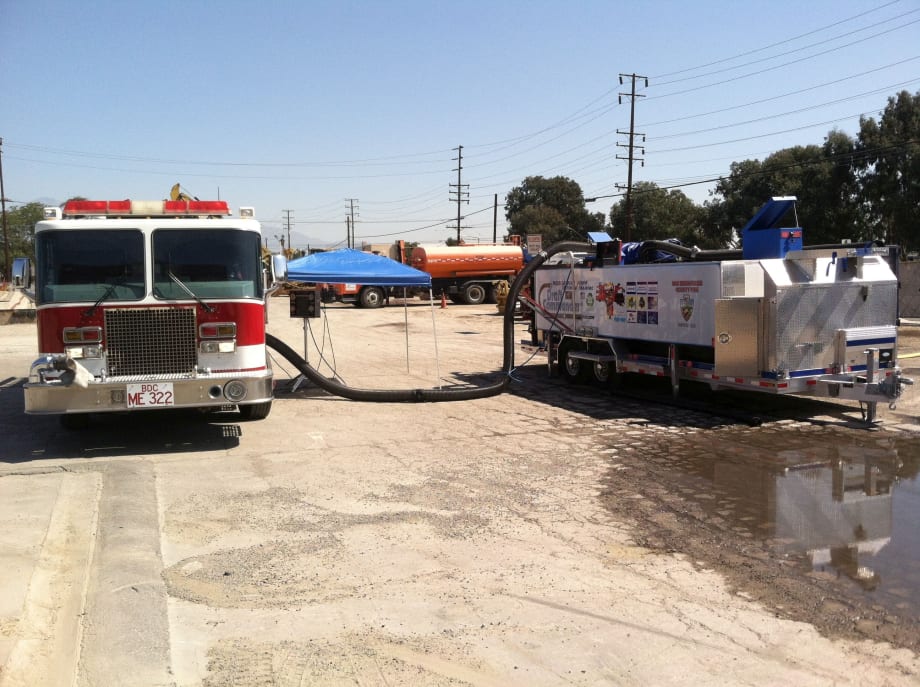
A Draft Commander mobile pump testing trailer helps the San Bernardino Fire Department stay in compliance with its pump testing schedule. Photo courtesy of San Bernardino County
Pump testing is arguably the most imperative task performed by government fleets operating fire apparatus. The impacts of an agency’s pump testing program can affect everything from firefighting performance to home insurance rates for community residents.
Like many agencies, the San Bernardino County (Calif.) Fire Vehicle Services (CFVS) staff members knew they were scheduling and doing pump tests regularly and believed they were fully in compliance with testing guidelines. However, during a vehicle record audit in the summer of 2013, it became evident that this was not the case. Overall compliance was around 60%, with some pumps receiving three to four tests per year when apparatus repair triggers were included while others had gone more than a year without being tested. Corrective action was necessary.
How the Problem Developed
According to CFVS Supervisor Doug Rand and Fleet Management Superintendent Bob Grisham, like many service problems in the fleet management profession, the situation developed as a result of several factors working together. These included:
Using spreadsheets to track and monitor test compliance. Over time, human error in entering data resulted in vehicles being left off the tracking sheet or tests not being recorded.
Not receiving adequate FMIS training. Despite having access to an updated fleet management information system (FMIS) since 2011, CFVS staff had not received complete training on the full capabilities of the system.
Geography. San Bernardino County Fire operates 84 fire apparatus spread out over 68 fire stations and 20,000 square miles. Coordinating pump testing at the more remote sites was, and remains, extremely challenging, with only two pump testing pits being previously available to CFVS.
Trying to control costs. CFVS had historically resisted sending work to outside vendors unless absolutely necessary as a cost-control tool.
Working Toward a Resolution
The first step toward resolution was to identify the specific apparatus that were out of compliance. This included a scrub of vehicle records, with the requirement of each vehicle having the last test date recorded in the FMIS.
The harder part was to find the time and available assets to get the units that were out of compliance tested quickly without impacting testing on units that were coming due for testing. This required CFVS to think outside the box. Some solutions included utilizing vendors and searching for other government agency testing locations to catch up.
It took 10 months, but the San Bernardino County Fire fleet is now at 100% compliance with its testing requirements.
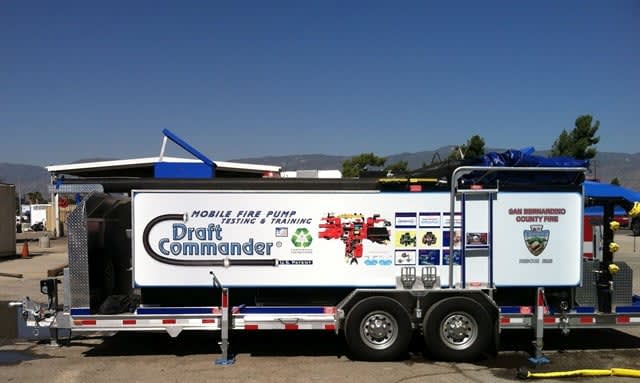
A Draft Commander mobile pump testing trailer helps the San Bernardino Fire Department stay in compliance with its pump testing schedule. Photo courtesy of San Bernardino County
Planning for Long-Term Compliance
After reaching its pump testing compliance level, the department’s challenge is to make the necessary adjustments in current practices and procedures to ensure it is maintained.
Utilizing the FMIS is the first step toward that goal. CFVS and Fleet identified the need for a specific preventive maintenance (PM) type that is only identified with pump testing. Staff organized specific vehicle classes in the FMIS for those units requiring pump testing. Joe Campbell, a full-time programmer/analyst assigned to the FMIS, completed the process by creating the pump testing PM and “mass updating” the PM schedule for the vehicle classes needing the test.
“Once we identified what specific units needed the pump test and grouped them by class, we were able to update the PM schedules in the FMIS for all 84 vehicles in a matter of minutes instead of hours,” Campbell said. Now the vehicle pump test records are updated automatically when the technician closes out the pump test PM code. Fleet staff can print reports of upcoming tests due with data from the FMIS, and tracking spreadsheets have gone the way of the dinosaur.
CFVS continues to utilize vendors when it makes sense. This includes ensuring all new units arrive with verification of pump test completion as well as testing units sent to vendors for other work if pumps are approaching their due dates.
Another new tool that CFVS is utilizing to maintain its pump test compliance is a Draft Commander portable pump testing trailer manufactured by Weis Fire & Safety Equipment Company. The trailer conforms to National Fire Protection Association (NFPA) requirements and can be towed behind a ¾-ton support vehicle. It collects and recycles the water from a fire apparatus, which is critical for an agency operating in a drought-stricken area. The trailer is also able to test two 1,500 gallon-per-minute pumps simultaneously.
The manufacturer also modified its standard design for CFVS by increasing the tank capacity from 3,000 to 4,000 gallons. This increase in volume is needed to accommodate the higher temperatures in Southern California by assisting in keeping the water temperature from exceeding the range allowed for testing.
“The testing trailer is a great tool for us,” says Don Trapp, San Bernardino County assistant fire chief. “We now have the capability of going to the remote areas and pump testing equipment without taking it out of service. This is a huge savings in equipment downtime. We are also able to utilize the trailer for training purposes. Last month County Fire utilized the trailer for engineer certification training and was able to conduct the training on-site rather than traveling to a pit.”
When asked if any other new tools or maintenance strategies were on the horizon, Chief Trapp stated, “We are committed to using technology and all other available resources to maintain a ready fleet in a cost-effective manner.”
About the Author:
Brent Wahl, CAFM, is superintendent of the Fleet Management Department at San Bernardino County, Calif.