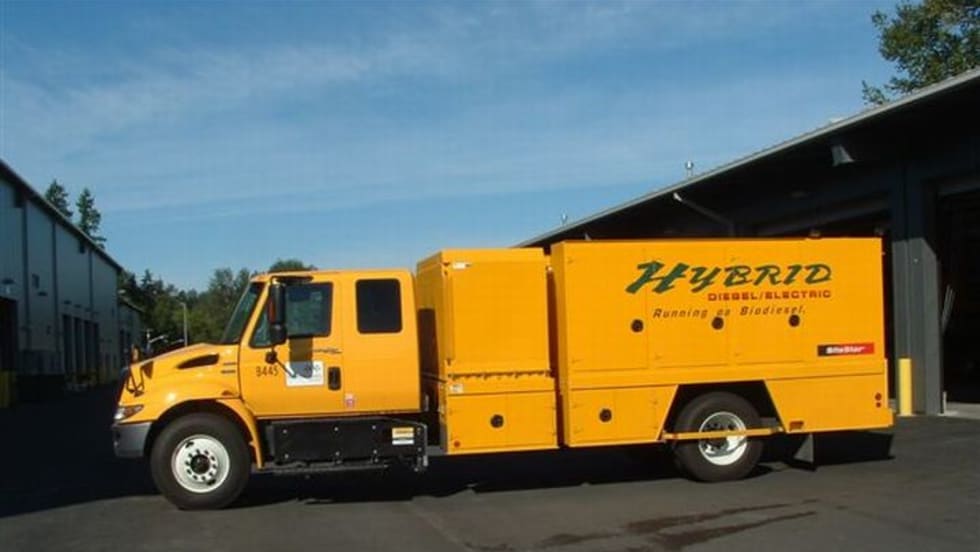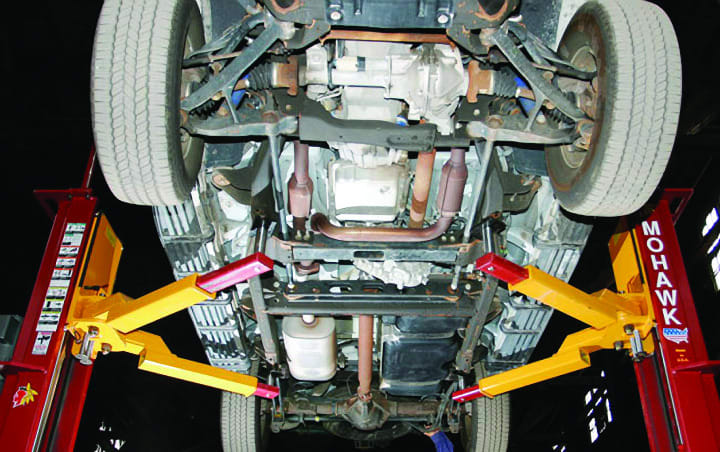
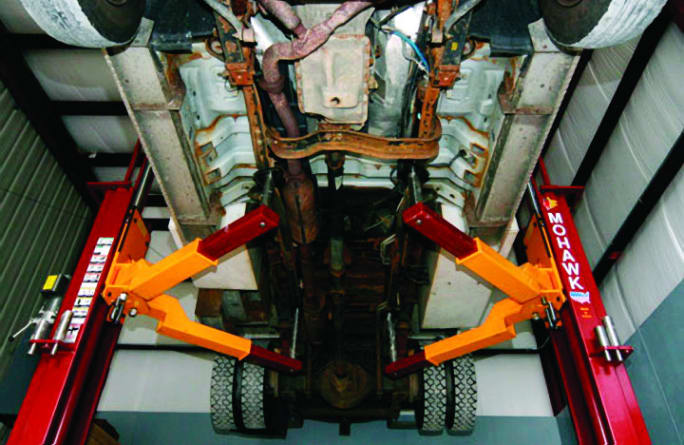
This truck is properly positioned on the lift, with the arms set against the lifting points.
No matter the vehicle or service/repair job, it's almost a certainty that doing the job requires getting under the vehicle. Years ago, that task meant working in a service facility or garage with a pit in the floor, but today, electro-hydraulic lifts are used to raise vehicles for technician access.
Safety becomes a major consideration when lifting an object weighing several tons and working under it. Steve Perlstein, sales manager for Mohawk Lifts, a major player in the field, offered guidelines to protect workers and equipment when using hydraulic lifts.
"The everyday task of raising a vehicle for service in the shop is something that should never be taken for granted," Perlstein began. "Vehicle lifts are safe and productive shop tools that help get jobs done faster and more efficiently; yet the safety of vehicle lifts and the vehicles being raised and the safety systems of the lifts themselves is something that should never be overlooked."
He noted every type of lift, whether a two-post side-by-side, in-ground, fore-and-aft lift, parallelogram, mobile, or four post ramp-style lift, has specific safety procedures for safely lifting the vehicles. American National Standards Institute (ANSI) and OSHA standards require annual vehicle lift inspections by experienced lift professionals. In addition, ANSI and OSHA require mechanics using vehicle lifts be properly re-certified annually on their knowledge of how to use lifts.
Sources of Knowledge
Perlstein said resources are available to shop managers on issues of lift inspection, proper operation, lifting procedures, and annual training.
"The primary source for this safety information," he said, "is the Automotive Lift Institute or ALI, an association of vehicle lift manufacturers. The mission of the ALI is promoting safe design, construction, installation, and use of vehicle lifts."
Lifting procedures vary depending upon the lift type being used, noted Perlstein. This article focuses on the most popular type of vehicle lift, the two-post, above-ground style. These lifts range in capacity from as small as 7,000 lbs. to as large as 30,000 lbs. and are used for servicing passenger cars, light-, medium-, and even some heavy-duty trucks.
Know the Lifting Points
A two-post lift engages the vehicle frame or lifting points. Perlstein said given this simple fact, it is critically important lift operators always know the specific lifting points for every vehicle. To help shop technicians determine manufacturer-specific lift points, ALI members include a copy of the book, Lifting Point Guide (LPG) with every lift they ship. Providing the book, which covers 20 years of vehicles from all passenger car and truck manufacturers, with every lift is an ANSI/ALCTV lift standard.
Vehicle Weight is Critical
"Another critical issue to consider is the weight of the vehicle and the capacity of the lift," Perlstein said. "This equation isn't as simple as you think. Every brand of two-post lifts has four telescoping swing arms that actually support the vehicle. So, it's vital to know the per-arm capacity (determined by dividing the total capacity of the lift by the four swing arms) so the arms will never be overloaded."
Perstein explained further. "Let's use the example of a 1-ton work truck with a standard load of tool boxes or service equipment. The lift we have is a 10,000-lb. capacity lift, meaning a maximum load of 2,500 lbs. per swing arm is the most we should try to lift. The truck we use in this example might only weigh 9,000 lbs. However, after putting the truck on a scale, we determine the rear axle has a weight of 6,000 lbs., while the front axle has a weight of 3,000 lbs. This means our 9,000-lb. truck is overloading our 10,000-lb. capacity lift because the 2,500-lb. rated rear arms are overloaded with 3,000 lbs. on them."
Using Perstein's example, raising the vehicle safely requires a 12,000-lb. capacity lift to accommodate the 6,000-lb. (heavy) rear end vehicle.
"Try this same example with one of your 13,000-14,000-lb. loaded utility trucks," Perlstein said. "You'll soon find the required lift for these vehicles (based on the likely 8,000-lb. rear axle) is in the 16,000- to 20,000-lb. capacity range."
To emphasize safety, one manufacturer offers a scale on its lifts. The scale serves to alert techs if the lift is loaded near capacity. Yet, even this safety device won't help with the situation Perlstein described, given that almost all work trucks are rear heavy.
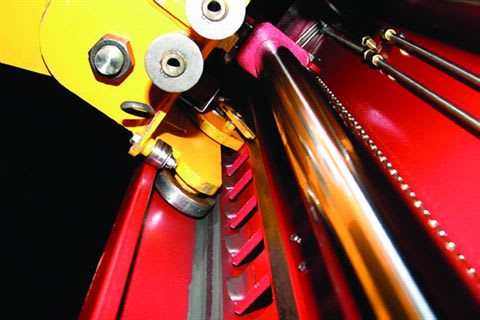
When the scale reads no weight, the operator is assured the lift is being used properly by lowering the vehicle onto the mechanical safety locks rather than leaving the load raised under hydraulic pressure.
The ALI booklet titled Lifting It Right is another ANSI safety standard lift manufacturers are required to meet. Lifting It Right covers the proper procedures for safely raising all vehicles on all types of lifts. For example, the two-post side-by-side lift should always be slightly raised a few inches, at which time the mechanics should also jounce the front or rear bumper to make sure the vehicle is securely resting on the proper lifting points. Taking this step for granted could be the difference between a technician going home safely at the end of the work day versus a potential accident if operator error causes the vehicle to fall.
"Lifts are safe pieces of equipment and necessary in your shop," Perlstein concluded. "Just as you'd always follow certain shop safety procedures such as wearing shop glasses or work gloves, following rules, understanding lifts and their abilities, and following suggested safety protocols are always recommended. Your family wants you to come home at night."