At a glance: |
Occupational Safety and Health Administration (OSHA) injury and illness recordkeeping rules vary by location and type of agency:
|
Maintaining and analyzing injury and illness records is a widely recognized method for uncovering workplace safety and health problems and for tracking progress in solving those problems. For government agencies, particularly fleets, whose workplaces often pose unique challenges, the records can be particularly useful — though determining what records must be kept and what records should be kept can be a daunting task. Knowing the requirements and the benefits of injury and illness recordkeeping can help fleets stay compliant.
State & Local Government Requirements Vary
For state and local agencies and their workers, hazards are many — from garbage collection to sewer work to road and vehicle maintenance to firefighting and police work, state and local workers are exposed to numerous workplace safety hazards. Therefore, tracking workplace injuries and illnesses is critical. However, determining what injuries to track, maintaining consistency, and making sense of the data can be challenging for a variety of reasons.
➤ Some covered by OSHA, some not
One of the major challenges for state and local governments is that some are not covered by either the federal Occupational Safety and Health Administration (OSHA) rules or state-run OSHA rules. Therefore, these workplaces do not have to follow the typical OSHA injury and illness recordkeeping criteria, which means they may rely on a different criteria set at the state, county, or city level. They may also have no recordkeeping oversight and rely on their own internal systems. In either case, this poses an issue when trying to compare performance to similar agencies following different recordkeeping systems. It also can pose problems uncovering workplace safety issues that would otherwise be brought to light during the reporting and recordkeeping process. See Chart 1:
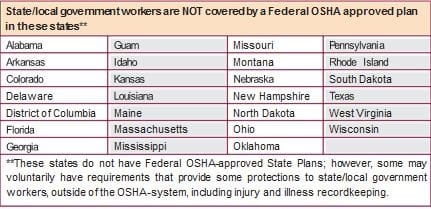
These states do not have Federal OSHA-approved State Plans; however, some may voluntarily have requirements that provide some protections to state/local government workers outside of the OSHA system, including injury and illness recordkeeping.
[PAGEBREAK]
On the other hand, several states do have federally-approved state OSHA plans. In these cases, most state and local government agencies are required to follow the standard OSHA injury and illness recordkeeping requirements (29 CFR Part 1904, discussed in this article). See Chart 2:
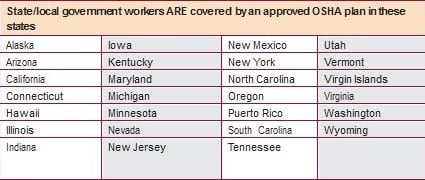
State and local government workers in half of all states are covered by a federal OSHA-approved plan.
Further, on the national level, the Bureau of Labor Statistics (BLS) annually surveys private and public sector workplaces on their injury and illness rates. However, not all state/local agencies are required to complete the survey (they still may be sent the survey and can participate voluntarily), so the counts are not complete, which clouds the national picture of the current state of safety and health among these workers.
➤ Resource issues
State and local agencies also encounter budgetary constraints, a significant problem in recent years, which can impact agencies in a number of ways. This includes:
Fewer safety professionals on staff (or available as a resource)
Fewer training opportunities (forexample, training those responsible for keeping records)
Delays in upgrades to software and electronic systems that could be used for recordkeeping.
Federal Agencies’ Requirements are Clear
For federal agencies, the requirements to follow OSHA recordkeeping requirements are not as gray as for states. In fact, since 2005, federal agencies have been required to follow the same OSHA injury and illness recordkeeping requirements as private sector workplaces.
However, there are still recordkeeping challenges for federal agencies — from determining what is and isn’t recordable, to finding a suitable system for maintaining and transmitting records, not to mention differing recordkeeping requirements from the Office of Workers’ Compensation Programs (OWCP). Further, as the result of a recent rule change, OSHA will require federal agencies, starting May 1, 2014, to electronically submit injury records to the BLS (which will subsequently send to OSHA) on an annual basis; this will be an added recordkeeping step agencies will have to manage and may also result in more targeted activity from OSHA.
Current OSHA Recordkeeping Requirements
Federal agencies (and many state agencies, as previously described) follow OSHA’s injury and illness recordkeeping regulations, which are contained in 29 CFR Part 1904. This means the agencies must record on OSHA Forms 300, 300A, and 301, with a few specific exceptions:
All work-related fatalities
All work-related injuries and illnesses that result in any of the following:
Days away from work
Restricted work or transfer to another job
Medical treatment beyond first aid (OSHA has a specific list of treatments that are considered first aid. Anything not on that list is medical treatment).
[PAGEBREAK]
In addition, agencies must record certain significant work-related injuries or illnesses diagnosed by a physician or other licensed health care professional, e.g., a punctured eardrum or broken toe, even if they do not otherwise trigger one of the general recording criteria.
For OSHA recordkeeping purposes, work-relatedness is presumed for injuries and illnesses resulting from events or exposures occurring in the workplace —except nine specific circumstances, which are not considered work-related:
Worker is present as a member of the general public
Signs or symptoms merely surface at work but are from non-work exposure/event
Injury/illness is the result of voluntary participation in wellness or recreational activities
Injury/illness is from eating, drinking, or preparing personal food/drink
Worker is injured doing personal tasks outside of normal work hours
Injury occurs during personal grooming, self-medication, or is self-inflicted
Injury is result of a motor vehicle accident in agency parking lot during commute
Common cold or flu
Mental illness (unless a doctor establishes work-relatedness).
Recordkeeping System Options
Agencies utilize a range of analytical methods, from manual cataloging of incidents to real-time computer monitoring of OSHA-related data as entered into an information system. In general, agencies with a greater number of employees, or higher incidence rates, use information systems and monitor the data more frequently. Some agencies analyze “near-misses” as well as actual accidents or incidents.
Federal agencies have a few options, such as workers’ compensation filing systems; additionally they have the option of signing a memorandum of understanding with the Office of Workers’ Compensation Programs to utilize additional systems.
Benefits of Injury & Illness Recordkeeping
Aside from any compliance issues, agencies can see many benefits from a good injury and illness recordkeeping system. Injury and illness records are critical indicators — both for agencies and for OSHA. They tell both parties how they are doing in efforts to keep workers safe. They pinpoint weaknesses — such as breakdowns in machinery, inadequate personal protective equipment, failures in communication, and insufficient training. When a worker gets sick or hurt, something has gone wrong; agencies need to look at these cases to see if they can take action to prevent future problems.
But there is also great value in reviewing the records as a whole to identify patterns and trends. What’s happening in specific departments and across the agency? How does injury and illness experience stack up against others? Is it clear that employees understand the need to wear protective equipment and follow safety rules? Asking these questions — and taking action in response to the answers — can prevent future injuries and illnesses, lowering costs and increasing productivity.
About the Author:
Travis Rhoden is a senior workplace safety editor with J. J. Keller & Associates, Inc., a source for OSHA compliance products and services.