






With an estimated fleet size of 21,000 vehicles, the State of Georgia operates one of the largest government fleets in the country. And while the Department of Administrative Services' (DOAS) Office of Fleet Management centralizes the state government's motor vehicle fleet management functions — to combat the increasing number of preventable accidents, including State-produced safety driving training videos and the Driver's Alert SMART RISK program called "Report My Driving." The program was rolled out to all state agencies and universities.
After using "Report My Driving" for only three months and implementing other sweeping loss-control measures, the State realized a 14-percent reduction in preventable vehicular accidents and an $800,000 savings to taxpayers.
"We are currently down 14 percent in auto liability claims," said Chris Risley, director, Risk Management Services, DOAS.
Risley, who supervises State insurance and loss control programs, pointed out that if the trend continues, the State will avoid at least $1.5 million in losses in the current fiscal year and potentially $5 million in the first five years of the program.
Change Began with Detailed Analysis
Vehicle accidents and driver safety fall under the supervision of the State's Risk Management Services, and since all claims are reported to and handled by RMS, the division's staff has an extensive database for ongoing analysis.
Prior to implementing the CLCP, loss information was analyzed internally to evaluate statewide driving habits and loss trends, as well as agency-specific loss trends. This step led to development of specific training on trended issues. It also produced focused penalties such as increased deductibles for certain kinds of preventable losses.
"An accident rate was difficult to calculate because liability in Georgia follows the driver, not the vehicle," Risley pointed out. "But at 500 to 700 auto accidents per year, and an average cost of nearly $21,000 per accident (when you include Workers' Compensation costs), the savings opportunity was obvious."
According to Risley, the big three cause codes were improper backing, failure to yield, and following too closely.
[PAGEBREAK]
Comprehensive Loss Control Program Revitalizes Fleet
The CLCP, which takes an Enterprise Risk Management approach, addresses eight of the most critical needs in loss control in all State of Georgia agencies. Auto liability and auto physical damage account for two of the program's eight components.
According to Risley, new legislation gives RMS the authority to implement loss control programs and to develop financial incentives and penalties for noncompliance with necessary programs.
"Loss prevention should be a cornerstone of any risk management program," he said.
RMS offered the program to each State agency as a means to enhance the workplace safety of employees and members of the community each agency serves. Since RMS has been the sole repository for all claims data resulting from state operations, the group leveraged its claims experience to create a comprehensive - yet customizable - solution for each state agency. In essence, RMS rolled out a philosophy without dictating a format.
The basic components of the auto program include:
Driver Qualification. Each state agency is required to develop minimum standards appropriate to its organization and including driver's license verification, driving record evaluation, and an appropriate understanding of the vehicle to be operated.
Driver Training. Annual training is provided on relevant topics, including defensive driving, distracted driving, and Georgia's unique insurance coverage. RMS has produced several videos to support employee training objectives.
Agency-Level Accident Review Panels. The panels were established to evaluate the facts and contributing factors of an accident to determine a "root cause" and implement changes where needed to prevent future accidents.
Vehicle Maintenance. Each agency is required to properly maintain its vehicles and report maintenance to the state Office of Fleet Management (OFM) either directly or through the use of a vehicle maintenance company approved by the OFM.
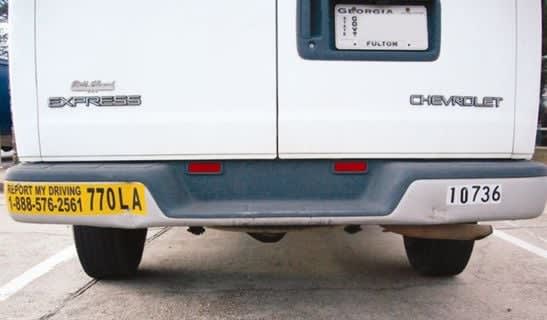
Vehicle Bumper Stickers. One element of the "Report My Driving" program, bumper stickers have been affixed to 15,984 non-emergency state vehicles. The stickers encourage the public to report poor driving habits before the behavior results in a preventable accident. Drivers cited in a complaint are counseled and/or receive additional training.
Agency Management Incentives. Participating agencies have most or all claim deductibles waived and avoid premium allocation surcharges. Agencies verify participation by providing photos of wrecked vehicles showing the bumper sticker and provide driver information for verification.
"RMS is taking a proactive approach to reducing losses because it's the right thing to do for all of Georgia, and it contributes to efficient and effective state government," Risley said.
He added that measuring a program's effectiveness and efficiency is just as important as measuring costs. The bottom line for the State of Georgia: Safety awareness and accident prevention programs save lives and reduce taxpayer dollars.
"By taking an Enterprise Risk Management approach, RMS provides educational opportunities to drivers while at the same time providing financial incentives to their managers," Risley concluded.<-->