




Red Government Fleet with star logo
MenuMENU
SearchSEARCH

How FCA Views the Police Market

Law enforcement agencies continue to purchase Fiat Chrysler's Dodge Charger Pursuit, which appeals to law enforcement officers, who say the vehicle in a violator's rear-view conveys business.

Paul Clinton
Paul ClintonSenior Web Editor
Read Paul's Posts
August 17, 2017
2 min to read


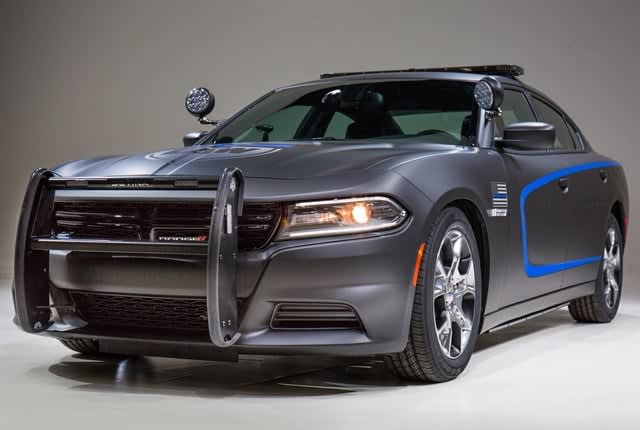
Photo of 2018-MY Dodge Charger courtesy of FCA.

Ford, General Motors, and Fiat Chrysler have all taken a different approach to the police vehicle market that's mostly based on their prior experience and feedback from agencies on their respective advisory boards.

This year, Ford introduced a pursuit-rated hybrid sedan and F-150 to complement its current offerings, and GM discontinued its sedans to focus on the rising popularity of utility vehicles.

Let's take a closer look at FCA's strategy. But first, some history.

In early 2006, DaimlerChrysler released a new police version of its Dodge Charger that it had shown at the New York International Auto Show the prior year. It added heavy-duty brakes, a severe-duty coooling system, police-performance Electronic Stability Program, police-tuned steering, and a gear shifter mounted to the steering column. The sedan was renamed the Dodge Charger Pursuit in 2011 and added all-wheel drive in 2014.

Law enforcement agencies can purchse a V-6 or HEMI V-8 model with a pair of axle ratios for each if agencies want more low-end torque.

While Ford's Police Interceptor Utility became the top-selling police vehicle following the end of the Ford Crown Victoria P.I., in recent years the Charger Pursuit has closed the gap, especially with large agencies such as the California Highway Patrol.

FCA's Dodge Charger Pursuit enjoys strong demand due to its performance capabilities and overall value. FCA approaches updates for the vehicle with a strategy that emphasizes technology, handling, and officer safety. For 2018, FCA is offering its Officer Protection Package as standard equipment.

"This package is designed to minimize the possibility of an officer from being ambushed from the rear while parked," said Jeff Kommor, vice president of U.S. sales operations, fleet and small business sales. "While it does not replace vigilance, this technology acts as a second set of eyes and provides police officers with added peace of mind when they are working in a parked Charger Pursuit."

The system uses ParkSense, the vehicle's rear parking assist system, and ParkView, the backup camera, to trigger an alert chime. The instrument panel screen will display the rear-facing field of view. The agency can also set it up to initiate a signal for the doors to lock, front windows to roll up, and reverse lights to turn on and tail lights to flash.

The Charger Pursuit's aggressive styling also appeals to law enforcement officers, who say the vehicle in a violator's rear-view conveys business.

"We are clearly dedicated to keeping the Dodge Charger Pursuit at the top of the mountain when it comes to police sedans," said Frank Dankovich, director of FCA's fleet sales. "Our strategy of commitment to those who serve and protect has never been stronger."

Subscribe to Our Newsletter

More Blog Posts

Managing a Police Fleetby Roselynne ReyesNovember 27, 2019

The Future of Police Fleets? Dubai Police Teases Cybertruck for Patrol

The Dubai Police Department posted a mockup of Tesla's new Cybertruck fitted with patrol-ready vehicle graphics.

Read More →

How Chevrolet's Tahoe PPV Differs From its Retail Relative

For the Chevrolet Tahoe PPV, tires are added to the vehicles that are capable of handling speeds of up to 134 mph and the brakes are adjusted to handle frequent stopping at high speeds.

Read More →
Managing a Police Fleetby Paul ClintonNovember 1, 2017

Police Vehicles Pushed to the Limit in California

The Los Angeles County Sheriff's Department conducted its annual evaluation of 2018-model-year police vehicles from Oct. 10 to 13. Agency deputies got behind the wheel of 13 four-wheel vehicles and five motorcycles for the testing.

Read More →
Ad Loading...
Managing a Police Fleetby Paul ClintonOctober 5, 2017

2018 Police Motorcycles Tested in Michigan

Harley-Davidson adds performance-oriented stage kits to its pair of bikes, while Yamaha offers a police version of its FJR1300 sport touring model.

Read More →
Managing a Police Fleetby Staff WriterOctober 3, 2017

2018 Police Vehicles Tested in Michigan

Michigan State Police test Ford's F-150 and hybrid sedan responders, as well as a Dodge Durango, during a 2018-model-year testing round that broadened the options for pursuit vehicles.

Read More →
Managing a Police Fleetby Paul ClintonSeptember 1, 2017

The Efficiency of the CHP's Vehicle Assembly Line

The California Highway Patrol uses an assembly line similar to one found in an automaker's factory to add auxiliary equipment to about 1,000 vehicles per year.

Read More →
Ad Loading...

Upgrading the F-150 for Off-Road Patrol

Ford took the wraps off its 2018 F-150 Police Responder earlier this month and showed police agencies its latest tool for law enforcement work on more rugged terrain. Early feedback indicates that the truck will find a place with more rural agencies.

Read More →
Managing a Police Fleetby Patrick Oliver and Samuel KirchhoffJune 28, 2017

Managing High-Speed Pursuits

Pursuits can be deadly for everyone involved, but they can't be prohibited in all cases. So agencies need to have policies and procedures in place to reduce the danger.

Read More →

How to Deal With the Privileges of Rank

In law enforcement, police chiefs, sheriffs, and other top brass have been known to request higher trim grades and other vehicle upgrades, which can present challenges to the public fleet manager who must repurpose the vehicle after the chief switches into a new vehicle.

Read More →
Ad Loading...

How Ford's Hybrid Patrol Car Is Different

Ford's Police Responder Hybrid Sedan offers several important differences from other retail hybrid cars that should make it well suited for the demands of a police duty cycle, while also providing lower costs to operate.

Read More →