Photo by Joe McHugh/CHP.
Assembly lines helped automakers in the early days of the industry increase production speed and create an efficient process to achieve standardization. Early cars such as Ford's Model T and Oldsmobile's Curved Dash rolled out of factories with the same parts attached in the same places.
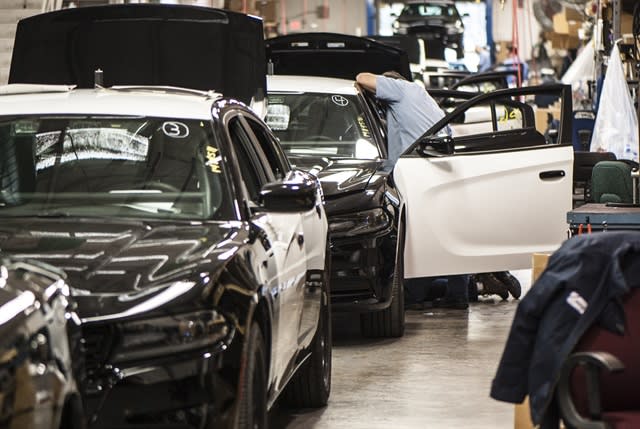
The California Highway Patrol (CHP) has applied this process to its vehicle upfitting in its Fleet Operations facility in West Sacramento – the nerve center for California's largest law enforcement fleet. With approximately 1,000 vehicles per year that need radios, gun mounts, lightbars, and other law enforcement equipment, the agency needs to stay organized.
The assembly line also gives the agency certainty that officer safety will remain a top priority during the set-up of the vehicles. Auxiliary equipment will function the same way for any officer who gets behind any wheel. The agency has been using this process for decades.
While efficiency remains a potent benefit, the process is in place to protect the agency's sworn personnel, said Capt. Steve Mills, who has served as the commander of fleet operations since 2013.
"Every vehicle has to be standard," Mills said. "Every switch needs to be in the same place."
Nearly two years ago, the agency began fine-tuning the assembly line to accommodate its large order of Dodge Charger Pursuit sedans, which would mark a shift from the agency's heavy use of mid-size SUVs. Fiat Chrysler Automobiles (FCA) won a bid in June of 2015 to supply the Dodge Chargers. The agency had ordered 580 Charger Pursuit sedans a year ago on a two-year contract. The agency had been using Ford's Police Interceptor Utility vehicles since shifting to that vehicle in 2012.
Part of the reason for the change came down to pricing, as the Chargers cost $23,695 per unit versus $27,465 for the Ford SUVs, Mills said. However, FCA was also able to increase the payload rating for the Charger's rear axle to accommodate a bulky tray of radios and other communications equipment that weighs about 246 lbs.
The rear-wheel drive, V-6 powered sedan could carry up to 1,359 lbs. after FCA beefed up the rear end assembly with factory modifications.
With new batches of vehicles arriving in bulk shipments, the agency's assembly line would soon be humming.
The CHP can equip about 100 cars a month to meet the demand for new patrol units by using the line.
The assembly line can crank out a car in 39 hours if needed with 22 workers and 11 stations, which include numerous stops for wiring (3 miles worth for each vehicle), radios, emergency lighting, brackets and mounts, and gun racks.

Photo by Joe McHugh/CHP.
The shop fabricates initial quantities of all of the mounts and brackets to secure equipment in the vehicle, and assembles all the wiring harnesses. Once tested, supplies for production are purchased from the California Prison Industry Authority. One technician programs vehicle functions for emergency lighting and other electronic functions. Changing patrol vehicles didn't present too much of a wiring issue because 80% of the wiring in a vehicle is standard even across various brands, Mills said.
Most of the assets in the CHP's fleet move through the line, including all of the 2,501 marked units as well as the undercover vehicles, tactical vehicles, motorcycles, and executive vehicles for the state's elected leaders. The garage set up Gov. Jerry Brown's black Chevrolet Suburban. Overall, Mills manages 4,533 assets, which doesn't include the 26 planes and helicopters in the air fleet.
Every CHP vehicle that's pressed into duty goes through the operations shop, including the ones used by officers in Southern California – the agency maintains a facility in Torrance where two technicians give vehicles shipped down on a flatbed a final inspection before handing the keys to an officer.
Units are taken out of service when they reach 100,000 miles, which is mandated by the state's procurement agency, the Department of General Services. A black-and-white unit averages about 34,500 miles per year, Mills said. Cars that are taken out of service are sold via auction at the West Sacramento facility.
In the West Sacramento operations center, Mills supervises a staff of 85 fleet technicians and supervisors, who are eligible for a $150-per-month stipend negotiated in an agreement between International Union of Operating Engineers' Unit 12 and the California Department of Human Resources.
Mills was able to scoop up some of the technicians from local dealerships who had to lay off staff during the Great Recession.
"What's key for us is the ability to retain people and get the best that's out there," Mills said.
Several other public service agencies have used the assembly line, including Cal Fire, the California Department of Corrections, and even the Nevada Highway Patrol. The agencies provide Mills with the vehicles and auxiliary equipment, and he runs them through the line. Using the process can save an agency up to four months of downtime.