Joined by representatives from the City of Houston Planning Department, Public Works, Mayor’s Office of Disabilities, and the Houston Police Department, Mayor Turner wants to end traffic deaths and serious injuries by 2030.
Photo: City of Houston
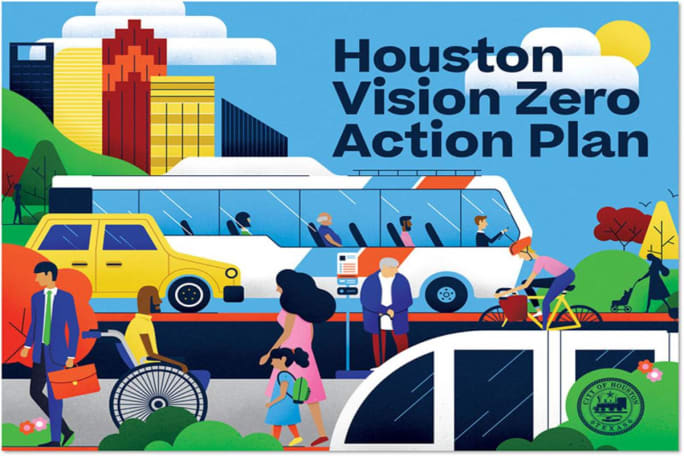
Houston, Texas, Mayor Sylvester Turner launched Dec. 16 a Vision Zero Action Plan (VZAP) to end traffic deaths and serious injuries by 2030 and improve street safety and equity for road users of all ages, abilities, and modes of transportation.
The mayor was joined by representatives from the City of Houston Planning Department, Public Works, Mayor’s Office of Disabilities, and the Houston Police Department.
More than 200 people die and nearly 1,000 people are seriously injured in crashes on Houston roadways every year. That means someone in Houston dies in a crash every other day and three people experience life-altering injuries each day.
In August 2019, the City of Houston committed to Vision Zero, a global network of cities with goals to end traffic deaths and serious injuries. After extensive data analysis, community engagement, and multiagency collaboration, the City of Houston created the Vision Zero Action Plan.
“We mapped out traffic deaths and serious injuries happening on Houston streets, and what we saw was unacceptable,” said Mayor Sylvester Turner. “So, we came up with a vision, a plan, and set the goal at zero, because zero is the only acceptable number of deaths. When you see folks crossing dangerous streets to walk their kids to school, or dodging traffic to get to the bus stop, or cyclists sharing road space with unyielding drivers, we have to make a hard left turn away from the mindset Houston streets exist solely for cars. We need to expand our outlook on mobility to recognize streets belong to everyone who walks, bikes, drives, uses a wheelchair, and takes public transit.”
Led by the City’s Planning and Development Department, the VZAP establishes four goals to reach zero: 1) create a safe, equitable, and accessible network of streets, 2) make walking, rolling, and biking safe, 3) make connecting to transit safe, and 4) make driving safe. The city will achieve each of these goals through measurable actions focused on communication, safe road systems, safe speeds, and programming. The plan outlines how and where to make proactive investments, prioritizing resources and action in vulnerable communities that have been disproportionately impacted by traffic deaths and serious injuries.
The VZAP draws input from multiple city departments and partner agencies including Houston Public Works, Health Department, Police, Fire, Mayor’s Office for People with Disabilities, as well as its partners at Harris County, METRO, social justice and multimodal transportation advocates, the private sector, and more. The VZAP also builds on existing plans and policies, including Plan Houston, Resilient Houston, Climate Action Plan, Complete Streets and Transportation Plan, and the Walkable Places and Transit-Oriented Development ordinances.
“The work we do – planning for Houston’s future – improves the quality of life for residents, but the Vision Zero Action Plan does more. It saves lives,” said Planning and Development Department Director Margaret Wallace Brown, AICP. “The city has laid out this plan, and we have already begun work on implementation, but we all have a shared responsibility to improve traffic safety. We will continue to collaborate with our partners to achieve our goal of zero deaths.”
Based on five years of crash data, the VZAP focuses safety improvements on streets that have the highest density of traffic deaths and serious injuries, known as the High Injury Network, and in communities who are more vulnerable to both natural and man-made crises.
Research shows that:
Nearly 60% of traffic deaths and serious injuries occur on only 6% of Houston's streets.
Of those 6% of streets, 52% are in vulnerable communities who are, among other social and physical factors, mostly minority, experiencing poverty, lacking access to transportation, and living with older adults, young children, or persons with a disability.
One-third of traffic deaths involve a pedestrian even though less than 2% of residents walk to work.
To open the dialogue about Vision Zero in the community, the city’s team of transportation planners hosted virtual open houses and socially-distanced outreach at transit centers, and launched an interactive community engagement platform over the course of the summer and fall 2020. Nearly 1,500 Houstonians used our interactive map to drop a pin on streets and intersections where they have a traffic safety concern. Residents commented on the action plan, took a safety survey, and signed the pledge.
The plan identifies 50 actions with 13 priority actions that will be the first for implementation. The value and effectiveness of the remaining 37 actions are dependent upon the success of the top 13 actions. These actions will be continually informed by data from reports and community members. Among the 13 Vision Zero priority actions are redesigning 10 high injury traffic locations and implementing construction within the following fiscal year. The city also plans to construct at least 50 miles of sidewalks a year and at least 25 miles of high-comfort bicycle facilities each year.