




Due to the financial troubles caused by COVID-19, many public fleet agencies are expecting budget reductions in the coming year. Deferring vehicle procurement may be the first option that comes to mind when facing budgeting concerns, but it’s not the only avenue.
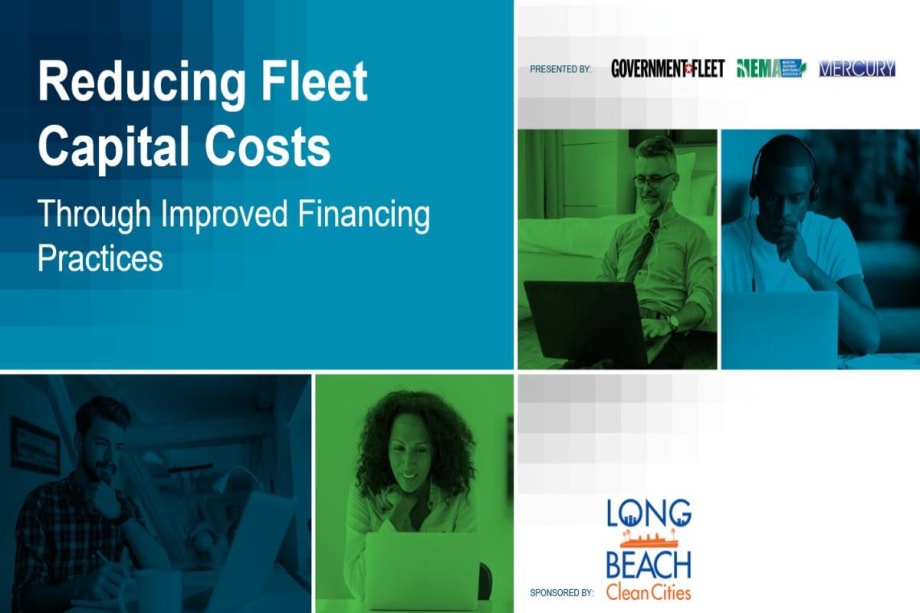
A June 24 webinar sponsored by Long Beach Clean Cities and presented by Government Fleet, MEMA, and Mercury Associates recently delved into how fleet managers can improve the way they finance vehicles in these tough economic times.

Keith Leech Sr.
Titled “Reducing Fleet Capital Costs Through Improved Financing Practices,” moderator Keith Leech Sr., chief of Fleet Division and Parking Enterprise, County of Sacramento, Calif., guided a presentation by Paul Lauria, president of Mercury Associates, and Maria Neve, manager of Mercury Associates, that delved into a few options fleet managers can use to reduce fleet capital costs and ensure their average fleet age doesn’t increase significantly.
Facing Directives
Lauria gave a brief overview of trends that occurred during the Great Recession, and then spoke about some of the directives some fleet managers are likely going to receive due to the economic impact of the COVID crisis. These include:
Reduce operating (e.g., personnel) costs
“Rightsize” (i.e., downsize) the fleet
Curtail take-home use of vehicles
Curtail use of personally owned vehicles
Investigate outsourcing
Reduce “excess” fleet replacement reserves
Explore leasing and other financing options that leverage cash
Four Ways to Finance

Paul Lauria
There are four main ways to pay for vehicle and equipment acquisitions:
Outright purchase with cash appropriated on an ad hoc (year-to-year) basis
Outright purchase with cash accumulated over time in a reserve fund
Outright purchase with funds borrowed from a lender and paid back over time
Leasing
Lauria noted paying for vehicles with cash isn’t “pay-as-you-go”…it’s “pay-before-you-go” financing.
“All of the other methods are reserve fund, which allows you to budget and put aside money incrementally over the life of the vehicle for the eventual outright purchase of a replacement, or using some kind of debt financing, lease purchase program, or leasing are all methods of financing that allow you to pay for the vehicle as you're using it,” explained Lauria.
More than 30 years of fleet replacement studies from Mercury have shown there are distinct advantages to using one of the pay-as-you-go financing methods. Lauria recognized fleet managers may encounter pushback from those who don't understand why you would ever want to incur the costs of borrowing money to pay for something that gets used up relatively quickly.
“The answer is because it allows you to have a fleet you otherwise could not own. Jurisdictions that purchase vehicles outright with cash almost always keep vehicles and equipment and service longer than is optimal. The choice you're faced with under that type of financing method is whether to repair and retain an old vehicle, or replace it with a new one where you have to pay the full purchase price up front.”
Replacement Reserve Funds
The next topic Lauria spoke on was using a Fleet Replacement Reserve Fund. These are usually classified as an internal service fund (ISF), which is a type of accounting entity generically referred to as a proprietary fund.
There are two types of proprietary funds:
Internal service funds, which account for and distribute the costs of goods and services provided to agencies within a government jurisdiction
Enterprise funds, which account for and distribute the costs of goods and services provided to entities outside the jurisdiction
ISFs are used for three reasons:
To facilitate the distribution of general government costs to non-governmental fund entities who might not otherwise pay their fair share of such costs
The accumulate reserves over multiple fiscal years to pay for the replacement of capital assets
To improve the management of resources by increasing the visibility of their costs
Fleet ISFs usually – but not always – are used with a cost charge-back system. This is the system used to distribute or recover the costs of fleet-related goods and services to/from the agencies that consume them.
Jurisdictions use many different methods for calculating charge-back rates, some of which are effective and some of which are not. For a round-up of common mistakes that can occur with Fleet Replacement Reserve Funds, as well as how to free up cash by right sizing a reserve fund balance, you can check out the on-demand version of the webinar starting at the 28:37 timestamp.
What Are My Options?

Maria Neve
Neve reinforced the fact one-size doesn’t fit all when it comes to financing. “There are too many variables to say what works for one entity will work for another. Right now, interest rates are historically low, so now is an opportune time to explore options,” she said.
These options range from simple to complex. In addition, multiple options can be combined to create a unique fleet financing plan that accounts for a jurisdiction’s needs and usage. There are fleet management companies and other financing arms that are willing to work with government entities across the entire range of options.
During the rest of the presentation, Neve went over pros and cons of each of the following:
Open-end (TRAC) Lease
Closed-end (Walkaway) Lease
Finance (Capital) Lease AKA $1 Buyout
Fair Market Value (FMV) Lease
Tax-Exempt Lease-Purchase (Municipal Lease)
Long-Term Rental (Penske, Ryder, etc.)
Certificates of Participation
General Obligation Bonds

![Officer Anthony Catania, of the Frankfort Police Department, became the first officer to hit the streets in Kentucky through the M-2-LE program.[|CREDIT|]PHOTO: Frankfort Police Department](https://assets.bobitstudios.com/image/upload/f_auto,q_auto,dpr_auto,c_fill,w_980,h_552/pm.cantania-02_1759887421355_f2jvs0.jpg)