A performance audit of the Ohio Department of Transportation (ODOT) operations included an analysis of fleet cost reduction strategies, concluding that ODOT should not move to leasing. However, the office suggested other solutions, including renting or sharing seasonal/low-usage equipment and rightsizing.
ODOT’s fleet includes approximately 16,000 assets organized into 232 different categories, including passenger vehicles, pickup trucks, tractors, excavators, trailers, and brush chippers. The agency spends approximately $43 million annually on fleet purchases. These purchases are made in cash, and have remained fairly consistent year over year, ranging between $35 and $55 million.
One challenge for the fleet is that it is decentralized, and a lot of the data collected is incomplete, incorrect, and inconsistent. The report recommended that the fleet track vehicle mileage through more accurate odometer readings and identify a more controlled method of collecting usage rates for heavy machinery.
Leasing as an Alternative to Ownership
Because annual fleet purchasing is such a large expense — and a necessary one, as fleet purchases are primarily used to replace aging assets — the report looked into leasing as a potential solution. The auditor’s office analyzed 21 vehicle categories, including passenger vehicles, light-duty trucks, and off-road equipment
The cost-benefit analysis considered three factors in total cost of ownership of these vehicles: depreciation, maintenance expense, and usage. This cost was compared using interest rates of 5%, 10%, and 15% for two-, four-, and six-year leases. In every scenario, ownership was less expensive than leasing. This was attributed to a few factors:
End-of-life maintenance costs are low due to reduced usage, avoiding the benefits from shorter life cycles under a leasing model
The expensive setup cost for new vehicles would be repeated more frequently if a piece of equipment is owned for a shorter duration
High depreciation in the first few years of vehicle ownership, which would be recovered by the lessor
Lease/finance fees, which ODOT currently does not pay since it pays cash for its vehicles.
The report noted that if ODOT moved to leasing, it would bring $168 million in one-time revenue from the sale of existing fleet vehicles, but leasing would cost an additional $22 to $42 million annually. Maintenance costs would not be expected to decrease, either, because a significant portion of maintenance costs are incurred prior to vehicle deployment for setup and modifications.
Rental as an Alternative to Ownership
The auditor’s office also conducted an analysis to determine when rental equipment would be a better option, primarily for low usage and seasonal categories.
The annual cost of ownership was compared to the annual expense of renting for those categories where a rental contract already exists in order to determine a breakeven point based on the rental contracts already in place.
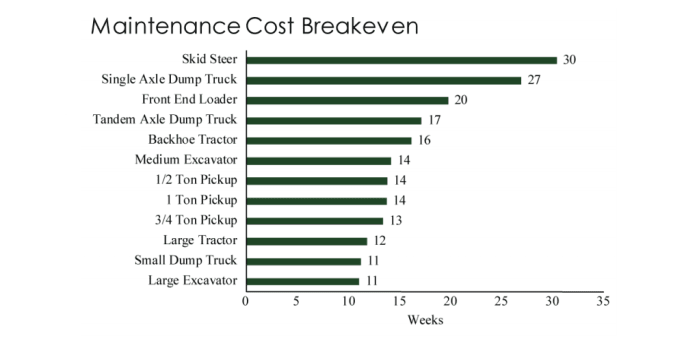
The breakeven point is the point at which it is worth it to own the equipment. If a piece of equipment is used less often than the brekeven point, it may be more reasonable to rent it.
Image courtesy of Ohio State Auditor's Office
For any equipment that is used less than the breakeven point, it is advisable to rent the equipment instead of owning. Under these rental contracts, the state would save from purchase and maintenance costs, and the rental agency would cover maintenance. The report also recommends that districts share expensive pieces of equipment when possible.
Although fleet size fell outside of the scope of the audit, the auditor’s office recommended that the department review its fleet size to eliminate unneeded vehicles or equipment as they are identified.
The full audit is available here.

![Officer Anthony Catania, of the Frankfort Police Department, became the first officer to hit the streets in Kentucky through the M-2-LE program.[|CREDIT|]PHOTO: Frankfort Police Department](https://assets.bobitstudios.com/image/upload/f_auto,q_auto,dpr_auto,c_fill,w_980,h_552/pm.cantania-02_1759887421355_f2jvs0.jpg)