Five years ago, when the fleet manager for Madison, Wisconsin, installed the city’s first electric vehicle charger, the city had no electric vehicles in its fleet. Today, the city operates 100 electric vehicles—more than any other municipality in the state. What helped with a smooth installation? They avoided the costly mistakes that derail most fleet electrification projects.
The gray Ford Mustang Mach-E that pushed Madison over the 100-vehicle milestone represents more than just another electric car. It illustrates the fact that government fleets can successfully navigate the transition from fossil fuels to a cleaner, more sustainable future.
But Madison's success wasn't accidental. While other municipalities struggle with overpriced charging infrastructure, electrical capacity problems, and vehicles sitting idle due to charging bottlenecks, Madison built their system methodically.
The primary barrier is confusion, as some fleets do not know where to start, leading them to buy more charging power than they need.
This confusion can cost taxpayers millions of dollars annually and delay critical sustainability goals. Fleet electrification continues to advance at the state and local level despite shifting federal policies. Many state and local governments maintain their own electrification mandates and continue to install charging infrastructure.
The stakes are high: get it right, and your fleet saves money while advancing goals for greater sustainability. Get it wrong, and you'll face years of operational headaches, budget overruns, and vehicles that can't fulfill their missions.
The good news? The pitfalls are predictable and avoidable. With the right approach, government fleets can build efficient, cost-effective charging systems that serve their missions for decades to come.
Understanding Your Fleet's Charging Needs
The first step in any successful fleet charging deployment is conducting a thorough analysis of existing operations. EVs achieve their best fuel economy during stop-and-go driving conditions typical of many fleet applications, making them particularly well-suited for government use cases like municipal services, law enforcement and transit operations.
Start by analyzing your fleet's daily usage patterns and asking yourself these questions:
How many miles do vehicles travel per day?
How long do the EVs remain parked at your facility?
What are your peak operational hours?
Are there different models or types of vehicles in your EV fleet, or is it homogeneous?
What is your five-year plan for the fleet?
These answers will determine both the number of charging stations you need and the appropriate charging speeds.
Government fleets often have the advantage of predictable routes and schedules. Unlike commercial fleets that may have unpredictable demands, municipal vehicles typically return to a central depot each night, making overnight Level 2 charging a viable option for many applications.
Determining the Right Mix of Charger Types
The charging industry offers three main levels of charging infrastructure, each suited for different applications:
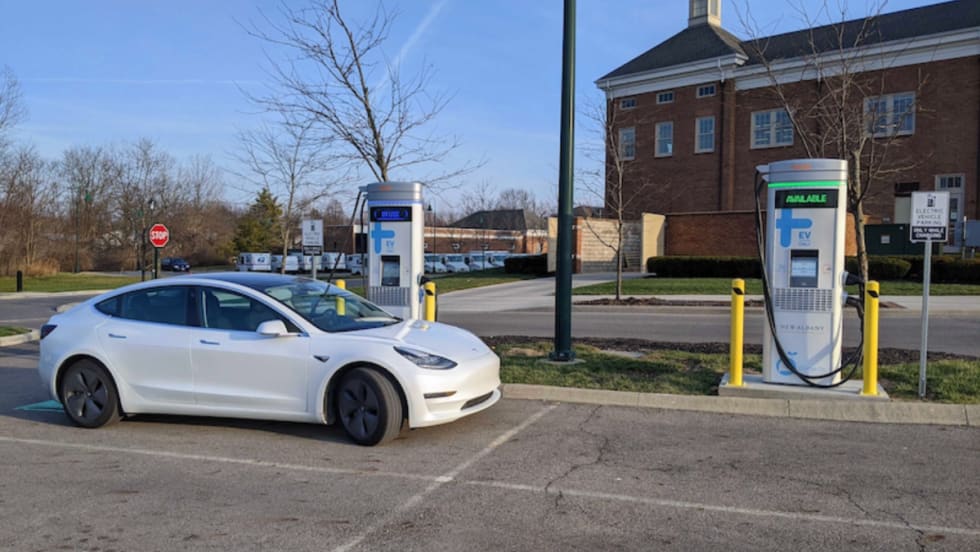
Level 2 (240V AC): The workhorse of fleet charging, Level 2 stations provide 3.3 kW to 19.2 kW of power, typically adding 10-40 miles of range per hour of charging. For most government fleets, Level 2 charging offers the optimal balance of speed, cost and electrical infrastructure requirements.
Level 3 DC Fast Charging: Providing 25 kW to 350 kW of power, DC fast chargers can add 100+ miles of range in 30 minutes or less. DC fast charging infrastructure carries a higher price tag than Level 2 and requires significant electrical upgrades and careful planning.
The key is right-sizing your charging infrastructure.
Can Operators Use One Charger for Multiple Vehicles?
One of the most common questions fleet managers ask is whether they can share charging stations among multiple vehicles. The answer depends on your operational requirements and charging strategy.
For fleets with sufficient dwell time (vehicles that remain parked for eight hours or more) Level 2 chargers can effectively serve multiple vehicles through managed charging schedules. Some manufacturers offer high-level L2 chargers with dual ports to service two vehicles simultaneously, offering a practical solution for overnight fleet charging.
Government fleets should prioritize durability and standardization when selecting charging equipment. Unlike consumer chargers that see occasional use, fleet charging stations operate daily in demanding environments.
This approach depends on the use case scenario, and Level 2 chargers might not work for fleets with high utilization rates or emergency response requirements. Police and fire departments, for example, need vehicles ready for immediate deployment, making dedicated charging stations a safer investment.
These emergency response teams that require vehicles ready for immediate deployment could justify a Level 3 DC fast charger. Depending on the type of vehicle, a DC fast charger could supply an 80% charge in as little as 10-15 minutes.
Modern charging management software can optimize shared charging resources through dynamic scheduling and load balancing. These systems can automatically queue vehicles for charging based on state of charge, scheduled departure times, and operational priorities.
Cables, Connectors, and Fleet Considerations
Government fleets should prioritize durability and standardization when selecting charging equipment. Unlike consumer chargers that see occasional use, fleet charging stations operate daily in demanding environments.
Connector standards: All current light-duty electric vehicles sold in North America use the SAE J1772 connector for Level 2 charging. For DC fast charging, the industry has largely standardized on CCS (Combined Charging System) connectors, though some older vehicles may require CHAdeMO compatibility. Check the connectors and compatibility for the charging stations considered for installation.
Cable management: Heavy-duty charging cables in fleet environments require robust management systems. Look for charging stations with integrated cable management that protects cables from vehicle damage and environmental exposure and take ergonomics into consideration.
Weatherproofing: Government vehicles operate in all conditions, and charging equipment must match this reliability. Specify charging stations with appropriate IP ratings for your climate and consider environmental factors like salt exposure for coastal locations.
Vandalism resistance: Public-facing fleet vehicles and charging stations may be targets for vandalism. Steel construction and tamper-resistant designs provide better long-term protection than plastic alternatives.
Maintenance and Security Considerations
Fleet charging infrastructure requires proactive maintenance planning, just like any fleet asset. However, electric vehicle supply equipment typically requires less maintenance than fuel infrastructure.
Preventive maintenance: Level 2 charging stations generally require only basic maintenance – cleaning connectors, inspecting cables and updating software. Plan for quarterly inspections and annual electrical testing.
Remote monitoring: Modern charging stations provide remote diagnostics and monitoring capabilities. This allows fleet managers to identify issues before they impact operations and track energy usage for cost management.
Cybersecurity: Network-connected charging stations represent potential cybersecurity risks. Modern fleet charging management software should implement multiple security layers to protect against unauthorized access and potential cyber threats, including expiring authentication tokens that refresh automatically, IP address validation and restricted access to technical configuration menus. The cost of a security breach far exceeds the investment in robust security measures.
Service contracts: Consider service agreements with charging equipment vendors, especially for DC fast charging installations. Leading manufacturers offer comprehensive service plans that include 24/7 diagnostic tools, remote software solutions and network-agnostic support with guaranteed response times.
The most reliable providers utilize in-house service teams rather than third-party contractors, offering remote support through helpdesk and dispatch services, plus on-site commissioning, preventive maintenance and emergency interventions. Some manufacturers provide technical training so fleets can have their own technicians trained for technical issues.
Procurement Best Practices: What to Know
Government procurement requirements add complexity to fleet charging deployments, but several strategies can streamline the process:
Simplify procurement: Look for vendors with cooperative purchasing agreements, such as the 791 cooperative purchasing agreement, which streamlines government procurement by providing pre-negotiated contracts that meet federal requirements.
Understand Buy America requirements: Buy America-compliant EV chargers meet strict manufacturing guidelines that require significant portions of the product to be made in the United States. Domestic manufacturers offer compliant solutions for federally funded projects.
Plan for installation complexity: Charging station installation often requires electrical upgrades, permitting, and coordination with local utilities. Factor these costs and timelines into procurement planning.
Consider turnkey solutions: Some vendors offer complete design-build services that can simplify procurement and project management for complex installations.
Learning from Successful Deployments
Government agencies nationwide are successfully navigating fleet electrification challenges. In addition to Madison, Wisconsin's success, Philadelphia has increased its fleet of light-duty electric vehicles from 34 to 300 since the transition was first announced, and projects overall savings of 20% in purchasing and operating costs, totaling over $12 million saved by 2030.
These successes share common characteristics: thorough planning, appropriate technology selection, and strategic use of available funding programs. They also demonstrate that fleet electrification is not just environmentally responsible but financially advantageous for government operations.
Fleet electrification is a long-term investment requiring infrastructure that can adapt to changing technology and growing fleets. Consider these future-proofing strategies:
Electrical capacity planning: Install electrical infrastructure that exceeds current needs to accommodate fleet growth and advancing charging technology.
Scalable charging systems: Choose charging platforms that support future upgrades and expansion without requiring complete replacement.
Software compatibility: Select charging management systems that integrate with existing fleet management tools and can adapt to future requirements.
Data collection: Implement systems that track charging patterns, energy usage, and operational metrics to optimize future decisions.
Interoperability: Ensure different systems, networks, and components—regardless of manufacturer, protocol, or payment system—work together seamlessly to ensure infrastructure compatibility.
The Path Forward for Success
For government fleet managers ready to begin their electrification journey, success requires careful planning but offers significant benefits. Start with a thorough assessment of your fleet's operational requirements, identify appropriate funding sources, and select charging infrastructure that matches your needs without over-investment in unnecessary capabilities.
The agencies succeeding in fleet electrification share a common approach: they start with data, plan systematically, and execute deliberately. They avoid the pitfalls of over-engineering solutions or under-planning for operational requirements.
The transition to electric fleets is inevitable. The question is whether your organization will lead with a well-planned deployment or struggle with a reactive approach. The funding, technology, and expertise exist to support successful transitions. The key is starting with the right foundation and building systematically toward your electrification goals.