Four years ago, in a Government Fleet article, I asked the following question: "What if BEVs aren’t the answer?"
In that article, I asked other introductory and, at that time, intriguing questions, such as:
What if BEVs are not the expected replacement for fossil fuels?
What if the automotive market becomes too populated with BEVs that the demand for an upwardly priced sedan or pickup dries up?
What if the public fails to accept an expensive BEV that, even years from now (2022), will only travel 300 miles, or less, without recharging?
Suppose BEVs are simply the flavor of the decade?
What if electricity, as a motive power source, is only a “bridge” fuel placeholder until a better, more environmentally friendly, longer-range alternative presents itself?
From “What If?” to a Market “Reset”
Now, halfway into the decade, the present state of play in the EV market has morphed completely into what the automotive industry is now calling a “reset”.
Despite the sugar-high EV sales experienced in the third quarter as tax incentives disappeared, MY25 will be the first year of this decade when total EV sales in the U.S. declined; industry pundits predict U.S. EV sales for MY26 will at least be flat and could instead decline by 20%. Conversely, in Europe, the BEV market is growing steadily. What happened?
As I write this, the U.S. EV market has now reached many of the above inflection points and certainly sooner than any OEM anticipated. The $27 billion in EV technology write-downs just announced by Ford and GM represent a staggeringly honest failure penalty that should instill a higher level of due diligence in the future than has been demonstrated so far.
Stellantis is clearly reassessing its electrification strategy but has not announced a write-down to date.
Yes, the EV tax incentive in the U.S. is gone. That, coupled with the relaxation of fleet average fuel economy standards, created a demand cliff, a record third quarter in EV sales volume, followed by a collapse. Despite announced plans to introduce new BEV models in 2026 by some OEMs, the market is unlikely to rebound even slightly in 2026.
EV headwinds abound. Existing tariffs have upset EV supply chains for key components and pushed up EV model pricing at a time when buyers could least afford them. Average new 2025 base model BEVs cost $50,000 (December 2025 average EV costs were over $58,000 according to Edmunds), but are expected to be lower in 2026 as new, lower-cost model sedans and SUVs are introduced. Tariffs are also impacting battery pack costs by nudging their costs upward.
If that were not enough, the additional headwind created by the just-announced slashing of Canadian tariffs on Chinese EVs from 100% to 6.1% is a significant blow to the U.S. EV market. The tariff reduction will allow annual imports of 49,000 Chinese EVs into Canada initially.
That limit will rise to 70,000 EVs in five years. This will allow companies like Geely, Xiaomi, BYD, and others to establish a second foothold (Mexico) in the North American automotive market.
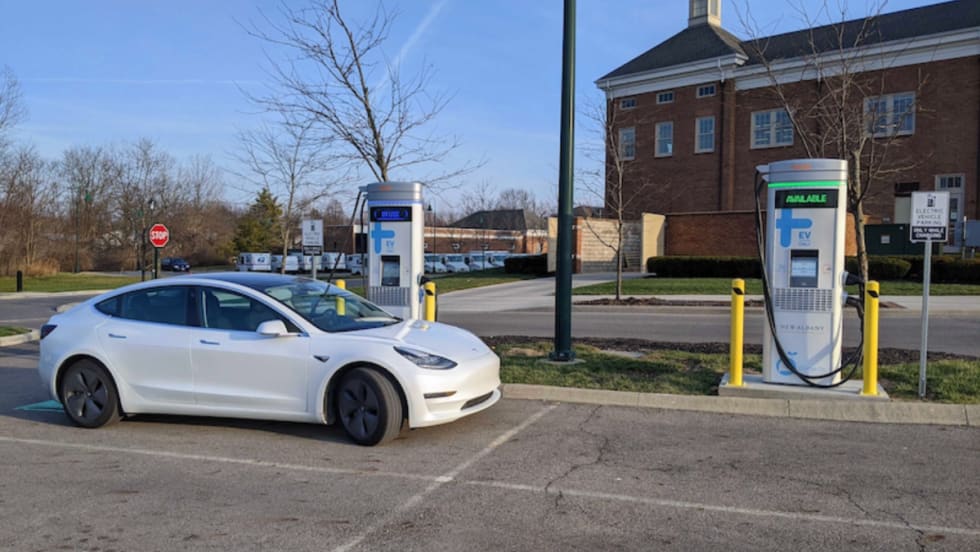
Yet another headwind continues to be charging costs and availability. Beyond the economical home charging alternative, charging costs at level II and III commercial sites are frequently higher than gasoline refueling costs.
The current administration has pulled $2 billion from charger deployment funding, surely slowing new charger deployment. This, combined with poor commercial charger reliability and what remains as limited coverage in many areas beyond major corridors, contributes to delaying EV adoption as consumers either wait or opt for a hybrid alternative.
What the Reset Means for Government Fleets
Government fleet adoption of EV technology continues to be an EV industry win. Governments that took that leap, however, now face increasing challenges. The gains expected in fuel savings and maintenance are being supplanted by the high maintenance and capital costs of their charging infrastructure. BEV maintenance cost savings have been largely disappointing.
Ford’s discontinuation of the Lightning will challenge governments wishing to increase their EV profiles, with the difficulty in finding a suitable replacement pickup. Remaining on the ½ ton pickup market are the Rivian or Silverado BEVs, each of which may be too pricey for government appetites, not to mention the poor optics their deployment in governments may create.
This vacuum leaves governments to wait until 2027 when the promised Slate, Scout, and Maverick EVs have hopefully been introduced.
Not surprisingly, Stellantis cancelled the electrified Ram and their three plug-in hybrid models for 2026. While they seem to be favoring non-plug-in hybrid technology, their history in this arena has been characterized by bold pronouncements but with little follow-through.
The latest EV technology announced is the gasoline-powered on-board electric generator model called the EREV. This iteration features an onboard gasoline-powered generator that continually recharges the battery pack.
Although yet to be released, Scout Motors has stated that most of their advance orders are for this technology. Ford’s retrenchment has included an announced shift to on-board generator tech for a new EREV Lightning, also expected in 2027.
For many government fleets, the hybrid alternative seems more attractive, but only for sedans and SUVs. Hybrid pickup choices in the U.S. feature equally limited choices. With no charging infrastructure needed, many governments favor hybrid sedans and SUVs, which can double or triple their average miles/gallon while utilizing the entity’s existing fuel site infrastructure and investment.
It is clear to this observer that BEVs were not fully ready for prime time. Instead, OEMs such as Ford missed the crucial step of allowing the consumer to decide what they wanted until it was too late. The high investment made by legacy OEMs in a BEV vehicle platform has largely collapsed under its own weight and should be a lesson for the future.
Following this “reset” period in 2026, charging pedestals may become dusty monuments to a technology wanted by too few, rejected by too many, and too costly for mass adoption. Further, early adopters may rush to replace their BEVs with EREV technology that will include…yes…the internal combustion engine, resulting in the elimination of range anxiety.
The 'flavor of the decade' may yet turn out to be electricity, but underpinned by a gasoline engine.
Confirmation Regarding Diesel Engine Emission Standards for 2027
Clarity now exists that certain implementations of the 2027 Ultra-low NOx emissions standards for diesel engines will occur. Adoption of the new standards has been confirmed and must be adopted on schedule, in MY27. As I noted in a previous article on this topic, government fleets will be directly impacted as the standards are targeted at all medium and heavy-duty diesel truck chassis regardless of their mission profiles.
Navistar has announced its S13 engine platform conforms to the new standards using variable valve timing and a more sophisticated aftertreatment system.
Cummins is actively developing and testing engines featuring advanced aftertreatment SCR systems and even electric heating, as these new standards require higher engine temperatures to meet the NOx reduction requirements.
You can also expect to see new powertrains integrated with the new engines.
Government fleet managers are advised to pay close attention to how this new technology will impact their diesel-powered heavy trucks.
Truck purchase prices will escalate for multiple reasons. Cost recovery of the technology, which has taken years to develop, includes the cost of the new hardware, sensors, and software, but also due to new Federal requirements that OEMs extend their emission system warranties from 100,000 to 450,000 miles.
The EPA may moderate this warranty threshold later this year due to its high cost both to the OEMs and ultimately to their customers. Regardless, the total estimated purchase price increase for new trucks is expected to range from $8,000 to $30,000.
In conjunction with the emissions changes, a new motor oil standard will be introduced in 2027. Called PC-12 (see my previous Government Fleet article), this new standard will feature two oil categories. API CL-4 will be the most utilized. It is compatible with the new engines and is also backwards compatible designed for mixed fleets (e.g. governments).
The second category, called API FB-4, is not backwards compatible and formulated to better exploit the new engine designs by featuring a lower viscosity such as 0W-20. Both will officially launch on January 1, 2027, replacing the current CK-4 and FA-4 standards. Yes, the new oil formulations will be more expensive.
Fleets are advised to carefully manage their lubricant inventories especially during the early transition periods in 2027, to ensure the correct oil is used in the new engines as they are deployed. Fleets are also warned of price instability as the supply chain adjusts to this new, yet required, entrant into the lubricant market.
Of further concern, regardless of the anticipated lengthening of warranty coverages, is the negative impact on maintenance costs and downtime as dealer and government fleet technicians climb yet another inevitable emissions and diagnostic learning curve.
In 2007-2010, when DPF and SCR systems were forced into the market, the technology made sense; the rollout was a disaster. Engines derated on roadway shoulders; trucks regened themselves into breakdowns, and government fleet technicians learned on-the-job how to repair these systems at the same time as the OEMs. Will the past be prologue; will history repeat itself with these 2027 systems?
Government fleets will surely struggle as most have few training resources and/or the budget allocation to cover the training costs in satisfying this learning curve. It is highly likely that dealer OEMs responsible for satisfying warranty repairs will be learning how to diagnose and repair these new engine platforms at the same pace as their customers.
Given how long it now takes for governments to order and for OEMs to build trucks, the pre-buy option for government fleets has largely expired. In December, Class 8 orders for MY26 trucks soared by 118%, going from 19,547 units in November to 42,700. According to ACT Research, the increase in orders is reflective of “buyer trepidation” over the new emissions technologies, not a reflection on the state of the currently uncertain economy.
One strategy adopted by many government fleets is the deployment of gasoline-powered light (F-450 & F-550 platforms) and gasoline-powered medium-duty (F-650 & F-750 platforms), in lieu of diesel-powered platforms, in those chassis sizes.
This strategy will avoid the coming emission standards changes altogether, yielding a less expensive capital outlay while expanding their gasoline “footprint” and employing well-known and proven technology with which they are familiar.
Government fleet managers should stay closely attuned to their OEM suppliers and learn as much as they can about these changes during the next few months.
Further, fleet managers should educate their customer departments, along with senior and fiscal decision makers, early and often that the truck market will tighten, unit purchase costs will rise in MY27 and beyond, and that truck operating profiles and maintenance will undergo significant changes…again.
This article was authored and edited according to Government Fleet editorial standards and style. Opinions expressed may not reflect those of GF.