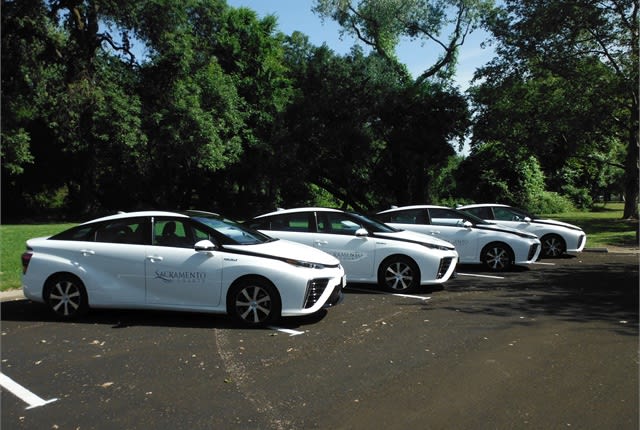
Sacramento County, Calif., is using its four Toyota Mirai fuel cell vehicles in its motor pool and hopes to add six more to departments by the end of the year. Photo courtesy of Sacramento County
The cost of fuel cell vehicles seems extravagantly high for a government fleet. Fueling and fuel, sold in kilograms, seems confusing. There are a limited number of fueling stations. But some California public fleets are able to overcome these hurdles and add Toyota’s new Mirai fuel cell vehicles to their operations.
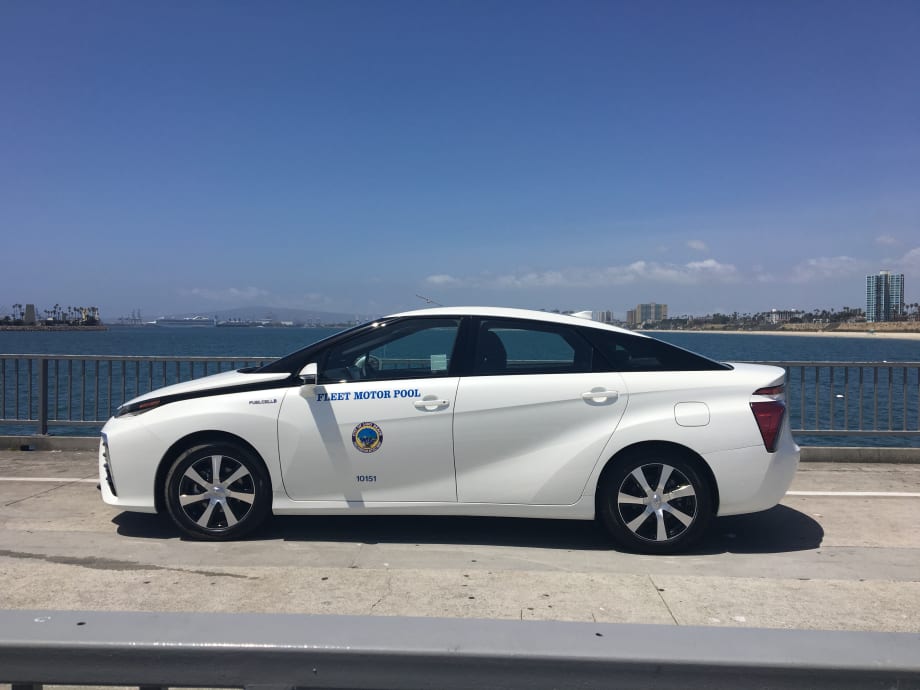
Sacramento County took delivery of four Mirai vehicles on May 9. In late April, the City of Long Beach added a Mirai to its motor pool.
With an MSRP of more than $57,000, how did these agencies make the numbers work?
Adding Up Incentives
Keith Leech Sr., chief of fleet and parking for the county, said purchase cost, a nearby fueling station, and rebates and incentives make the four-vehicle purchase a no brainer.
“We normally wouldn’t be buying a fleet vehicle with a sticker price of $57,000, but at $41,000 with all the Toyota incentives, then you knock off the $15,000 [public fleet state rebate], and they give you free hydrogen for three years, it’s a no brainer if you have the fuel station [nearby],” Leech said.
Leech is referring to the California state contract cost of $41,000 for the Mirai, a $15,000 Public Fleet Pilot Project rebate per vehicle from the California Air Resources Board (CARB) reserved for select pollution-burdened areas, and up to $15,000 in free fuel for up to three years from Toyota.
The state contract cost was established by a winning bid from Toyota of Sunnyvale, the sole provider of Mirai at state contract pricing.
There’s a fueling station just minutes from the downtown garage where the county’s motor pool vehicles are located. Paul Jontig, national fleet sales manager for Toyota, estimates that with the current price for hydrogen fuel in the area — just under $16 per kilogram — county drivers could drive up to 60,000 miles (or three years, whichever comes first) before they use up $15,000 in fuel.
These vehicles join the compressed natural gas (CNG), liquefied natural gas (LNG), plug-in electric vehicles (PEVs) and hybrid vehicles already in the fleet. However, Leech believes it may take a while before drivers warm up to the vehicle. That’s why he’s placed the first four into the motor pool rather than user departments.
“We’re not forcing anything on anybody but what I anticipate is some of our employees with authorized home retention are going to see that driving these fuel cell vehicles will get them commute benefits with the white [carpool lane] sticker, and they’re going to want a Mirai if they pass by the West Sacramento hydrogen station on a daily basis,” he said.
He’s taking the same strategy he used with all-electric vehicles, first trying to entice interest and showing drivers that the vehicles aren’t so exotic or scary. Then if all goes well, he’d like to place more fuel cell vehicles in specific departments. Leech’s goal is to purchase about six additional vehicles by the end of the calendar year, assuming the CARB rebates are still available.
The county has purchased a maintenance program, so technicians don’t need to worry about maintaining and fixing these vehicles. Fleet employees will take care of fueling the motor pool vehicles.
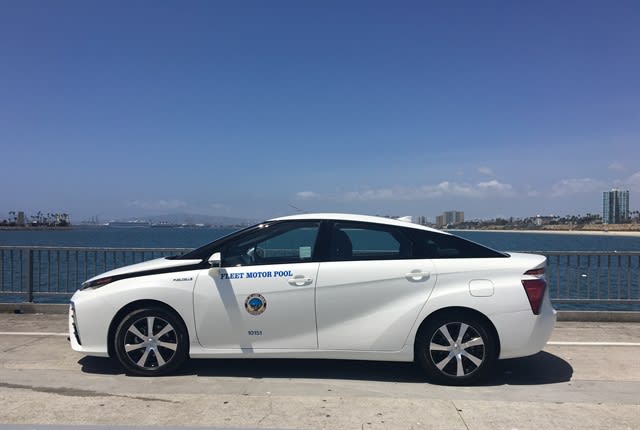
The City of Long Beach, Calif., is testing out a Mirai to determine practicality and operating cost. Photo courtesy of City of Long Beach
Piloting a Leased Mirai
Sacramento County chose to purchase vehicles, but another California entity has chosen the lease method. The City of Long Beach, in Southern California, added a Mirai to its motor pool as part of a pilot to assess practicality and operating cost of the vehicle.
“We had a survey built that we’re going to have drivers fill out…on what they think of the car, how practical they think it is. After three to six months in the motor pool, we’ll rotate between some departments so we can get longer-term feedback,” said Dan Berlenbach, CPFP, fleet services bureau manager, City of Long Beach.
The city chose to lease because it wanted to be cautious and see how the technology advances in the next few years, Berlenbach said. The three-year, $24,000 contract includes fuel and maintenance, and Berlenbach reports that technicians are curious about the technology.
“When we had it in the shop when it was first delivered, we had mechanics clustered around it. We’re very interested in it, and we’re excited to get it out in the fleet,” Berlenbach said.
Like at the county, fleet staff at Long Beach will handle fueling at a station about five miles away.
A Leader in Greening
California has long been a leader in fleet greening. Governor Jerry Brown declared that by 2020, 25% of light-duty fleet purchases made by state agencies must be of zero-emission vehicles (ZEVs). State policies have made it easier for fleets and regular drivers to switch to advanced technology vehicles, including rebates, incentives, carpool lane stickers, and the Low Carbon Fuel Standard.
But it’s California’s expanding hydrogen fueling infrastructure that has allowed drivers to test out this new technology. The state has 29 open hydrogen fueling stations as of early May, including private stations, according to the Alternative Fuels Data Center. This is more than 60% of the total stations open in the entire country.
As these fleets and others within the state test out the fuel cell vehicles, the rest of the industry will be able to see whether these new vehicles can fit within a public fleet.