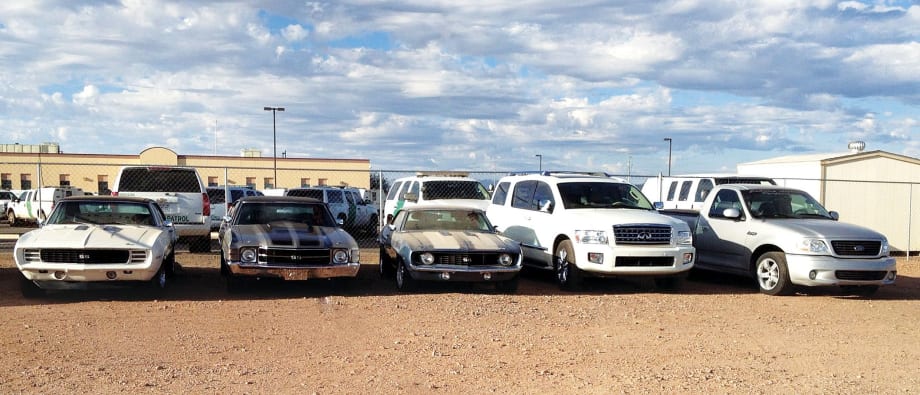
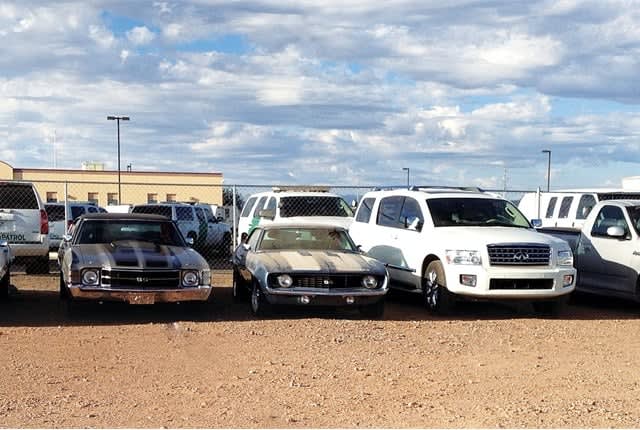
Law enforcement agencies seize a wide variety of vehicles including trucks, SUVs, and classic muscle cars. Photo courtesy of DEA
Narcotics officers need everyday vehicles that blend into the surroundings of the scofflaws they’re targeting. As a result, law enforcement agencies issue vehicles that are both familiar to the driving public and free from police markings. These widely driven vehicles might include Toyota Corolla sedans, Ford F-150 pickups, or Chevrolet Silverado pickup trucks and Malibu sedans.
Civilian-type vehicles often slip off the radar of law enforcement vehicle acquisition that prioritizes marked black-and-white units and the gear needed to equip these patrol vehicles.
While government fleet managers can acquire unmarked vehicles from dealers or at used-car auctions, a third option guarantees that the undercover officer will be driving a car familiar to a drug dealer — he will likely be driving a drug dealer’s car.
A legal process known as asset forfeiture allows municipal, county, or state agencies to acquire vehicles seized during the commission of a crime and place them into the agency’s fleet as a weapon against the criminal networks that once used the vehicle to transport illicit drugs, cash, or firearms.
Several states have passed laws banning police use of forfeited vehicles, but agencies outside the purview of those laws use criminal, civil, or administrative forfeiture to fight crime. Criminal forfeiture is most common of the three; vehicle ownership is transferred to the agency following a jury verdict and court order.
In civil forfeiture, agencies can seize the vehicle faster by filing legal action that essentially indicts the property rather than the criminal defendant. In administrative forfeiture, no court action is required. In this highly controversial method, a federal agency can seize the vehicle under the Tariff Act of 1930 if it was used to import, transport, or store a controlled substance.
Drug Vehicles Join Police Fleets
As a matter of agency policy, the nation’s top drug-fighting agency prefers criminal forfeiture. Forfeited vehicles make up less than 20% of the Drug Enforcement Administration’s (DEA) fleet but provide a needed tool, said Special Agent Joseph Moses, an agency spokesman.
The DEA prohibits official use of any seized vehicle until a court order finalizes forfeiture and transfers ownership to the agency. During the process, the vehicles are warehoused and maintained by the U.S. Marshals Service. The DEA usually acquires title six months to a year following the seizure. Checks and balances have been built into the system to thwart misconduct.
“We record and track the vehicles as official inventory during this process,” Moses said. “Vehicles don’t just disappear into a warehouse.”
The City of Chicago also uses criminal forfeiture permitted by Section 1505 of the Illinois Controlled Substances Act. The city repurposes as many as 75 seized vehicles as narcotics enforcement vehicles each year in its aptly named “1505 program.” At any one time, the Chicago Police Department maintains between 240 and 260 seized vehicles, which account for about 5% of the total police fleet. The department’s Organized Crime unit handles any initial maintenance and the storage of the seized vehicles.
Most of the vehicles seized during law enforcement operations head to the auction block. Those singled out as candidates for repurposing usually come from a wide spectrum of makes and models. They must also meet certain criteria, including having a lien-free title, U.S. registration, and needing little maintenance. So-called “grey market” vehicles registered in other countries head to auction.
In its fight against Mexican drug cartels, pharmaceutical rings, and other wide-ranging criminal networks, the DEA will sometimes seize exotic luxury vehicles. In 2011, as part of Operation Pill Nation, DEA agents seized 49 vehicles including a Lamborghini, Ferrari, Bentley convertible, Ford GT40, and several Mercedes-Benzes. Most of these high-priced vehicles head to auction; however, a few are kept as “special purpose vehicles” when agents need a flashy, high-end vehicle for an operation.
A quick visit to the U.S. Marshals asset forfeiture website in late January 2014 shows a Southern California auction of a 2009 Lamborghini Mercielago, 2010 Porsche Panamera, and 1965 Ford Thunderbird.
Narcotics operations involving the DEA are usually run through regional task forces because they cross jurisdictional boundaries. As such, municipal, county, and sometimes state agencies share forfeiture proceeds and vehicles. The DEA has been known to hand over vehicles to participating agencies that request them, Moses said.
Picking the Cream of the Seized Vehicle Crop
Seized vehicles often require little maintenance before they’re added to a law enforcement fleet. The cost of any required maintenance often comes out of cash forfeiture proceeds rather than taxpayer-funded fleet operational budgets.
“We don’t want to spend a lot of money on repairs and upkeep,” Moses said. “The vehicles are maintained prior to forfeiture, so they are kept in running shape.”
While the DEA outsources maintenance, the City of Chicago’s fleet and facility management department handles the forfeited vehicles in-house, purchasing vehicle parts through a contracted parts vendor, NAPA Auto Parts. The vehicles get an initial evaluation at the maintenance garage and are then put on a schedule for regular preventive maintenance.
“We pick the cream of the crop,” said Mark Chapulis, director of maintenance operations, who oversees police vehicle maintenance. “Very rarely will we get a low-mileage vehicle in here. We’re looking at 70,000 miles or greater.”
Chapulis will authorize brake jobs, suspension repairs, body work, and some major repairs up to a point. If the vehicle becomes a budgetary burden, he sends it to auction.
Government fleet managers and their technicians face several challenges with these vehicles, including making specialized repairs since police maintenance technicians are trained to work on Ford Crown Victoria Police Interceptors, Chevrolet Tahoes, Ford Police Interceptor sedans, and P.I. Utility vehicles, and other technicians may not be familiar with the vehicles.
The fleet department may not always have the proper vehicle manuals, diagnostic tools, or mechanic knowledge to work on these vehicles.
Not an Option for Every Agency
Not all states allow law enforcement agencies to repurpose forfeited vehicles. California’s Health and Safety Code (Section 11469g) expressly forbids the practice. When vehicles are forfeited in California, they’re always sold at auction.
“Seizing of vehicles happens rather rarely, as there must be a certain value associated with the vehicle, and a host of other regulations that preclude the seizure of most vehicles associated with our cases,” said Officer John Harris, public information officer of the California Highway Patrol.
Limits on the repurposing of vehicles often stem from earlier times, when agencies discovered ethical lapses by officers using the vehicles.
“Because these seized vehicles fall outside of the normal department’s budgets, there is a danger of misappropriation and misuse,” said Richard Valdemar, a retired Los Angeles County Sheriff’s gang sergeant. “Sometimes they lead to real corruption, especially when they are unusual, high-dollar vehicles.”
Law enforcement officers who work in states that don’t allow the use of forfeited vehicles can still use these vehicles if they’re provided by federal agencies.
“My surveillance team often drove seized vehicles, because they do not look like police vehicles,” Valdemar added. “Some were provided by DEA or FBI and some from our own department.”
Repurposed vehicles rarely dominate a government fleet manager’s time, and often fall to a lower priority when black-and-white units arrive for repair. But they can provide a cost-effective alternative to auction purchases and help stock a law enforcement agency’s unmarked enforcement fleet.


![Is the law on use of force really changing? What is science saying about bias? What can you do to be safer on the job?[|CREDIT|]Photo: Getty Images](https://assets.bobitstudios.com/image/upload/f_auto,q_auto,dpr_auto,c_fill,w_980,h_552/pm.gettyimages-169937496_web_1759886967625_pm6g0r.jpg)