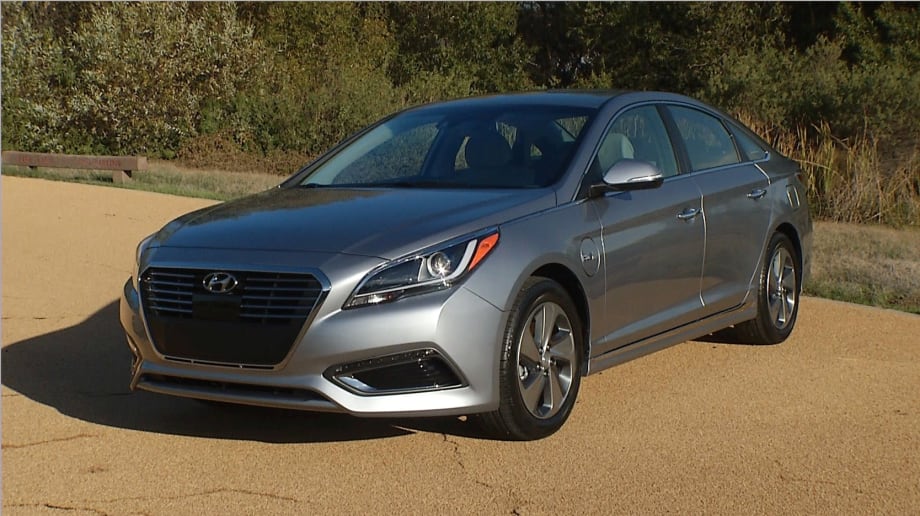
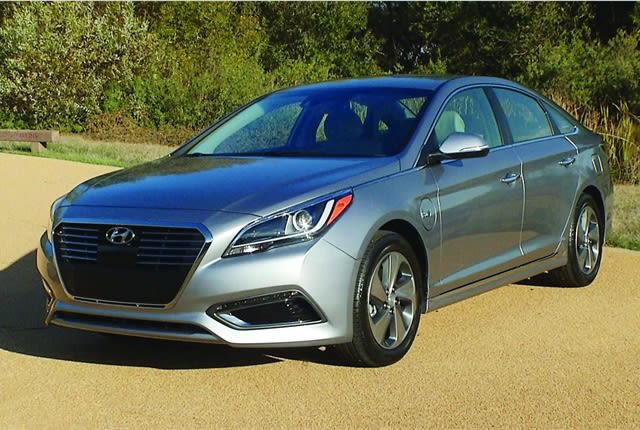
The Sonata Hybrid was Hyundai’s first venture into alternative-fuel vehicles. Photo courtesy of Hyundai
Although best known for its gasoline models, Hyundai has been working on steadily releasing a line of eco-friendly options, including fuel-efficient versions of some popular models. Now, Hyundai is moving on to the next step. The company is getting ready to release its newest model: the Ioniq. Offered as a hybrid, plug-in hybrid, and battery-electric, it will be the first car on the market offered in three alternative powertrain options.
“We know that a single solution doesn’t work for everyone and we are trying to create a wide range of different vehicle types to cater to the needs of all different consumers,” said Gil Castillo, senior group manager, alternative vehicle and advanced vehicle strategy.
Sonata Hybrid and Plug-In Build on Popular Gas Model
The Sonata Hybrid was first released in 2010 as a new alternative of its already-popular model. Since then, Hyundai has worked on additional fuel-efficient options and, last year, released a revamped 2016 Sonata Hybrid along with a Sonata Plug-In Hybrid, the company’s first plug-in model.
The 2016 Sonata Hybrid offers the best- in-class cargo volume at 13.3 cu. ft., 10% more than the original 2010 model. It can operate at speeds up to 75 mph on electric power and averages 42 mpg city/highway. The Nu engine produces 154 hp and 140 lb.-ft. of torque, while the electric motor can produce 51 hp and 151 lb.-ft. of torque.
John Shon, senior manager, product planning, said the new Plug-In Hybrid is a great option for agencies that are interested in electric vehicles but may not feel ready for a full commitment to electric.
“For everyday driving, the first 27 miles on a full charge are all-electric. And once you use that electric charge, it operates just as efficiently as a hybrid does, getting up to 40 miles per gallon from combined driving,” he said. “It’s really the best of all worlds — not only do you have the electric vehicle standpoint for the first 27 miles, you get all the efficiency benefits of a hybrid after you use that electric range.”
The Plug-In Hybrid uses a 50 kW electric motor that’s 32% more powerful than the one in the Sonata Hybrid and, when combined with the Nu engine, offers a total system output of 202 hp at 6,000 rpm.
Both the Sonata Hybrid and Plug-In Hybrid have the same maintenance schedule as the gasoline equivalent and come with the same 10-year, 100,000-mile warranty as all Hyundai vehicles.
“You get the interior space, you get the cargo space, and it’s in a conventional sedan format where people are most comfortable driving. It just happens to be a powertrain alternative,” Shon said. The suggested retail price for the Sonata Hybrid starts at $26,000 and the Plug-In Hybrid starts at $34,600.
An added bonus for the Sonata Hybrid and Plug-In Hybrid is Hyundai’s Lifetime Hybrid Battery Warranty. This is perfect for those who have never tried a hybrid vehicle before and are wary of the risk.
“A lot of the concern with these alternative powertrain vehicles is, ‘What happens if the battery system fails?’ It’s a huge cost component for sure, but we wanted to give peace of mind to our customers that as long as you own your Sonata Hybrid or Plug-In Hybrid, we’ll cover the battery system throughout your ownership period,” Shon said. “We’re the only ones in the industry to offer a lifetime hybrid battery warranty.”
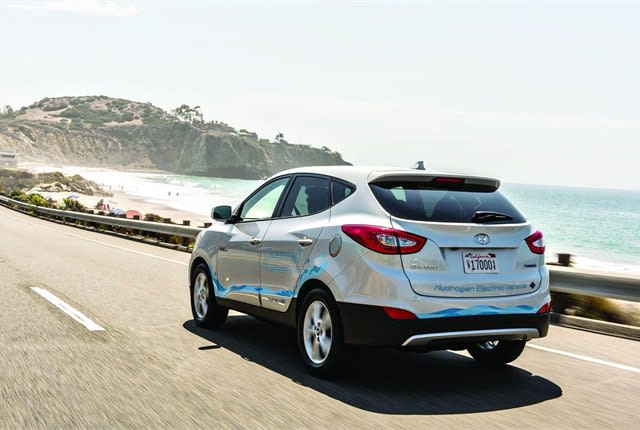
The Tucson Fuel Cell lease program comes standard with unlimited complimentary hydrogen fueling and At Your Service Valet Maintenance. Photo courtesy of Hyundai
Tucson Fuel Cell’s Oxygen Use Saves Energy
When the Tucson Fuel Cell was first introduced in 2014, it was the first mass-produced fuel cell vehicle ever. The vehicle utilizes a fuel source that promises a maximum vehicle speed of 100 mph and 50 mpge city/highway.
Hydrogen fuel is stored in the tank and supplied to the fuel cell stack. An inflow of air is supplied to the fuel cell stack, and the reaction of air and hydrogen generates electricity and water. The electricity powers the motor and battery, and the vehicle’s only emission is water.
“The exciting thing about fuel cells is the potential for renewable use,” said Derek Joyce, product public relations manager. “It has quicker refueling speed, greater range, and complete vehicle size scalability compared with typical electric vehicles.”
The Tucson Fuel Cell has an estimated driving range of 265 miles (depending on driving conditions) and it takes about five minutes to fill up from empty at a hydrogen fueling station.
Since its initial release, the model has been in limited production due to the limited availability of hydrogen fueling stations. The 2016 model is currently available in Northern and Southern California, and Hyundai hopes to extend the availability in the future.
“A year ago, you had one fueling station to count on. Now there are a number of fueling stations. I think that opens a lot of doors,” Castillo said.
The Tucson Fuel Cell is available for lease in select areas of California. The vehicle is available for $499 per month for a 36-month term with a $2,999 down payment. Hyundai offers unlimited complimentary hydrogen refueling and At Your Service Valet Maintenance, which includes free pickup, delivery, and loaner vehicles, standard through the Tucson Fuel Cell lease program.
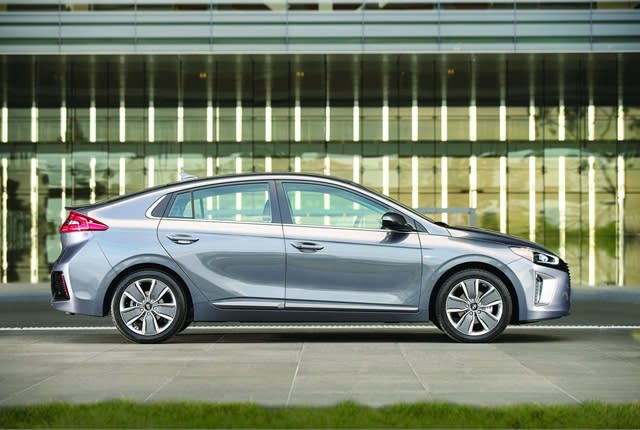
Available later this year, the all-new Ioniq will be available in three fuel-efficient options. Photo courtesy of Hyundai
Ioniq Available in Three Alt-Powertrain Options
Hyundai’s newest offering for the 2017 model-year is the Ioniq, the company’s first dedicated alternative powertrain vehicle. Available this winter, it will come in three fuel-efficient powertrain options.
“It’s designed from the ground up to be an alternative powertrain vehicle,” Shon said. “It will be the only vehicle available on the marketplace offered as a hybrid, a plug-in hybrid, and also a battery-electric vehicle.”
The Ioniq will use a lithium-ion polymer battery from LG Chem, which is 20% lighter than a non-polymer lithium-ion battery. In the Ioniq Electric, this battery can charge up to 80% in about 20 minutes using a Level 3 DC fast charger.
Instead of a continuously variable transmission (CVT), the Ioniq Hybrid and Plug-In vehicles uses a six-speed EcoShift dual-clutch transmission (DCT), which offers a smoother ride and more natural drive-feel compared to other hybrid vehicles, according to Hyundai.
“The low center of gravity makes it a no-compromise vehicle,” Joyce said. “It’s fun to live with and fun to drive.”
Although the specifications are not all available yet, Shon said preliminary numbers for the Ioniq have been very positive.
“The Hybrid will have the highest fuel economy of any vehicle without a plug, higher than even the all-new Prius that launched earlier this year,” he said.
The Plug-In Hybrid is expected to travel more than 25 miles on electric-only when the battery is fully charged. Once the electric range is depleted, it can continue to travel for more than 550 miles on gasoline. But the battery-electric model is especially positive, with a range of more than 110 miles.
All Ioniq models will come standard with a 7-inch color touchscreen audio equipped with rearview camera, Bluetooth, Apple CarPlay, and Android Auto.