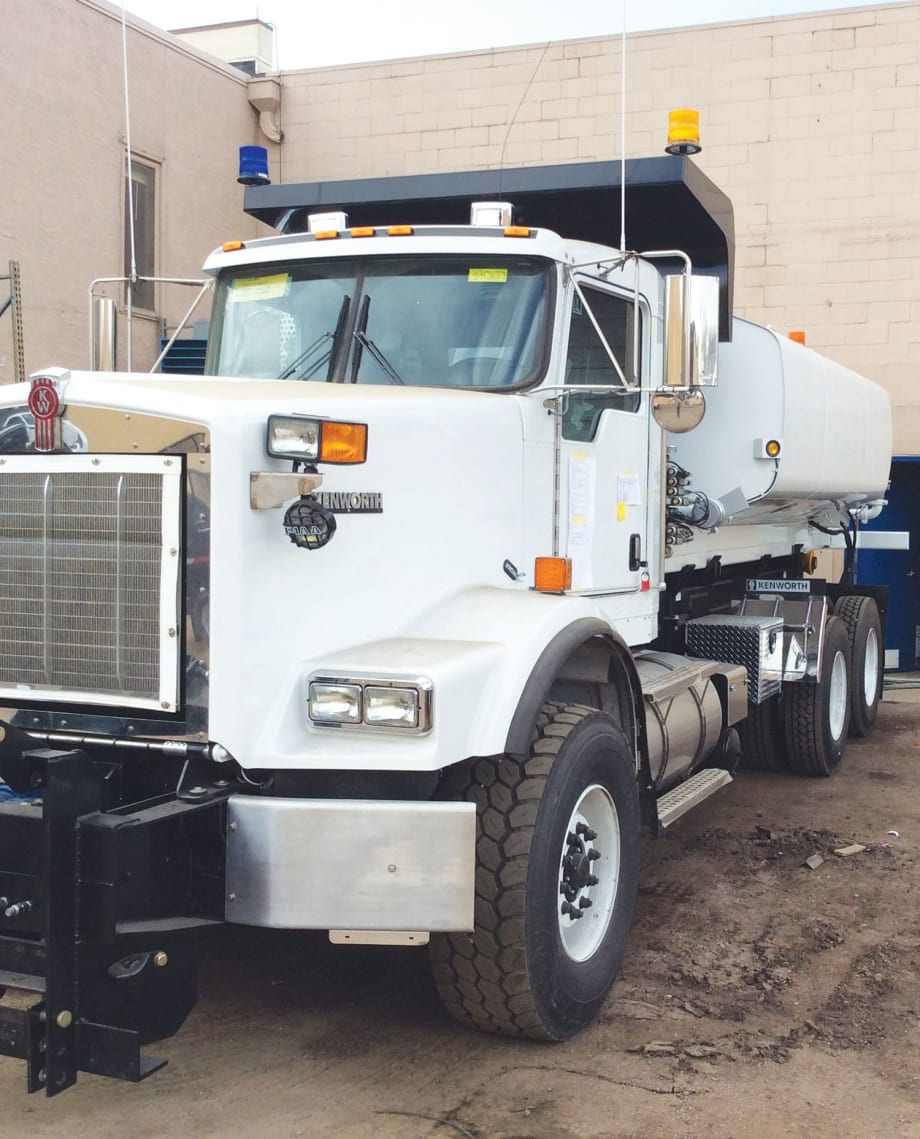
When choosing the right upfitter, fleets should consider parts and service availability and local support from the vendor. Photo courtesy of Auto Truck Group
For many fleets, a piece of equipment used once a year is not an option when dealing with small budgets and fleet reductions.
The best way to get the most out of a lean fleet is to ensure vehicles operate efficiently, either by performing multiple tasks or performing a singular task as effectively as possible. Either way, this can be accomplished with the proper upfits.
Choosing upfits that meet a fleet’s needs can increase fuel efficiency, decrease unscheduled repairs, and minimize risk, among other results. It can also result in time and cost savings. We spoke to a few upfitting experts and found that fleets are getting lighter, safer, and more user-friendly.
Ditching Weight
When seeking a more efficient fleet, weight is an important factor. Joe Birren, senior truck & upfit engineer for Merchants Fleet Management, said many of the company’s government customers aim to keep trucks’ gross vehicle weight (GVW) under 10,000 lbs. Past this threshold, drivers need a commercial driver’s license (CDL).
In addition to changing requirements, lower vehicle weight means more payload capacity for cargo and equipment, greater fuel economy, and a lower chance of overloading the vehicle, which can lower the need for unscheduled repairs.
One way to reduce vehicle weight is through choosing more lightweight materials. Merchants works with light-, medium-, and heavy-duty upfits, and Birren noted that many of these fleets have inquired about equipment made from aluminum or composite as an alternative to steel. An aluminum service body, for example, can weigh 600 lbs., compared to a 1,000-lb. steel dump body, and carries a lower price tag, with an $850-$900 price difference. For an enclosed body, switching from steel to aluminum can reduce weight by more than 900 lbs.
Birren noted that weight savings are much greater on large upfits, such as enclosed service bodies, but he has noticed a similar transition toward aluminum and composite materials in smaller upfits, such as shelving on cargo vans.
Auto Truck Group deals with more heavy-duty vehicles, most notably Class 7 and 8 plow trucks for state agencies. Joe Burbach, municipal sales manager, western region, has also noted a trend in new materials — the use of stainless steel over traditional steel. In addition to its lighter weight, stainless steel is more resistant to de-icing chemicals that can cause damage to vehicles and equipment. However, it does not offer the same cost savings as aluminum or composite.
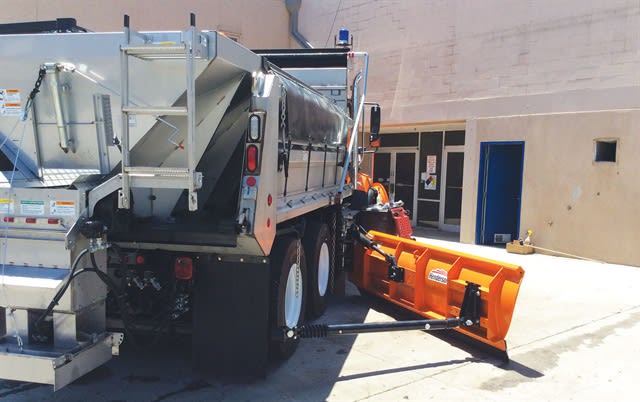
More lightweight upfits can allow a fleet to install more equipment. This plow truck, for example, features plows and a salt spreader. Photo courtesy of Auto Truck Group
Choosing the Right Equipment
With lower vehicle weight, fleets have more payload capacity. This is especially beneficial to public sector fleets, which often have multiple jobs to accomplish with specific equipment needs.
Ranger Design offers storage system upfits for a variety of customers, including the United States Postal Service (USPS). Rafik Soliman, sr. fleet operations manager, said the shelving systems on the USPS next-generation delivery van incorporated foldable shelves and can be used in multiple configurations, depending on the size and number of packages transported on each trip.
For added efficiency, the fleet is adopting movable carts, which are filled with mail in a USPS facility. When a delivery van is ready to leave for the day, the full cart is loaded onto the vehicle, reducing the downtime spent loading cargo onto vehicle shelving.
Making the extra investment in equipment can pay off in the long run. An agency that used salt or sand spreaders in the past may purchase a brine machine to save on space and improve operations. According to Burbach, utilizing a brine machine can make de-icing operations more efficient. Although it may carry a higher price tag, the standalone unit does not have a negative effect on vehicle weight.
Birren noted that it is crucial to properly spec the chassis for the intended application of the vehicle. For example, if the truck will be used for plowing, including factory options such as a Snow Plow Prep Package, heavy-duty alternator, and front suspension upgrade will increase longevity and reduce failures.
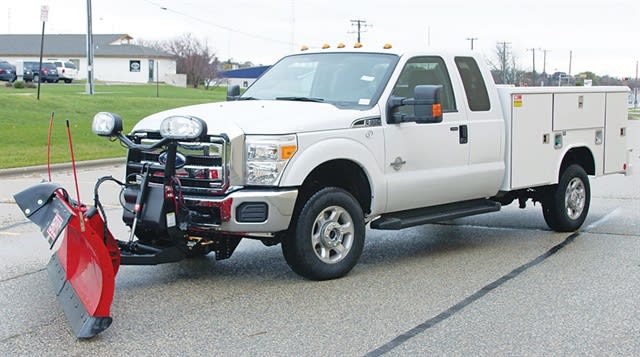
For fleets concerned about staying below 10,000-lb. GVW, upfitting a light- or medium-duty truck with a plow attachment offers more versatility than a dedicated plow truck. Photo courtesy of Merchants Fleet Management
Increasing Safety
New upfits pay more attention to ergonomics. Fleets are choosing features that improve the operators’ experience, keeping them comfortable and making their jobs easier. But in order to choose the most ergonomic options, it is important to understand the fleet application and an operator’s duties.
For example, Birren noted that choosing a drop-down ladder rack over a fixed ladder rack can mitigate the risk of an employee injury. In the USPS’ case, this includes designing shelving specifically made for envelopes so cargo does not move around or get misplaced while the vehicle is in transit.
Safety considerations do not end with ergonomics, either. Additional safety-minded upfits include rear cameras, which can reduce the risk of accidents, and telematics, which can improve routing and driver behavior, among other benefits.
Upfitting Dos and Don'ts
DO consult operations to undersyand the fleet application
DO consider long-term use in addition to current needs
DO look at market trends and potential mandates
DON'T mismatch the chassis to the equipment
DON'T choose a product without considering maintenance, such as parts and service offerings
DON'T forget to consider the vendor's value, including its responsiveness and availability

Photo: Getty Images





![Is the law on use of force really changing? What is science saying about bias? What can you do to be safer on the job?[|CREDIT|]Photo: Getty Images](https://assets.bobitstudios.com/image/upload/f_auto,q_auto,dpr_auto,c_fill,w_980,h_552/pm.gettyimages-169937496_web_1759886967625_pm6g0r.jpg)