Red Government Fleet with star logo
MenuMENU
SearchSEARCH

Sacramento Takes the Green Leap

Over the past few years, the City of Sacramento has pioneered a number of alternative-fuel programs, including the use of renewable natural gas produced by food waste.

by Stephane Babcock
March 18, 2014
Sacramento Takes the Green Leap

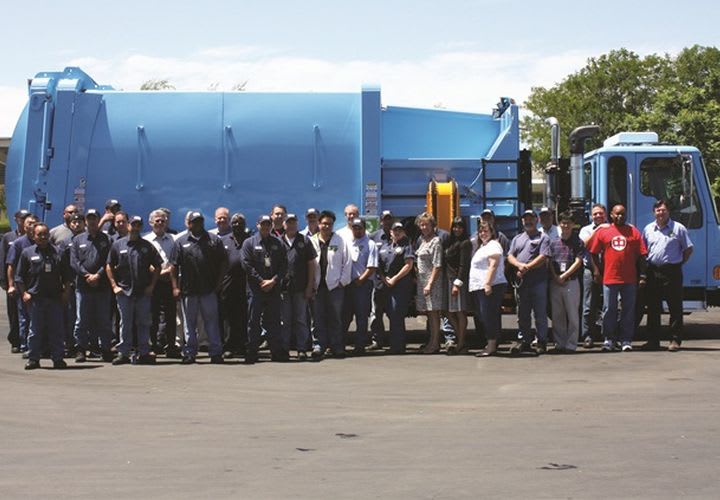
The City of Sacramento's fleet department has reduced gasoline consumption by 10% since 2011 and increased the use of compressed natural gas. Photo courtesy of City of Sacramento.

3 min to read


The City of Sacramento's fleet department has reduced gasoline consumption by 10% since 2011 and increased the use of compressed natural gas. Photo courtesy of City of Sacramento.

In the capital of alt-fuel friendly California, the City of Sacramento's Fleet Manager, Keith Leech, has not only invested in going green, he's converted more than 20 percent of the City's fleet to alternative-fuel vehicles, including liquefied natural gas (LNG) and compressed natural gas (CNG) refuse trucks, flex-fuel light-duty sedans and pickup trucks, propane autogas vans and trucks, and plug-in battery electric and hybrid motor pool vehicles.

"Fleet management decided to make the change to reduce the fleet's reliance on petroleum and also reduce emissions," said Leech, a 2013 Green Fleet Sustainability All-Star. He has measured the effectiveness of different alternative fuels based on the reduction of emissions, as well as their cost effectiveness and total cost of alt-fuel vehicle ownership (TCO).

Leech is able to justify the cost difference of alt-fuel vehicles by recovering the added initial cost through the lifecycle of the vehicle due to their lower fuel and maintenance costs. "Additionally, we are reducing the carbon footprint, which is in alignment with the City of Sacramento Sustainability Master Plan," Leech added.

Over the past few years, the City of Sacramento has pioneered a number of alternative-fuel programs, including the use of renewable natural gas produced by food waste. The Sacramento BioDigester, manufactured by CleanWorld, is the largest closed-loop anaerobic digestion system in North America, according to the City. It converts 25 tons of food waste per day — and will soon be upgraded to 100 tons per day — into a number of different forms of renewable energy, including heat, electricity, and CNG, which is dispensed at an adjacent fueling station that is owned by Atlas Disposal and operated by Clean Energy Fuels.

"The City of Sacramento is the first government fleet in the country to use renewable CNG produced locally from food waste from an anaerobic digester to power their trucks," Leech said. "The City also uses more than 1 million gallons of LNG per year to power its refuse trucks, which saves Sacramento more than $1 million versus diesel trucks."

According to Leech, the City has a sourcing agreement in place for up to 2,500 gallons of CNG per week. This includes at least 30-percent renewable CNG at the fueling station, which will fuel 20 new heavy-duty CNG-powered trucks, 11 Autocar rear loaders, three Freightliner Elgin Broom Bear sweepers, two Vaccon sewer truck, a pavement patch truck, and three Freightliner M2 Utility Service trucks.

Sacramento's fleet management department was provided a report containing the results of two separate analyses based on data provided by Utilimarc, a fleet consulting and technology solutions firm. These analyses included fuel consumption by type as a percentage of fleet and greenhouse gas emissions (GHG) analysis.

According to Leech, "the report quantifies the City's reduction in petroleum consumption and increases in alternative-fuel usage with the associated emissions benefits. This information has been extremely effective in further educating and influencing the city council and our fleet customer departments resulting in the adoption of our enhanced Fleet Sustainability Policy."

Among the fleet's sustainability achievements due to its alternative-fuel fleet between 2011 and 2013:

  • Gasoline consumption was reduced by 10 percent.

  • LNG fuel consumption was increased by 87 percent.

  • Diesel consumption was reduced by 34 percent.

  • The City fleet consumed 703,419 fewer gallons of gasoline and diesel fuel in 2013, compared to 2009.

  • Fleet had a decrease of 33.5 percent in total  fuel consumption, compared to 2009.

  • GHG gas emissions decreased by 3,040 metric tons from 2009 to 2013, an 11-percent decrease from 2009 to 2013.

Editor's note: This story first appeared in the March/April issue of Green Fleet Magazine.

Subscribe to Our Newsletter

More Green Fleet

SponsoredFebruary 6, 2026

Hybrids: Electrification Without the Challenges

Hybrids bridge the gap between ICE vehicles and EVs, making them a smart choice for fleets that want to reduce emissions but aren’t ready to fully electrify. Hybrids, which are powered by internal combustion engines and electric motors, capture the benefits of electric power without the barriers many organizations find challenging.

Read More →
Green Fleetby Bob StantonJanuary 21, 2026

Flavor of the Decade: What if BEVs Aren’t the Answer?

A look at the present state of play in the EV market, plus a 2027 heavy truck emissions update.

Read More →
Ad Loading...
SponsoredJanuary 19, 2026

3 New Ways Fleet Software Pays: ROI opportunities for modern fleet managers

Public fleets face constant pressure to do more with limited budgets. This eBook outlines how modern fleet software helps agencies extend asset life, reduce unplanned downtime, and improve safety by automating maintenance, using smarter video insights, and unifying fleet data. A practical look at how technology can drive measurable ROI for taxpayers.

Read More →
Off-grid Beam Global EV ARC charging systems installed at the City of Fresno Municipal Service Center Yard, featuring solar canopies and EV chargers used by the city’s electric vehicle fleet.
Green Fleetby News/Media ReleaseJanuary 12, 2026

City of Fresno Deploys Beam Global EV ARC Off-Grid EV Charging Systems to Support Municipal Fleet Electrification

The City of Fresno deployed off-grid EV charging systems to support municipal fleet electrification without relying on utility grid connections.

Read More →
Green Fleetby Staff WriterDecember 8, 2025

City of Quincy Partners with Cero Global to Launch Pilot to Reduce Emissions, Fuel Costs

The pilot will use Cero Global’s technology on city-owned vehicles to evaluate its impact on emissions and fuel consumption, as well as potential savings in municipal operating costs.

Read More →
Ad Loading...
SponsoredDecember 5, 2025

The Road to Smarter Electric Van Transitions: A practical roadmap for integrating electric vans into your fleet

Electric vans are becoming a strategic tool, not just a sustainability move. Get a roadmap that breaks down costs, charging planning, upfit compatibility, and what fleets should evaluate before making the switch.

Read More →
Small blue car with a green leaf and an electric plug.
Green Fleetby Staff WriterDecember 1, 2025

New Mexico Signs Agreement Advancing Electrification and Grid Resilience Efforts

The City of Socorro signs a new agreement to accelerate electrification and infrastructure development.

Read More →
UGI Energy Services logo over an image of a CNG trash compactor truck, representing Philadelphia’s move to fuel refuse vehicles with renewable natural gas.
Green Fleetby News/Media ReleaseDecember 1, 2025

UGI Energy Services and The City of Philadelphia Announce Biofuel Agreement

Philadelphia is shifting its trash collection fleet toward cleaner operations with a new partnership that will power 35 CNG compactors using renewable natural gas sourced from regional landfills.

Read More →
Ad Loading...
An electric vehicle charges at a public EV charging station outside a municipal building.
Green Fleetby News/Media ReleaseNovember 17, 2025

Sourcewell Awards ChargePoint New EV Charging Contract

ChargePoint secures a new Sourcewell contract to expand access to EV charging for public agencies across the U.S. and Canada.

Read More →