Red Government Fleet with star logo
MenuMENU
SearchSEARCH

When Hybrid Batteries Die

The batteries in hybrid vehicles today are based on nickel-metal hydride technology. They last a long time, but not forever. Here is what to do when the battery in a hybrid dies.

Paul Dexler
Paul DexlerFormer Contributor
Read Paul's Posts
April 1, 2009
When Hybrid Batteries Die

Art by Henry Olivas

3 min to read


Many fleets, both public sector and commercial, have been moving aggressively towards acquiring more hybrids. One issue not fully addressed in the lifecycle analysis of electric and particularly hybrid-electric vehicles is what happens at the end of their service life. Most vehicle batteries, in fact most batteries in general, contain highly poisonous substances that should never enter our drinking water or food chain.

So, what should be done with the batteries, and does disposal vary for different kinds of batteries?

Since the first onboard electric systems became available in the early years of the 20th century, the system's battery in automobiles were still lead-acid units. Lead and hydrochloric acid are not noted for being environmentally friendly. Nickel-cadmium batteries are even worse. New battery technology is much "greener."

NiMH, the Technology of Choice

Nickel-metal hydride (NiMH) is the technology of choice for the emerging hybrid-electric vehicle market. The technology is gaining acceptance for mission-critical backup power needs due to its excellent performance, high energy, reliability, low cost of ownership, and long life.

Cobasys LLC, headquartered in Orion, Mich., with manufacturing facilities in Springboro, Ohio, has been a leader in the development of NiMH batteries for automotive and other applications. Cobasys was formed as a joint venture between Chevron and Energy Conversion Devices (ECD Ovonics) to further the development of emerging technologies and alternative-energy processes and products. The company has been working closely with major automakers to incorporate advanced energy storage systems to meet hybrid-electric vehicle requirements. According to Cobasys, battery packs in hybrid vehicle applications must survive extremes in temperature and road vibrations and last the life of a vehicle.

NiMH batteries consist of two electrodes: the positive uses nickel-hydroxide for the cathode and the negative uses metal hydride for the anode. The electrodes are sandwiched together with a polymer separator to eliminate shorting. A small amount of water plus a potassium hydroxide mixture forms the electrolyte, which is added to the cell. The cell is sealed and charged electrically to form a 1.2v electrochemical couple. Individual cells can be connected in series to make batteries in various voltage ranges. A typical module is 12v.

Battery technologies are evaluated in terms of complete discharge cycles. A standard electric-vehicle battery can be charged and discharged 1,000 times to 80 percent depth-of-discharge (DOD), equivalent to more than 100,000 miles.

Hybrid vehicle applications use batteries differently. Generally, the battery is never fully charged or discharged in hybrid applications. NiMH batteries used in hybrid-electric vehicle applications can be cycled in shallow discharges hundreds of thousands of times and last more than 200,000 miles under a partial charge/discharge regime.

Recycling is the Answer

NiMH batteries are 100-percent recyclable and use no toxic materials (lead, cadmium, or lithium), making them the only rechargeable battery that can be legally disposed of in a landfill. But simply dumping them into a landfill is not economically nor environmentally sound.

So the answer is recycling. Hybrid vehicle manufacturers said they would accept the old battery and recycle it when it needed replacing.

Battery technology is advancing day by day. If you put a hybrid vehicle into service today, you probably will never have to worry about replacing the battery.


Subscribe to Our Newsletter

More Green Fleet

SponsoredFebruary 6, 2026

Hybrids: Electrification Without the Challenges

Hybrids bridge the gap between ICE vehicles and EVs, making them a smart choice for fleets that want to reduce emissions but aren’t ready to fully electrify. Hybrids, which are powered by internal combustion engines and electric motors, capture the benefits of electric power without the barriers many organizations find challenging.

Read More →
Green Fleetby Bob StantonJanuary 21, 2026

Flavor of the Decade: What if BEVs Aren’t the Answer?

A look at the present state of play in the EV market, plus a 2027 heavy truck emissions update.

Read More →
Ad Loading...
SponsoredJanuary 19, 2026

3 New Ways Fleet Software Pays: ROI opportunities for modern fleet managers

Public fleets face constant pressure to do more with limited budgets. This eBook outlines how modern fleet software helps agencies extend asset life, reduce unplanned downtime, and improve safety by automating maintenance, using smarter video insights, and unifying fleet data. A practical look at how technology can drive measurable ROI for taxpayers.

Read More →
Off-grid Beam Global EV ARC charging systems installed at the City of Fresno Municipal Service Center Yard, featuring solar canopies and EV chargers used by the city’s electric vehicle fleet.
Green Fleetby News/Media ReleaseJanuary 12, 2026

City of Fresno Deploys Beam Global EV ARC Off-Grid EV Charging Systems to Support Municipal Fleet Electrification

The City of Fresno deployed off-grid EV charging systems to support municipal fleet electrification without relying on utility grid connections.

Read More →
Green Fleetby Staff WriterDecember 8, 2025

City of Quincy Partners with Cero Global to Launch Pilot to Reduce Emissions, Fuel Costs

The pilot will use Cero Global’s technology on city-owned vehicles to evaluate its impact on emissions and fuel consumption, as well as potential savings in municipal operating costs.

Read More →
Ad Loading...
SponsoredDecember 5, 2025

The Road to Smarter Electric Van Transitions: A practical roadmap for integrating electric vans into your fleet

Electric vans are becoming a strategic tool, not just a sustainability move. Get a roadmap that breaks down costs, charging planning, upfit compatibility, and what fleets should evaluate before making the switch.

Read More →
Small blue car with a green leaf and an electric plug.
Green Fleetby Staff WriterDecember 1, 2025

New Mexico Signs Agreement Advancing Electrification and Grid Resilience Efforts

The City of Socorro signs a new agreement to accelerate electrification and infrastructure development.

Read More →
UGI Energy Services logo over an image of a CNG trash compactor truck, representing Philadelphia’s move to fuel refuse vehicles with renewable natural gas.
Green Fleetby News/Media ReleaseDecember 1, 2025

UGI Energy Services and The City of Philadelphia Announce Biofuel Agreement

Philadelphia is shifting its trash collection fleet toward cleaner operations with a new partnership that will power 35 CNG compactors using renewable natural gas sourced from regional landfills.

Read More →
Ad Loading...
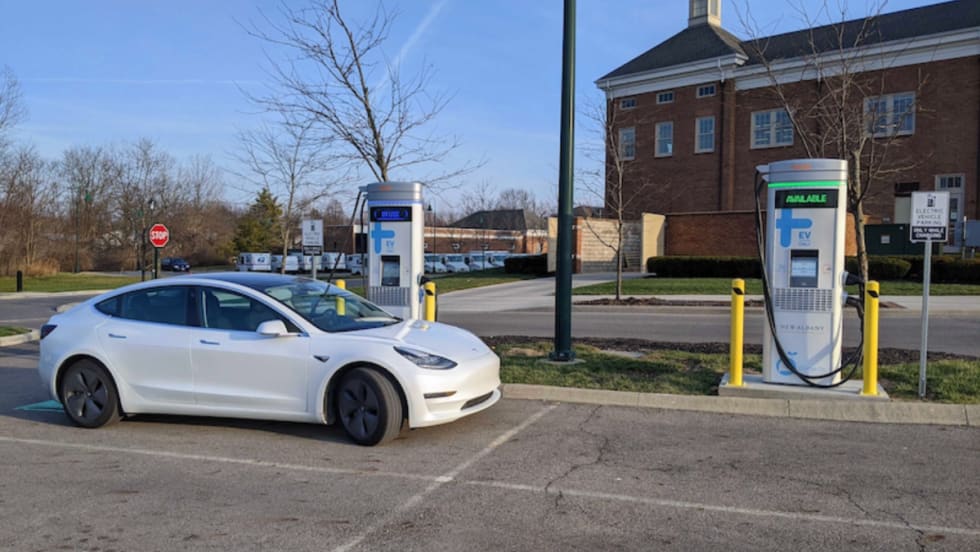
An electric vehicle charges at a public EV charging station outside a municipal building.
Green Fleetby News/Media ReleaseNovember 17, 2025

Sourcewell Awards ChargePoint New EV Charging Contract

ChargePoint secures a new Sourcewell contract to expand access to EV charging for public agencies across the U.S. and Canada.

Read More →