




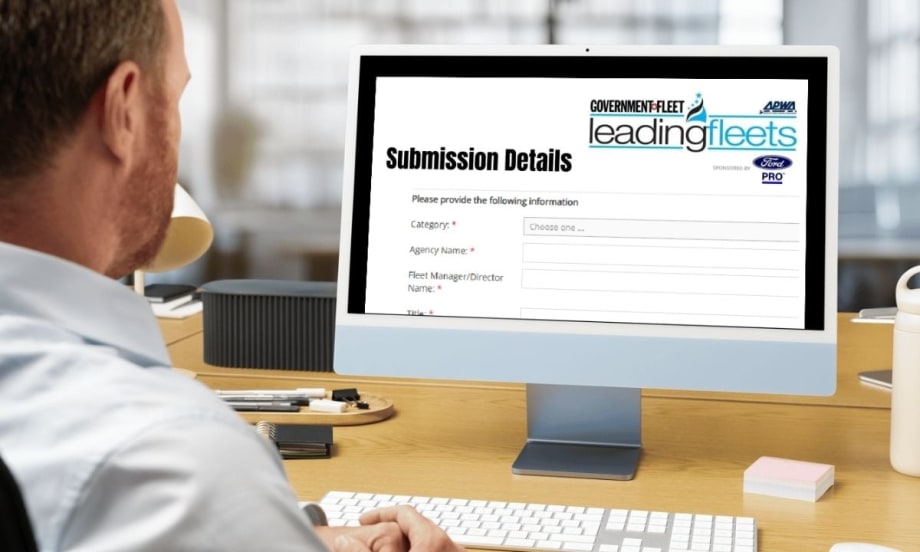
The Leading Fleet's application is open, but the difference between “submitted” and “standout” usually comes down to how clearly you tell your story and back it up with results.
To help fleets put their best foot forward, we asked this year’s Leading Fleets judges two simple questions: what applicants should keep in mind as they complete the form, and why the process is worth the time even before the winners are announced.
What should fleets keep in mind when filling out their application?
Bradley Northup, Public Works Superintendent – Fleet Operations, City of Carlsbad
Remember to think beyond the walls of your fleet operation and make sure to include your organizational efforts that benefit your team as well.
While including your accomplishments, don’t forget to also include your projects already in progress, many fleets have initiatives that are years in the making that show you know where your issues lie, and that you are working to solve them.
Jeffery Shepard, Director, City of Tallahassee – Fleet Management
Be clear and concise. Answer each question directly and avoid jargon. Reviewers may not be familiar with your internal acronyms or systems.
Use data and outcomes. Quantify results where possible (e.g., reduced downtime, cost savings, improved availability, emissions reductions).
Tell the story behind the numbers. Briefly explain the challenge, the action taken, and the impact—this context matters.
Show sustainability and scalability. Highlight initiatives that are repeatable, long-term, and aligned with strategic goals.
Emphasize people and process. Leadership, workforce development, safety culture, and collaboration are as important as technology.
Proofread and follow instructions. Complete every section, stay within word limits, and submit on time.
Rick D. Longobart, Fleet Operations Manager, City of Raleigh, Engineering Services Department, Fleet Management Operations
1. Data Accuracy and Consistency
The judges look for precision. If your turnover rate in one section doesn't align with your hiring data in another, it raises red flags.
Double-check your metrics: Ensure your safety scores, retention rates, and mileage data are pulled from the same timeframe.
Be honest about the "bad" years: If your turnover spiked, explain why and what specific steps you took to course-correct. Judges value transparency and problem-solving over "perfect" but questionable data.
2. Focus on "The Why," Not Just "The What"
Most fleets offer competitive pay and insurance. To be a "Leading Fleet," you need to explain the philosophy behind your programs.
Example: Don't just say "we have a safety bonus." Explain how that bonus is structured to encourage long-term habit changes rather than just short-term compliance.
Show the ROI: Explain how a specific initiative (like a new driver mentorship program) directly improved driver satisfaction or reduced claims.
3. Driver Feedback is the "X-Factor"
Most prestigious fleet awards include a driver survey component. Your application can be perfect, but if the driver surveys tell a different story, you won't make the cut.
Close the loop: Show examples of where you took driver feedback and actually changed a company policy.
Communication: Make sure judges understand why you are applying. If they feel like the application is just a "marketing stunt," their survey answers will reflect that cynicism.
4. Highlight Innovation and Technology
Leading fleets are expected to be early adopters or creative problem solvers.
Equipment: Mention specific specs that improvements
Efficiency: How are you using AI or data analytics to make the operators and customer service better and easier.
5. Professionalism and Narrative
Think of this as a grant application or a high-level business proposal.
Use Clear Language: Avoid excessive jargon. Use bullet points for easy reading but provide enough narrative context so the judges understand your company culture.
Provide Evidence: Whenever possible, tell stories about your operation and successes.
Kevin L. Schlangen, CPFP, CAFM, CEM, Fleet Manager
Avoid long narratives with limited details.
Get to the point and use the space to tell your story not explaining what fleet is
Get to the facts including data to prove what you are doing. Include your goal, present number and how your numbers have changed.
Not every idea or new program is a home run. It is ok to talk about what you tried and what you learned even if you are not happy with the results.
Eric Winterset, Fleet Services Manager
Tell your story: share where you started and what was your vision. What strategies were used, how did you use innovation in the process, and how did it impact your organization and community.
Be specific and don’t submit broad/vague statements. Show what you did, how you did it, what were the results, and how you measure it against be successful or not.
Show your why on initiatives you are presenting in the application, what went into the decision, how were resources prioritize and how it best serves the organization and its customers.
Highlight measure KPI’s or outcomes. Cost savings, productivity, availability, and customer satisfaction.
How did you share in the knowledge or learn from the fleet industry?
Be honest about challenges, if you didn’t hit the desired marks, share in why you didn’t and explain a plan to achieve those results moving forward.
2. Why should a fleet submit a Leading Fleets application?
Bradley Northup, Public Works Superintendent – Fleet Operations, City of Carlsbad
Submitting your application is a great learning experience in fleet management. Rarely can a fleet do everything, and this awards program helps to highlight areas you may still need to work on, which encourages continuous improvement of your operation.
Jeffery Shepard, Director City of Tallahassee - Fleet Management
National recognition. The Leading Fleets program highlights top-performing public-sector fleets across North America.
Benchmarking. Applicants gain insight into how their practices compare with peer agencies and industry leaders.
Credibility with stakeholders. Recognition supports budget requests, grant applications, and executive confidence.
Employee pride and retention. Celebrating achievements boosts morale and helps attract and retain talent.
Sharing best practices. Award recipients help advance the profession by showcasing innovative, proven approaches.
Validation of progress. Even non-winners benefit from the self-assessment, which often reveals strengths and areas for improvement.
Rick D. Longobart, Fleet Operations Manager
1. The "Internal Audit" and Roadmap
The application process acts as a comprehensive self-audit. To answer the questions, you must pull data on efficiency, lifecycle costs, and performance metrics that you might not look at daily.
Identify Gaps: The criteria cover industry best practices. If you can’t answer a specific question, it highlights an area where your fleet can improve.
Track Progress: Many fleets use the application as an annual benchmark to see how they’ve evolved year-over-year.
2. Securing Funding and Resources
Fleet departments often operate "under the radar" until something goes wrong. A national ranking provides tangible proof of your department's value to city managers, mayors, or boards.
Political Capital: Past winners have used their "Leading Fleet" status to justify requests for additional funding, new vehicle technology, or staff pay increases.
Proof of ROI: It demonstrates to taxpayers or stakeholders that their money is being managed by a top-tier, efficient team.
3. Recruitment and Retention
In a tight labor market, being a "Leading Fleet" is a powerful recruiting tool.
Attracting Techs: Technicians want to work for organized, forward-thinking shops that use the latest technology.
Team Pride: Recognition boosts morale. It validates the hard work of the mechanics, drivers, and admin staff who keep the operation running behind the scenes.
4. Industry Networking and Peer Learning
Applying puts you in the room with the best in the business.
Benchmarking: You get to see how your operation stacks up against others of similar size (Small, Mid-size, or Large).
Knowledge Sharing: Winners are often asked to speak at conferences or host tours of their facilities, allowing your team to learn from—and lead—other industry professionals.
5. Validation of Innovation
If your fleet has implemented a "practical hack," a new sustainability initiative, or a creative way to stretch a budget, this award validates those risks.
Kevin L. Schlangen, CPFP, CAFM, CEM
Why should a fleet submit a Leading Fleets application?
Application is a great team building exercise.
Great review of what your team did this last year and ideas of what you could/should do in the years ahead.
Recognition for your fleet team.
The award criteria covers what a consultant would ask to improve your operation. Cost are much lower than a consultant…………free!
Eric Winterset, Fleet Services Manager
Being in the award process and placing signals to Elected official, Executive leadership, peer agencies, and your staff that your operation is functioning at a high level and can be trusted. Its political capital.
Benchmarking against the top fleets in the country. You evaluate against all these great agencies on operational efficiency, sustainability efforts, asset management practices, and technology adoption.
Evaluation reveals data you may not have thought about. Additional staffing, funding needs and potential resources, facility upgrades, and training needs.
Celebrates your team accomplishments and sets the tone for the next year on items you want to improve on or implement into your organization.
Elevate your organization reputation and showcase your team’s accomplishments.