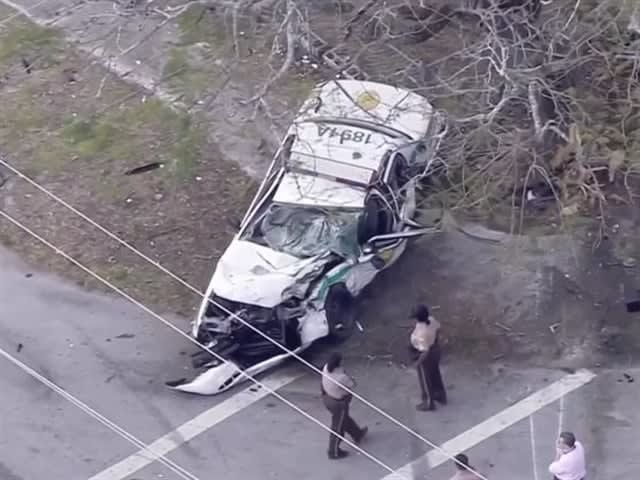
A Miami-Dade police officer was injured March 21 after a pursuit. Screenshot via Local10.com.
While shootouts and ambush killings of police officers provide high-profile examples of the hazards of police work, more often than not officers lose their lives while driving patrol vehicles.
Pursuing suspects or responding to an officer-needs-help radio call present situations that cause officers to drive more aggressively, which can increase risk to their own lives and those of bystanders on the roadways. Statistics bear this out.
Of the 45 officers who were accidently killed in 2015, 29 died in automobile accidents, according to the latest FBI statistics. Seven others were struck by vehicles. Four died in motorcycle accidents. Of the accidental deaths, 29 were killed in the South and 19 were employed by city agencies, according to the FBI's 2015 Law Enforcement Officers Killed and Assaulted report.
These statistics can be sobering, and public fleet managers have become increasingly concerned about distracted and aggressive police driving that endangers the lives of the officers and exposes agencies to legal actions.
Larger agencies have faced countless lawsuits from victims of police driving crashes. In one such case, the Los Angeles City Council agreed to pay $6.6 million to the family of 27-year-old Jovanna Lugo in 2012. Lugo's car was broadsided by a vehicle driven by Officer Richard Brubaker as she pulled out of her driveway. Brubaker was responding to a possible stolen car and hadn't activated the patrol car's emergency lights.
High-risk drivers populate plenty of industries outside law enforcement. Few others place the dynamic driving demands on its workers.
Officers are often required to multi-task while on patrol and behind the wheel. They answer calls from dispatchers on their police radios and cell phones. The type in license plates on vehicle-mounted laptop keyboards to search for stolen vehicles. They must respond quickly when felons decide they won't be headed back to prison that day.
Distracted driving can also take a more garden-variety form in law enforcement when no threat has presented itself. What methods exist for this form of distracted driving?
Tulsa, Okla.-based Mobile PC Manager offers software, including its flagship ScreenSafe, which can disable a laptop monitor while the vehicle is in motion and provide web-based reporting and real-time alerts to fleet managers.
While this product may be considered too intrusive by officers, a broader implementation of a telematics system can cure these ills.
The Snohomish County (Wash.) Sheriff's Office added Ford's Telogis-powered telematics system in their vehicles after reviewing the data. In 2015, 11 collisions involving on-duty deputies cost the county $151,171 in medical and legal expenses, including lost work hours and wages. The collisions caused $2.3 million in litigation expenses.
Undersheriff Rob Beidler championed the telematics system after meeting with Dale Stockton, a former deputy who formed Below 100, a nonprofit organization seeking to reduce crash fatalities of officers and civilians.
"I know, absolutely know, that officers have killed innocent people because of the technology in their car and I strongly believe that we have lost officers in crashes where distracted driving was the fatal flaw," Stockton told Government Fleet. "In regard to the officers, it's almost impossible to prove because they're not around to tell the story but the circumstances certainly make a strong case."
The police telematics system has been valuable off the road. Analysts use geofences to plot crime statistics. Deputies include collected data in critical incident debriefs, and vehicle diagnostic information helps plan maintenance.
"The sooner that you know about an issue with your vehicle, the safer you are," Beidler told Telogis. "Even if it’s a low tire, the more advance notice you have the sooner you can get it rectified."
Snohomish County expects to pay for the system by reducing idling by 1.4 hours per vehicle per shift.