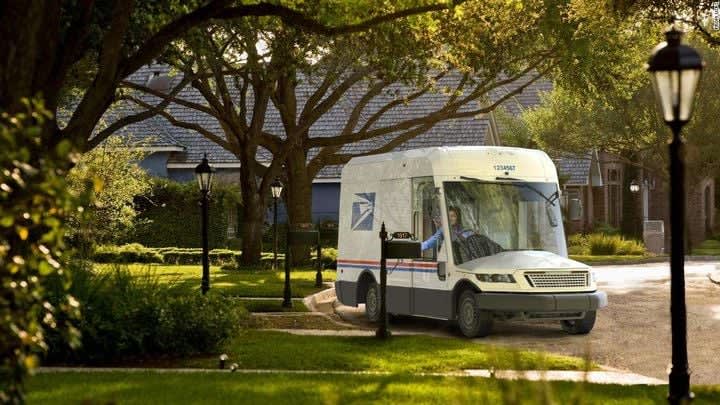
The U.S. Postal Service hopes to purchase and deploy anywhere from 50,000 to 165,000 new vehicles in its fleet over the next decade. Its recommended vehicle mix is 90% internal combustion engine (ICE) vehicles and 10% battery-electric vehicles (BEVs), all of which would be purpose-built.
While President Joe Biden, lawmakers, and special interest groups advocate for the purchase of all-electric vehicles for the USPS fleet, moving to an entirely electric procurement policy would come at a price tag of up to $3.3 billion higher than the USPS’s recommended fleet mix, according to a 339-page environmental impact statement the agency released in December 2021. There are alternative purchasing plans that would come at a lower price, but it would mean not being fully electric.
Under the four plans laid out in the environmental impact statement, the replacement vehicles would either be purpose-built, right-hand drive (RHD) Next Generation Delivery Vehicles (NGDV), or commercial off-the-shelf (COTS) vehicles. The purchasing plans outlined are:
Purchasing 90% ICE and 10% battery-electric NGDVs (recommended)
Purchasing only battery-electric NGDVs
Purchasing only right-hand-drive commercial ICE vehicles (such as the Mercedes Metris)
Purchasing only left-hand-drive commercial electric vehicles.
According to the USPS report, commercial ICE vehicles would not provide the same benefits as the purpose-built NGDV. For example, they would not have body components designed for frequent and repetitive use, leading to expected higher maintenance and repair costs, and body components that would need to be replaced more frequently, when compared with the NGDV. The ICE vehicles would also require higher fuel consumption than the NGDVs. In addition, the body and frame of commercial ICE vehicles have been found to last eight to 12 years on average, while the body and frame of the NGDVs are designed to last a minimum of 20 years. The report also said the ICE NGDVs do not have the same route length and other operational constraints as the BEVs.
The USPS doesn’t receive government aid, after the 1970 Postal Reorganization Act reorganized the agency. It will have to spend its own money when purchasing new vehicles. To electrify 75,000 of its 212,000-strong fleet, the agency believes it could would need an additional $2.3 billion more than its preferred 10%-BEV recommendation. Electrifying the full 165,000 vehicles proposed in the action plan would cost an extra $1 billion. The Postal Service is committed to procuring at least 10% BEVs but needs additional money for that to increase, according to the report.
The inability to fund an entirely electric fleet is problematic considering President Joe Biden’s goal of converting the federal vehicle fleet to an electric fleet. In December, Biden issued an executive order asking the U.S. government to buy only EVs by 2035.
Last year, the USPS announced its plans to roll out its NGDV in the next 10 years through a contract with Wisconsin-based Oshkosh Defense. The NGDV production platform provides the latest safety systems to protect carriers, a flexible powertrain to demonstrate the Postal Service’s commitment to sustainability, increased cargo capacity for more efficient delivery of packages, and is telematics compatible for predictive maintenance and operational benefits. The NGDV can also be retrofitted to keep pace with advances in BEV technologies.
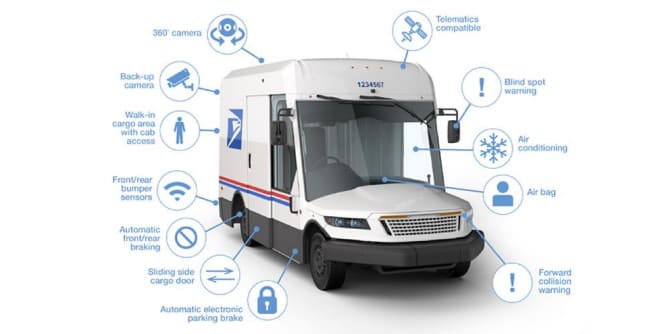
The USPS awarded a contract to Oshkosh launch a NGDV. It features new technology to benefit drivers.
Photo: USPS
The Zero Emission Transportation Association (ZETA), a coalition advocating for electric vehicles, critiqued a draft of the report in September 2021, claiming the report “demonstrates a clear, illogical commitment to internal combustion engine vehicles (ICEVs) over battery electric vehicles (BEVs), which hinges on outdated and incorrect information.”
The USPS believes it could place its first order for the vehicles in 2022, with the first vehicles rolling off the assembly lines in 2023.