




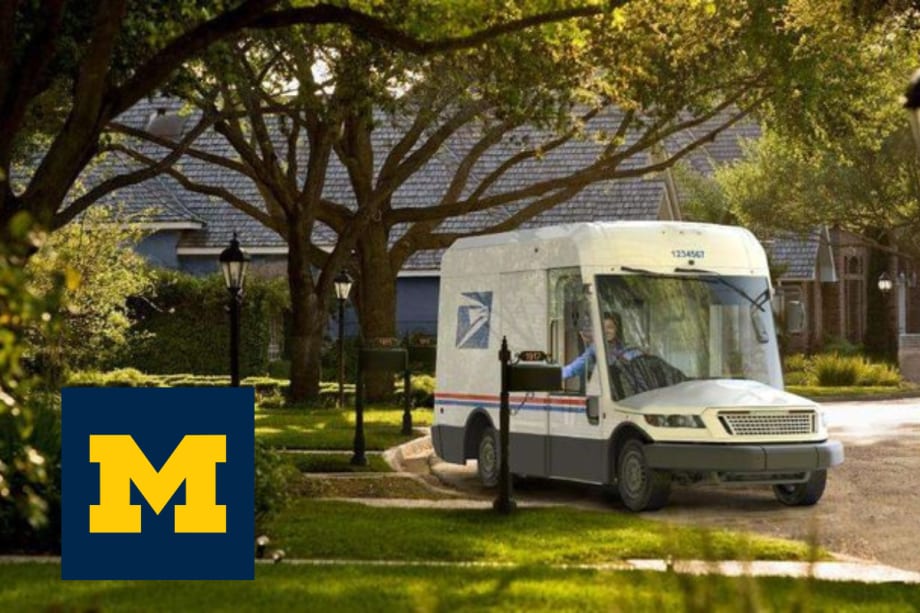
A new study by the University of Michigan (U-M) finds that switching to an all-electric mail delivery fleet would lead to far greater reductions in greenhouse gas emissions than previously estimated by the United States Postal Service in its Environmental Impact Statement (EIS). The statement was prepared as required by the National Environmental Policy Act to lay out the environmental impact of the USPS' next-generation delivery vehicles (NGDVs) it is purchasing from OshKosh Defense.
In its statement published in January, the Postal Service compared the expected environmental impacts of a delivery fleet with 10% battery-electric vehicles (BEVs) and 90% gasoline-powered trucks (called the ICEV scenario) to a fleet with 100% BEVs (called the BEV scenario).

U-M Study Points Out Discrepancies in USPS EIS
U-M researchers conducted a cradle-to-grave greenhouse gas emissions assessment—known as a life-cycle assessment, or LCA—of the two scenarios and reached different conclusions than the Postal Service did, according to a press release.
The U-M team determined that:
Lifetime greenhouse gas emissions under the ICEV scenario would be 15% higher than estimated by the Postal Service, while emissions tied to the BEV scenario would be at least 8% lower than estimated by the agency.
When anticipated improvements to electric vehicles and future electrical-grid decarbonization are factored in, a fully electric USPS delivery fleet would result in up to 63% lower greenhouse gas emissions than the agency estimated, over the lifetime of the fleet.
An all-electric fleet would reduce lifetime greenhouse gas emissions by 14.7 to 21.4 million metric tons of carbon dioxide equivalents when compared to the ICEV scenario. The USPS estimate was 10.3 million metric tons.
In February, the Postal Service announced it had completed its environmental review and was moving forward with its plan to acquire up to 165,000 NGDVs, with at least 10% of the vehicles being BEVs and the rest being gasoline-powered vehicles. The plan was meant to be flexible to allow for more BEVs if additional funding became available. The USPS then faced backlash from the Biden Administration, as well as a lawsuit from 16 states, the District of Columbia, and several environmental groups. The agency then pledged to electrify at least 40% of its new delivery fleet, explaining that its modernization plan allowed for the purchase of more BEVs.
The authors of the new study argue the main reasons their findings differ substantially from the USPS results are:
The U-M study includes greenhouse gases generated throughout a delivery vehicle’s lifetime, including the mining and manufacturing of materials, vehicle assembly, vehicle operations and service (known as use-phase emissions) and end-of-life disposal. The Postal Service analysis looked only at use-phase emissions.
The new study includes projections of how electrical-grid emissions are likely to change over the estimated 20-year service life of next-generation delivery vehicles, as renewables increasingly replace fossil fuels. The USPS analysis did not address this factor, which is known as grid decarbonization.
The U-M study uses a more accurate method to calculate vehicle operating emissions, one that relies on fuel economy and fuel combustion intensity rates. The USPS analysis of projected operating emissions was based on estimated per-mile emissions rates.
Study senior author Greg Keoleian said the new findings suggest the Postal Service should be deploying electric delivery trucks at a rate much higher than 40%. The failure to do so exposes a lack of sustainability leadership by the agency, he said. He pointed to efforts by private fleet operators like FedEx, UPS, Amazon, and Walmart that have more ambitious electrification and decarbonization targets than the current USPS purchase plan.
“Each gas vehicle purchased locks in infrastructure for at least 20 years, which will cause the federal government to fall behind private vehicle fleets and will drive future greenhouse gas emissions that could be dramatically reduced by greater electric delivery vehicle deployment,” said Keoleian, who is the director of the U-M Center for Sustainable Systems.
Concern About Cost over Greenhouse Gas Emissions
Ultimately, the USPS decision about NGDVs was based more on cost than climate-altering greenhouse gas emissions, Keoleian argued. The agency estimated that an all-electric delivery fleet would have a total cost of ownership about $3.3 billion higher than a fleet with just 10% electric vehicles.
However, the recently signed U.S. Inflation Reduction Act (IRA) includes $3 billion to help the U.S. Postal Service meet zero-emission vehicle goals: $1.29 billion for the purchase of zero-emission delivery vehicles and $1.71 billion for infrastructure to support those vehicles. The additional funds will likely reduce cost-based objections to a fully electric postal delivery fleet.
U-M's analysis came on the heels of a bill-signing ceremony for the IRA earlier this month. The USPS has the nation's largest civilian vehicle fleet, with more than 212,000 vehicles. It generally receives no tax dollars for operating expenses and relies on the sale of postage, products, and services to fund its operations. Postmaster General Louis DeJoy has previously pointed to lack of adequate funding as the reason for not purchasing more BEVs.
The authors of the U-M study say the mail agency’s estimate of a $3.3 billion cost savings for the ICEV scenario failed to account for the climate and public health damages associated with continued use of fossil fuel-powered vehicles.
“Given the long lifetimes expected of these vehicles, committing to such a course contradicts U.S. climate policy and environmental justice goals, squanders an opportunity to deploy BEVs in an ideal use case, exposes a lack of sustainability leadership, and jeopardizes our ability to meet national and international climate targets,” the study authors wrote.
Government Fleet reached out to the Postal Service for a statement in response to the U-M study. A spokesperson pointed to the July announcement about the USPS' modernization plan, which will change the scope of its EIS, leading to an updated EIS that addresses the changes from the modernization plan. That's because the EIS released in January is no longer up to date.
The work was supported by Ford Motor Co. through a Ford-University of Michigan Alliance Project Award, by the Responsible Battery Coalition and by the U-M School for Environment and Sustainability.
In December, President Joe Biden issued an executive order asking the U.S. government to buy only EVs for the federal fleet by 2035. While the USPS was exempt from the order, a spokesperson has previously told Government Fleet that the Postal Service hopes to follow the same precedent.