[Editor's Note: This story originally ran in the June 2020 issue of Police Magazine, a Bobit Business Media publication]
If your agency is discussing the purchase of a patrol boat, it's important that you know this process is more complex than selecting a land vehicle for your department. Unlike patrol cars and SUVs, there are more variables to consider as to what type of vessel is appropriate for your department. However, if you focus on a single question, you will be successful.
The most important question to answer when purchasing a new vessel is: "What will be the vessel's mission(s)?" It will be important to revisit this question several times throughout the selection process.
Mission Profile
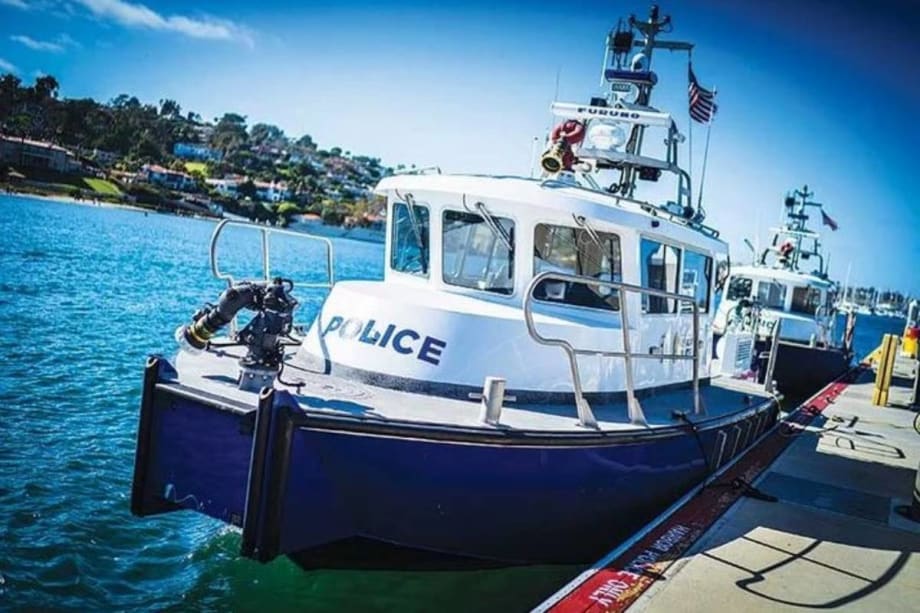
Let us share with you some information on our agency and its missions. The Port of San Diego Harbor Police is the local law enforcement agency with jurisdiction on San Diego Bay, the surrounding tidelands, and at San Diego International Airport. In addition to law enforcement duties, all Harbor Police officers are cross trained as maritime firefighters.
The Port of San Diego Harbor Police operates 10 vessels for two very different missions. Our primary mission is law enforcement and our secondary mission is maritime firefighting. Because these two missions are fundamentally different from each other, the two types of vessels we use are completely different in hull shape, design, and propulsion.
Our primary patrol vessel, a 36-foot Metal Craft Firestorm, also serves as a maritime firefighting platform. It is essentially designed as a highly maneuverable fire engine. It has a wide hull that makes it a stable platform with a shallow draft, a large open stern deck to lay out hoses or equipment, and a jet drive propulsion system that improves maneuverability in tight spaces.
Our law enforcement vessel, manufactured by SAFE Boats International, is a modified V-hull design conducive to conducting vessel boardings, delivering a tactical team, deploying divers, and maximizing speed for interdiction. The hull is shaped to cut through the water, has a shorter freeboard to aid in law enforcement contacts, and is equipped with outboard engines.
Your mission and budget will heavily influence what type or types of vessel your agency will ultimately purchase.
Project Team
As purchasing a new vessel is a major project, we have found that forming an interdisciplinary team is important to ensuring successful procurement. Your committee should be made up of key stakeholders, namely the end users of the vessel, a command staff member, your purchasing department, maintenance personnel, an environmental representative, a finance specialist, and a grant writer, if you have one.
Acquiring a vessel can be very expensive. The Port of San Diego Harbor Police has been very successful using grant programs such as the Port Security Grant Program (PGSP) to fund our purchases. It is worth the effort to research if you are eligible for any type of grant to offset the cost.
And the purchase cost does not factor in maintenance or fuel. Maintenance will be dependent on vessel usage, but plan to have maintenance for every 100 to 250 hours that you run your engines. Outboard motors require increased maintenance when compared to most diesel engines. You should also factor in fuel costs.
Buying the Boat
Once you have listed the operational requirements, reach out and visit other agencies doing a similar mission and in a similar environment to your jurisdiction. Harbor Police Captain Chris Woodward cautions, "Don't reinvent the wheel. If you do your homework, you can find other agencies that have been through this process who can advise you on best practices related to this type of purchase." These trips will give you valuable insights into unforeseen issues and aspects that you have not thought to address. Once you have chosen a vessel manufacturer, a visit to their plant and to other agencies that use their vessels is in order.
Environmental factors are often an afterthought. One factor that was important to consider for our operating environment was kelp, the seaweed that grows in abundance around San Diego Bay. We had to install a rake system and adjust our operating procedures after having numerous issues with kelp clogging our vessel's jet propulsion system. Ultimately there will always be unforeseen circumstances when undertaking a project of this magnitude. Keeping them to a minimum is key throughout this process.
Understanding your vessel's mission will help you understand the level of customization required. If you are purchasing an off-the-shelf vessel, you will need to work with the existing features of that vessel. This includes the propulsion, hull design, deck layout, electronics, storage solutions, emergency lights, or any other modifications that you might need. Off-the-shelf vessels are generally cheaper and outfitting them is very similar to a patrol vehicle.
If you are purchasing a custom or semi-custom vessel, the outfitting is much easier. This is due to the vessel being made specifically for your department. Everything can be customized to suit your needs, including hull length and design, deck space and layout, propulsion, lights, and electronics. Keep in mind that this comes with a price.
Once you have taken delivery of the vessel you should arrange for a three- to six-month evaluation period. During this time, have the vessel crews note any issues during routine and emergency operations. These issues can range from propulsion and deck space layout, to equipment placement and ergonomics. This is especially important if you are purchasing more than one vessel. Identifying issues early will give you options before finalizing a loadout for your second vessel.
Ultimately, your process for selecting a vessel will be unique to your agency. A prepared set of mission expectations, input from outside of your agency and knowledge of the initial and recurring costs will streamline the process.
There will always be unforeseen issues that emerge during a major procurement process. But developing and following a solid plan will minimize them.
Mark G. Stainbrook is the chief of the San Diego Harbor Police Department (HPD).
Sgt. T.D. De La Pena is a 15-year veteran with the Port of San Diego Harbor Police.





![Is the law on use of force really changing? What is science saying about bias? What can you do to be safer on the job?[|CREDIT|]Photo: Getty Images](https://assets.bobitstudios.com/image/upload/f_auto,q_auto,dpr_auto,c_fill,w_980,h_552/pm.gettyimages-169937496_web_1759886967625_pm6g0r.jpg)