The California Air Resources Board (CARB) approved what it called a first-of-its-kind rule that requires a phased-in transition toward zero-emission medium-and-heavy duty vehicles, as well as a rule aimed at kickstarting the transition to ZEVs in all public fleets.
It was approved on April 28, following over 140 public comments in reaction to the regulation and an hours-long discussion by members of CARB, according to David Renschler, CPFP, fleet division manager for the city of Fairfield, California.
Known as Advanced Clean Fleets, the new rule helps put California on a path toward accomplishing Gov. Gavin Newsom’s goal of fully transitioning the trucks that travel across the state to zero-emissions technology by 2045. It's a compliment to CARB’s previous Advanced Clean Trucks rule, adopted in 2020. That rule, as previously reported by Government Fleet, mandates that by 2045, every new truck sold in California must be zero-emission.
How the New Rule Affects Fleets
Under the new rule, fleet owners operating vehicles for federal fleets such as the Postal Service, along with state and local government fleets, will begin their transition toward zero-emission vehicles (ZEVs) starting in 2024. Fleets with vehicles that run private services such as last-mile delivery will also be included.
State and local agencies must ensure that 50% of vehicle purchases are zero-emission beginning in 2024, and 100% beginning in 2027. Small government fleets — those with 10 or fewer vehicles — and those in designated counties would start their ZEV purchases beginning in 2027.
An alternate plan allows government fleet owners to meet ZEV targets using the ZEV Milestones Option, which uses a phased in approach based on the type of vehicle. See the chart below for details.
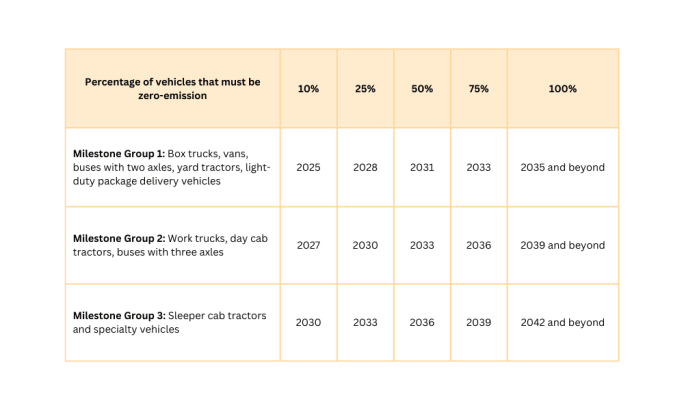
Fleets that fall under the High Priority and Federal Fleets or the State and Local Government Fleets parts of ACF may choose to use the ZEV Milestones Option, shown here, to meet their ZEV targets.
Source: CARB
The flexibility is intended to take into consideration the available technology and the need to target the highest-polluting vehicles.
Government fleets may purchase either ZEVs or near-ZEVs, or a combination of ZEVs and near-ZEVs, until 2035. Starting in 2035, only ZEVs will meet the requirements.
You can find more information about how this impacts trucks in Heavy Duty Trucking's story about the Advanced Clean Fleets rule.
What About the Existing Fleet Vehicles?
The rule includes the ability to continue operating existing vehicles through their useful life. However, due to the impact that truck traffic has on residents living near heavily trafficked corridors, drayage trucks will need to be zero-emissions by 2035.
State and local government fleets have no requirement to end the use of their existing compliant vehicles.
The rule also allows fleet owners to receive exemptions based on available technology to make sure fleet owners continue to replace their older polluting trucks with ones that have the cleanest engines available. There are already about 150 existing medium- and heavy-duty zero-emission trucks that are commercially available in the U.S. today, according to CARB.
Fleet managers are projected to save an estimated $48 billion in their total operating costs from the transition through 2050, according to CARB. Additionally, the change is expected to generate $26.6 billion in health savings from reduced asthma attacks, emergency room visits, and respiratory illnesses.
While trucks represent only 6% of the vehicles on California’s roads, they account for over 35% of the state’s transportation generated nitrogen oxide emissions and a quarter of the state’s on-road greenhouse gas emissions.
California communities that sit near trucking corridors and warehouse locations with heavy truck traffic have some of the worst air in the nation, CARB reported.
California is set to invest almost $3 billion through 2025 in zero-emission trucks and infrastructure. The investment is a part of a $9 billion multi-year, multi-agency zero-emissions vehicle package to equitably decarbonize the transportation sector that was agreed upon by the governor and the Legislature in 2021.
“We have the technology available to start working toward a zero-emission future now,” CARB Chair Liane Randolph said. “The Advanced Clean Fleets rule is a reasonable and innovative approach to clean up the vehicles on our roads and ensure that Californians have the clean air that they want and deserve. At the same time, this rule provides manufacturers, truck owners and fueling providers the assurance that there will be a market and the demand for zero-emissions vehicles, while providing a flexible path to making the transition toward clean air.”
No More ICE Truck Sales After 2035
The Advanced Clean Fleets rule includes an end to internal combustion engine (ICE) truck sales in 2036, a first-in-the-world requirement that factors in public commitments to transition to zero-emission technology by truck manufacturers, potential cost savings for fleets, and accelerated benefits for California communities.
The rule also provides fleet owners flexibility and provides regulatory certainty to the heavy-duty market.
Meeting the Need for New Infrastructure
An analysis of the sales and purchase requirements estimates that about 1.7 million zero-emission trucks will hit California roads by 2050. To support the needed infrastructure and services to make this transition, agencies across the government have committed to the Zero-Emission Infrastructure Joint Agency Statement of Intent.
For more than a decade, California has been making investments in infrastructure and to support the development and adoption of zero-emissions vehicles. The Joint Statement of Intent lays out the basic tools for direct communication and collaboration between CARB and other state agencies. Together, they will plan, develop, deploy, and help to fund the network of electric charging and hydrogen stations required to help get California to zero-emissions by 2045.
As part of the vote, board members directed staff to coordinate with relevant state agencies on how non-fossil biomethane from sources related to the state’s wastewater and food waste diversion requirements can be used in hard-to-decarbonize sectors as part of the transition, and to report to the Board, by the end of 2025, any actions needed to accomplish the transition.
According to projections published in 2022, the Advanced Clean Fleets and Advanced Clean Trucks rules together are expected to result in a growing number of ZEVs in California, with estimates at:
510,000 ZEVs by 2035.
1,350,000 ZEVs by 2045.
1,690,000 ZEVs by 2050.