The U.S. military is going greener, with fleet electrification efforts underway at military installations across the country.
In December 2021, President Joe Biden announced an executive order requiring federal vehicle acquisitions be 100% zero-emissions by 2035. That includes 100% zero-emission light-duty vehicle acquisitions by 2027 — among other commitments to achieve zero emissions by 2050.
A New Shade of Army Green
In February 2022, the U.S. Army released its Climate Strategy in response to the executive order. It outlines a plan to reduce its net greenhouse gas emissions by 50%, in part by transitioning to a fully electric vehicle (EV) fleet by 2050. For its non-tactical, light-duty fleet, the service plans to be all-electric by 2027.
To help meet this goal, the Army called on the U.S. Army Corps of Engineers, Engineering and Support Center in Huntsville, Alabama, to provide acquisition services, contract management and technical expertise for installing EV charging stations at more than 70 sites, Huntsville Center Program Manager for EV Charging Stations Jason Bray said.
Going Solar to Lead the Charge
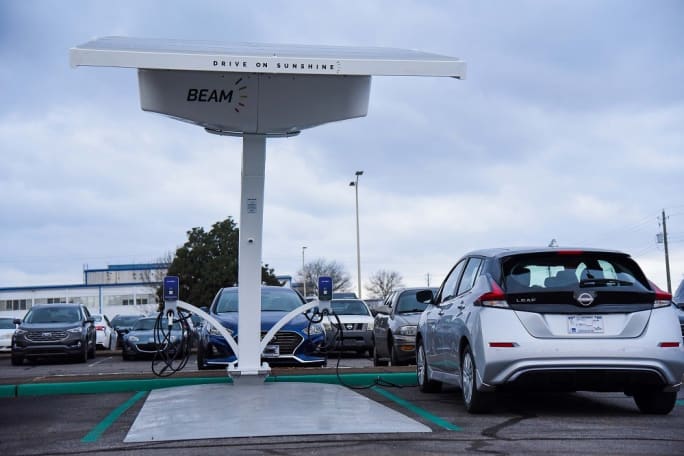
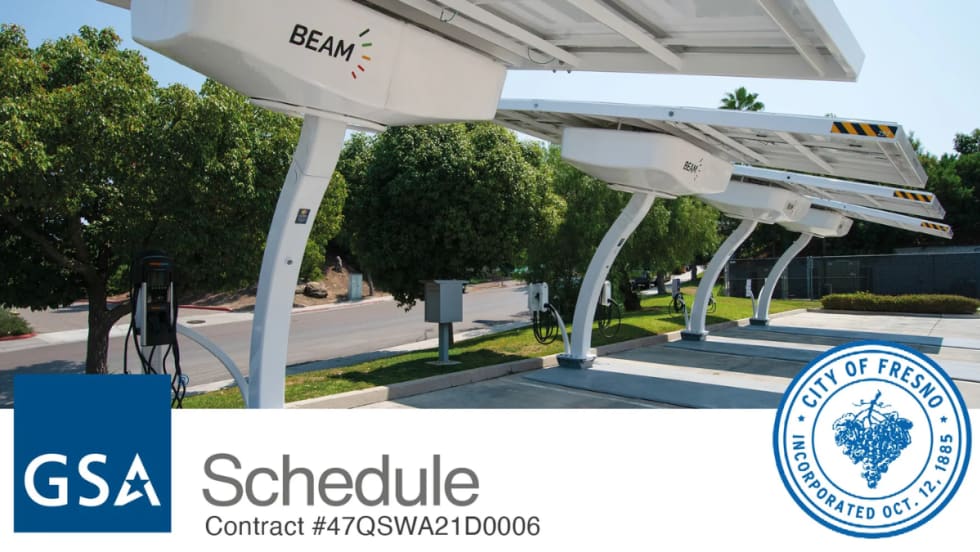
Seven solar-powered EV charging stations have been set up on Redstone Arsenal in Huntsville, Alabama. Seven more are set to be installed this year.
Photo: Erin Elise Enyinda via USAG Redstone Public Affairs
Huntsville Center awarded contracts for 367 solar-powered charging stations at 50 installations for the U.S. Army Installation Management Command (IMCOM) and 112 stations at 21 sites for the Army Materiel Command, according to an article on the U.S. Army's website. Government Fleetpreviously reported that TechFlow selected Beam Global's EV ARC charging systems to fulfill the award from the Army Materiel Command.
“Because the stations are solar powered and, therefore, not connected to the utilities grid, they don’t require additional construction or electrical work,” Bray said. “The solar piece was not part of the original plan for this acquisition, but we were able to get these in place much faster than other options and added the benefit of meeting energy initiatives in resiliency.”
Each station uses large solar panels that move throughout the day to maximize the amount of power they can draw from the sun. That power is then stored in batteries under the panels to allow charging at night and on cloudy days.
Powering Up on Redstone Arsenal
Thirty of the contracted stations for IMCOM have already been installed at six garrisons, including seven on Redstone Arsenal in Huntsville. Redstone Arsenal Energy Manager Don Henderson said the benefits to using solar power are about more than easy installation.
“When you have power coming from the grid, its subject to cyberattacks and natural disasters,” Henderson explained. “If you’re relying on the grid and that power line gets cut or the programming gets hacked, it can delay the mission and impact a plethora of things.”
Redstone Arsenal plans to install seven more charging stations this year. By 2027, the post will need enough stations to charge a full fleet of 500 non-tactical EVs.
Taking Charge at Fort Knox
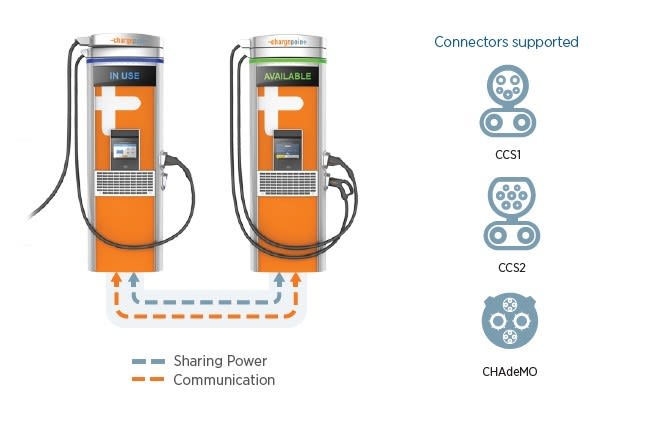
The 16 ChargePoint Express EV charging heads set to be installed at Fort Knox in Kentucky will have the ability to be coupled together in groups of two to provide up to a Level 3 charge.
Photo: ChargePoint via U.S. Army
EV charging stations will soon be available at Fort Knox in Kentucky. Eight charging ports are scheduled to be operational at two different sites at Fort Knox on or around April 1, according to the Army. One location will be fully accessible to all EV drivers, while the other will be divided between public and government vehicle-only access.
Fort Knox opted to install ChargePoint stations. The eight stations at each location can be coupled together, Fort Knox Directorate of Public Works Energy Program manager R.J. Dyrdek said. They are electrically connected in groups of two, so the eight can be used like four and provide a supercharge, he explained.
Dyrdek said the Level 3 chargers will allow drivers to choose the supercharge level when connecting the two stations together.
Government Fleetpreviously reported that Fort Knox received its first EV, a 2022 Ford E-Transit 350 EV van, in September 2022.
Colorado Army National Guard an Example of Success
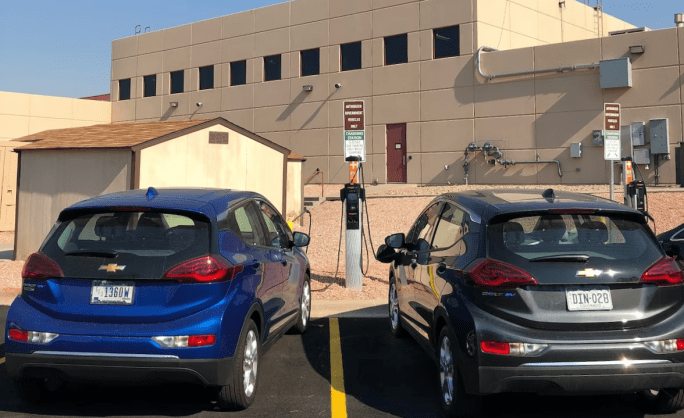
The Colorado Army National Guard's environmental quality program helped the Guard replace five of its non-tactical vehicles with EVs from 2019-2020.
Photo: U.S. Army National Guard
From 2019 to 2020, the Colorado Army National Guard's (COARNG) environmental quality program helped replace five non-tactical vehicles with EVs and one hybrid. Each EV that replaces an internal combustion engine (ICE) vehicle saves an estimated $2,000 a year in fuel and maintenance costs, according to the National Guard. By 2026, COARNG officials plan to achieve 12% battery-electric and 18% plug-in hybrid vehicles in its fleet of state and federal vehicles.
While moving to the electrification of its fleet, the Guard faces different challenges from its active-duty counterparts, whose infrastructure is largely self-contained on large installations, as mentioned above. Guard units are housed in smaller armories spread throughout each state, which creates logistical challenges in delivering electric charging stations for vehicles.
The solution: use hybrid non-tactical vehicles throughout the process of converting the fleet. Col. Timothy Wood, NGB logistics officer explained that hybrids allow the Guard time and flexibility to, "meet climate strategy goals, but at the same time continue with our mission." He said the Guard is also considering using electric microgrids at armories. This would mean linking several buildings at armories with underground connections to provide more charging stations. Existing diesel fuel power could be connected to electric charging options, which would allow for more versatility in responding to national emergencies like natural disasters.
Last year, a 99-acre solar energy microgrid and storage project broke ground at a California National Guard military training facility and emergency hub.
Furthering Electficiation Efforts at California Naval and Marine Corps Installations
The California Energy Commission (CEC) recently approved nearly $2 million for electrification programs at Navy and Marine Corps installations in California. It's part of a partnership formed by the Navy and CEC in December 2021.
The Navy programs receiving the funding are:
Defense Innovation Unit Electric Vehicle Pilot: The CEC funds will be used to procure and install 10 Level 2 and four Level 3 chargers at Naval Base San Diego for charging personal and government vehicles. The Navy will measure uptime, usage, duty cycle, vehicle types, ratio of government to personal vehicles, and max charging power
Electrification Blueprints: Electrification Blueprints will be created for three installations chosen by Navy Region Southwest and three installations chosen by Marine Corps Installations West: Naval Base San Diego, Naval Base Ventura County, Naval Air Station Lemoore, Marine Corps Base Camp Pendleton, Marine Corps Air Station Miramar and Marine Corp Air Ground Combat Center 29 Palms.
This project will develop specific transportation electrification blueprints for each selected base, to support the transportation electrification requirements of their civilian and military workforce. The blueprint will provide quantitative analysis cost benefit analysis of leveraging innovative technologies in the electrification of transportation infrastructure, particularly those related to vehicle-to-grid integration (VGI) and EVSE to grid.
What the Legislation Says
The FY2023 National Defense Authorization Act (NDAA) included a bill that established a 2035 target for the Department of Defense's (DoD) fleet of non-tactical vehicles to be electric or zero-emissions, pending a DoD study. This provision reflected the intent of the Military Vehicle Fleet Electrification Act, introduced earlier in 2022. U.S. Sen. Joni Ernst added language to the bill requiring the DoD study.
The Pentagon is required to first supply Congress with a report on the cost estimates per unit, for the infrastructure to support them as well as a comparison of their lifecycle costs compared to costs of ICE vehicles. The report will also have to provide an assessment of any supply chain shortfalls and fire-related security risks while identifying any components of the vehicles being sourced from China, according to Defense News.
Government Fleet has previously reported that the DoD currently has more than 174,000 non-tactical vehicles across all service branches, the second-largest federal fleet behind the U.S. Postal Service.
What About the Tactical Fleet?
The military has slowly introduced an array of tactical vehicles in pilot programs to its fleet. Here are a couple examples from recent Government Fleet stories:
In July 2022, the U.S. Army contracted $67,500 to Canoo to supply an EV for analysis and demonstration. Canoo could not specify what vehicle the Army would get.
In July 2022, the U.S. Army also selected GM Defense to provide a battery-electric vehicle, the GMC Hummer EV, for analysis and demonstration.