





Electric vehicles (EVs) are the next frontier for many public sector fleet managers. Government Fleet has a roundup of recent headlines involving EVs, including:
Bollinger Motors Receives EPA Certification for Class 4 EV Commercial Trucks
GM Defense Testing Ultium Platform Technology for Military Platforms
Mack Delivers Maine's First Electric Refuse Vehicle
City in Arizona Leans on National Renewable Energy Laboratory for EV Planning
Bollinger Motors Receives EPA Certification for Class 4 EV Commercial Trucks
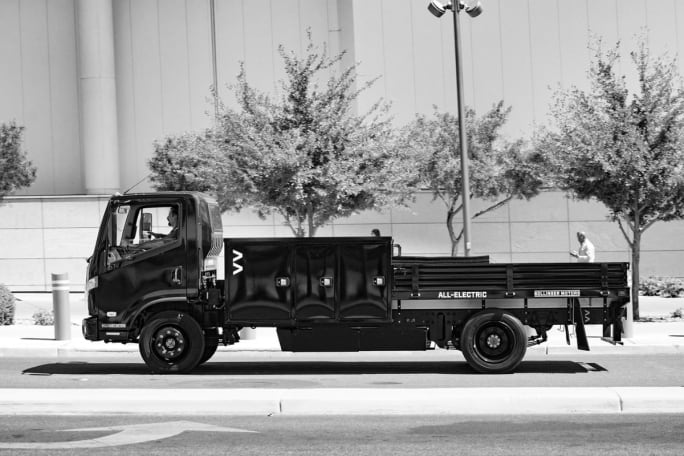
Bollinger Motors plans to launch the Bollinger B4 Chassis Cab in the second half of 2024.
Photo: Bollinger
Bollinger Motors, a subsidiary of Mullen, has received its Certificate of Conformity from the Environmental Protection Agency (EPA) for its Class 4 B4 Chassis Cab.
The Certificate of Conformity is EPA's certification to a vehicle manufacturer that a vehicle class confirms to the agency's emissions requirements. Every class of motor vehicle put up for sale in the United States must have a Certificate of Conformity, according to the EPA.
Bollinger Motors plans to launch the Bollinger B4 Chassis Cab in the second half of 2024.
“This is a huge step for us in becoming the leader in all-electric, commercial trucks,” Bollinger Motors Founder and CEO Robert Bollinger said. “We are proud that the Bollinger B4 is engineered and assembled right here in Michigan with 70% American-made content.”
The Bollinger B4 Chassis Cab is an all-new, battery-electric, zero-emissions Class 4 commercial truck designed from the ground up with extensive fleet and upfitter input. Bollinger’s unique chassis design protects the 800-volt battery and components to offer safety, flexibility and performance.
GM Defense Testing Ultium Platform Technology for Military Platforms
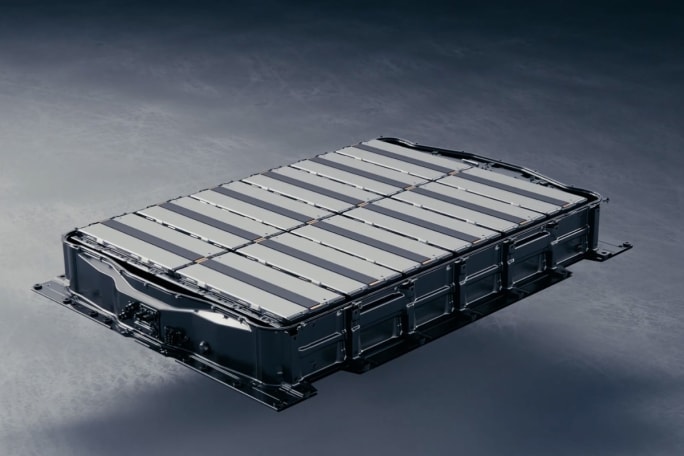
GM Defense is leveraging GM’s Ultium Platform propulsion architecture, for evaluation and testing. The Ultium Platform is pictured here.
Photo: GM Defense
GM Defense, a subsidiary of General Motors, is testing a new EV platform for potential future military use.
The automaker is providing commercial battery electric technology in support of the University of Texas at Arlington (UTA) Pulsed Power and Energy Laboratory (PPEL) and Naval Surface Warfare Center Philadelphia Division (NSWCPD).
UTA PPEL will evaluate the technology to understand current capabilities of commercial automotive batteries under dynamic discharge and charge scenarios. The team’s evaluation of the technology will help provide pathways and options for domestically supplied energy storage for future use in military platforms.
GM Defense is leveraging GM’s Ultium Platform propulsion architecture for evaluation and testing. The modular and scalable Ultium Platform can deliver power, range, and scale beyond any previous GM hybrid or extended range EV technology, according to the automaker.
The work performed in this new effort will provide insights into the performance and design considerations when batteries are used in more dynamic, high-power operations than would be faced by more typical applications.
“The Department of Defense can benefit from billions of dollars in GM investments to develop and manufacture transformative battery technologies,” GM Defense President Steve duMont said. “These technologies offer significant potential to enhance operational capability, whether at the tactical edge or on installations throughout the world. GM Defense welcomes the opportunity to support this important project and to help transition our global defense and government customers.”
GM Defense has previously announced its participation in the Defense Innovation Unit’s Jumpstart for Advanced Battery Standardization (JABS) project.
Similar to this latest project, JABS is designed to evaluate and test high voltage battery systems to optimize commercial technologies. GM Defense provided a prototype of a battery system based on GM’s Ultium Platform for the project.
Under the same contract, GM Defense demonstrated mission power capabilities by integrating a high-voltage battery pack into a light tactical utility vehicle. Key learnings from the previous project will help inform the integration requirements of future battery electric defense solutions.
Mack Delivers Maine's First Electric Refuse Vehicle
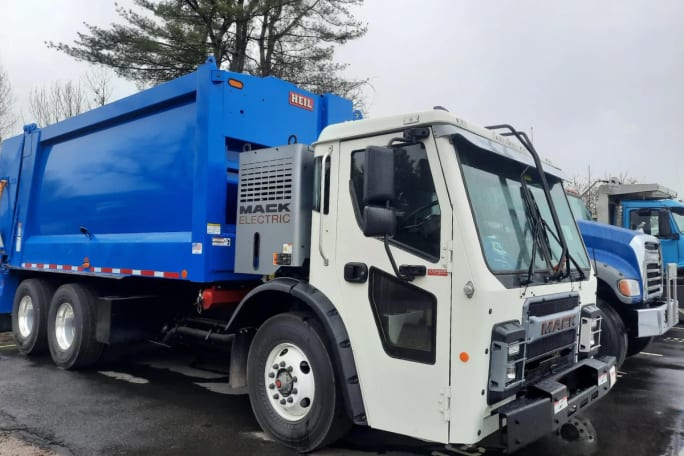
Portland has a goal to run on 100% clean energy by 2040, and vehicle electrification will play a big part in achieving that goal.
Photo: Mack
City of Portland, Maine, officials recently took delivery of a Class 8 Mack LR Electric model – the state’s first refuse battery-electric vehicle (BEV).
“The City of Portland’s choice to purchase the Mack LR Electric refuse truck to help meet its sustainability goals speaks to the partnership approach that allowed Mack and the city to implement the needed ecosystem of service and support for electric vehicles,” said Jonathan Randall, president of Mack Trucks North America. “Mack is excited to deliver the first electrified refuse vehicle to Maine.”
Portland has a goal to run on 100% clean energy by 2040, and vehicle electrification will play a big part in achieving that goal. The city is also interested in improving air quality and transitioning from diesel to EVs to reduce emissions.
“This is a significant step forward in electrifying the City’s vehicle fleet,” Portland City Manager Danielle West said. “It represents a bold leap forward in sustainable transportation, offering an electric solution that significantly reduces carbon emissions and environmental impact.”
A combined grant from the EPA Diesel Emissions Reduction Act and the Maine Department of EPA helped fund the purchase.
Portland’s Mack LR Electric is equipped with a Heil 25 cu.-yd. rear loader body, and it will be serviced and supported at O’Connor Motor Company based in Portland.
“Our familiarity with Mack through our previous vehicle purchases, along with our relationship with O’Connor makes this a great fit for the city of Portland,” said Mike Murray, director of Public Works for the City of Portland. “This is the first electric Class 8 vehicle in Portland’s fleet.”
The next generation Mack LR Electric offers a standard 376 kWh total battery capacity for 42% more energy and increased range between vehicle charges. Twin electric motors produce 448 continuous hp and 4,051 lb.-ft. of peak torque output from zero RPM.
Four Nickel Manganese Cobalt Oxide lithium-ion batteries, charged through a 150 kW, SAE J1772-compliant charging system, power the vehicle and all onboard accessories through 12V, 24V and 600V circuits. The two-stage regenerative braking system helps recapture energy from the hundreds of stops the vehicle makes each day with an increasing load.
The LR Electric and its batteries will be supported by Mack GuardDog Connect, Mack’s integrated telematics solution that helps customers achieve peak operating conditions and maximize uptime.
The connected service monitors battery health and performance and checks for fault codes and defects reported by the battery and electric components of the energy storage system.
City in Arizona Leans on DOE Program for EV Planning
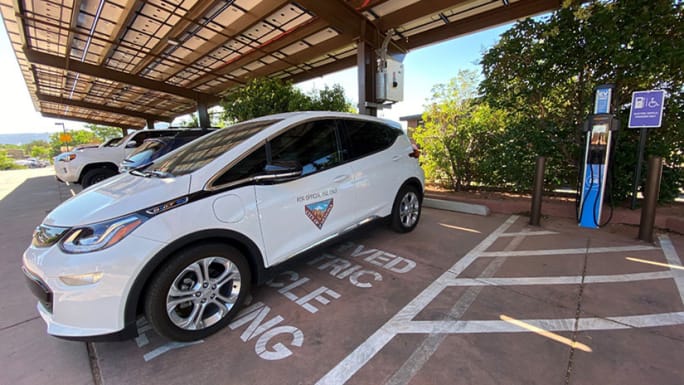
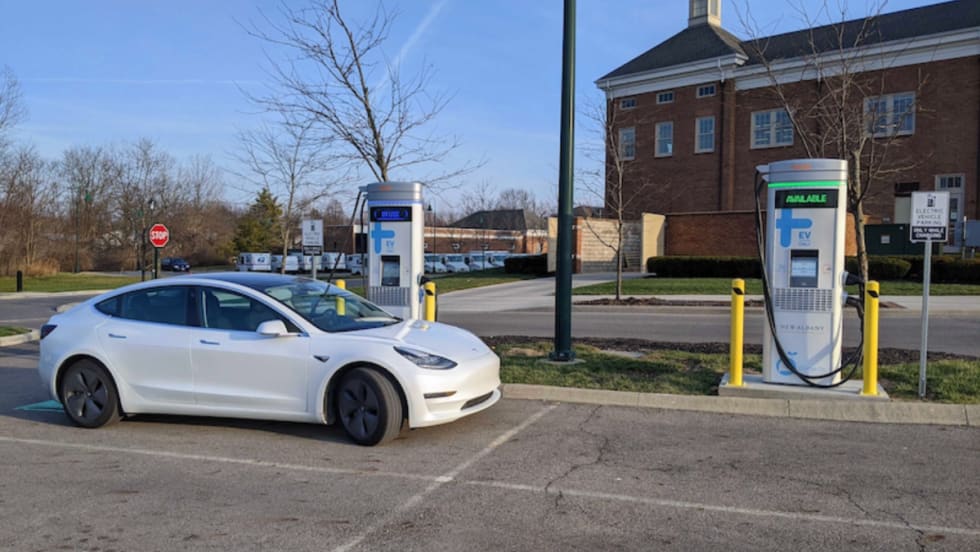
The city of Sedona is expanding EV charging capabilities both for public-facing and fleet use.
Photo: NREL via Bryce Beck
The city of Sedona, Arizona, is taking steps toward supporting its growing EV fleet, as well as vehicles for area tourists.
Seeking ways to build EV charging capacity, Sedona recently participated in a peer-learning cohort through the U.S. Department of Energy’s (DOE’s) Clean Energy to Communities (C2C) program focused on planning and funding strategies for EV charging infrastructure deployment.
Interactions with peers and tailored advice from experts provided the city with tools and ideas for updating building codes to streamline the process for installing EV chargers.
In addition to needing the infrastructure for visitors, the city also has a Climate Action Plan, which set a goal to cut Sedona’s greenhouse gas emissions by 50% by 2030. That plan includes transitioning all passenger vehicles in the municipal fleet to zero-emissions vehicles.
“We were just excited to see what that path could look like,” Sedona Sustainability Manager Bryce Beck said. “We were trying to get a sense of available funding opportunities along with the strategies we could utilize to align city codes more effectively to meet electrification and climate action goals.”
The city also adopted an EV building code, which requires 5% EV-capable parking spaces at new commercial developments.
Sedona joined 14 other organizations in this C2C cohort, meeting regularly from July to December in 2023. C2C cohorts are funded by DOE and managed by the National Renewable Energy Laboratory (NREL) with support from the World Resources Institute.
Each cohort is made up of 10–15 representatives from local and regional governments, Tribes, electric utilities, or community-based organizations. Participants learn from each other and national laboratory experts in a collaborative environment centered on a clean energy topic.
NREL helped Sedona consider safety needs for EV infrastructure and envision how to incorporate flexibility into its building code, allowing developments to have slower or faster charging speeds based on the type of property.