




To look into how fleets are tackling fuel efficiency, especially through technology, a cohort of thousands of Samsara customer organizations that deployed Samsara Vehicle Telematics and Samsara AI Dash Cams were evaluated. The cohort’s fuel efficiency was assessed in their first month and in their 13th month of adoption to discover the percentage increase in fuel efficiency. It was found that they realized a 1.2% decrease in mean gallons of fuel per mile during their first year.
According to a recent Samsara report, 99% of physical operations leaders surveyed have already implemented or plan to implement a sustainability program, while 85% have said that increasing the sustainability of their operations is a high or critical priority. As a result, nearly half (49%) accelerated their transition to EVs.
The Samsara Data Science and Analytics team also examined EV and hybrid vehicle adoption data from a global customer cohort. Millions of vehicles across a cohort of thousands of Samsara customer organizations globally were evaluated in March 2024. The company assessed primary and secondary fuel types, electrification levels, and applied business logic for specific makes and models to identify electric and hybrid vehicles.
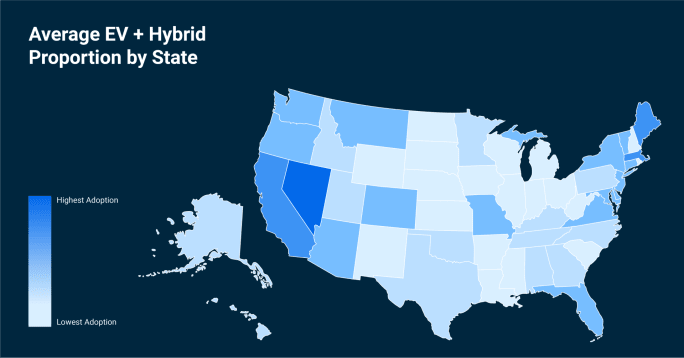
Nevada and California are the top states for EV and hybrid
adoption, according to data.
Photo: Samsara
Government and Nonprofit Take the Top spot for Industry Adoption
Within Samsara’s customer base, the industry with the highest proportion of EVs in their fleets is government and nonprofit — which includes organizations such as municipalities and charities that make deliveries — followed by utilities and consumer products. manufacturing and passenger ''transit round out the top five.
Government & Nonprofit
Utilities
Consumer Products
Manufacturing
Passenger Transit
Why these industries in particular?
Clear policies and incentives were indicators for significant EV adoption among governments and nonprofits. Well-developed programs and goals for sustainability, technology investments, and public health among other initiatives that strongly align with the benefits of EVs could point toward more rapid electrifcation.
In addition, some governments have implemented regulations or incentives to promote EV adoption, such as zero-emission vehicle mandates or tax incentives for EV purchases. Government agencies may be required to comply with these regulations or may benefit from associated incentives, further driving EV adoption.
Moreover, the data showed that EV adoption is much higher for organizations that drive fewer total miles, a factor that many of these industries may have in common. For example, municipal vehicles may only need to drive within city limits to serve constituents, or an electric utility provider may only need to drive within a defined area to maintain its services. These organizations may also operate in locations with more charging stations and better EV infrastructure.
Stories behind the data: The City of Boston
The city of Boston has a goal to fully electrify its fleet by the year 2030, and has made a sizable investment in EVs to support the transition. As a start, the city purchased eight fully-electric light-duty vehicles and 14 plug-in hybrids to include in their municipal vehicle-sharing program. In addition, the city’s code enforcement team uses the EVs to inspect snow and trash removal, as well as city code compliance.
These EV investments, combined with Samsara technology, have helped the city to
eliminate 513K pounds of CO2 emissions and save an estimated $86K in fuel spend across 18 vehicles.
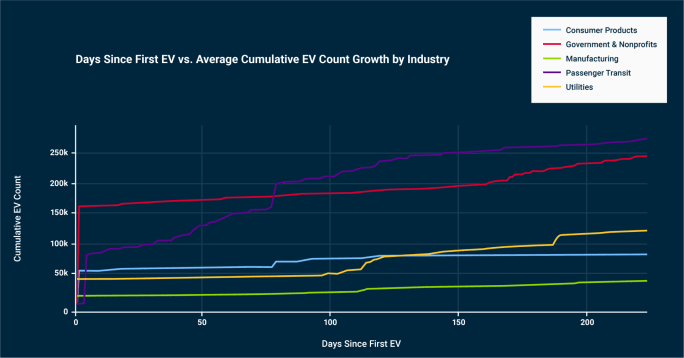
In sectors like passenger transit, federal regulators have recently focused on incentivizing the increased adoption of EVs.
Photo: Samsara
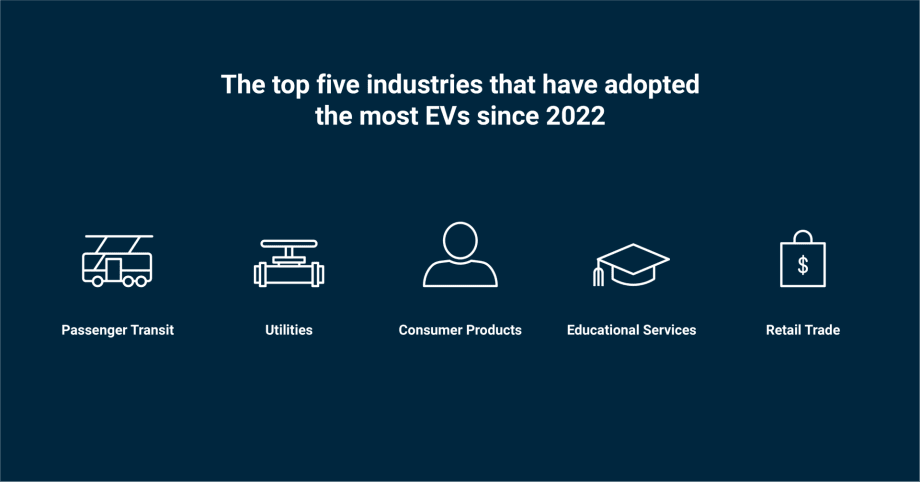
Which Industries Have Adopted the Most EVs Since 2022?
This more recent list is somewhat different, with passenger transit jumping to the top spot and educational services moving onto the list.
Passenger Transit
Utilities
Consumer Products
Educational Services
Retail Trade
One factor that could be seen as contributing to a recent boost EV adoption is the U.S. government’s recent investment in transportation and infrastructure. In sectors like passenger transit, federal regulators have recently focused on incentivizing the increased adoption of EVs.
For example, under the Inflation Reduction Act, businesses and tax-exempt organizations that buy qualified commercial clean vehicles could qualify for a clean vehicle tax credit of up to $40,000 (for vehicles larger than 14,000 pounds).
In addition, the Infrastructure Investment and Jobs Act, signed into law in 2022, set forth funding for EV-related grants, such as the EPA's Clean School Bus Program, a potential catalyst to drive EV adoption in the Education Services sector.
States That Have the Most EVs and Hybrid Vehicles
According to Samsara data, the top five states are Nevada, California, Massachusetts,
Maine, and Arizona.
Each one of these states has multiple public and private incentives aimed at driving EV adoption, with varying refunds, grants, and exemptions. For example, Nevada and Massachusetts both offer grants to mitigate diesel emissions, while California and Maine offer rebates to businesses that purchase EVs. Arizona offers businesses rebates for the purchase or lease of electric forklifts, truck charging bays, and other electrification projects.
The number and variety of electrification incentives indicate that federal, state, and local governments could be a force behind sustainability initiatives. However, the number of incentives does not appear to dictate the volume of EVs on a state's roads today. For example, Nevada has far fewer incentives than California—six versus 92, respectively—but Nevada still ranks first in our list of states with the most EVs.