




What do you do when it’s time to electrify a 950-vehicle fleet on a campus that can see up to 82,000 people on it on any given weekday? This was exactly the issue the University of California, Los Angeles, faced to meet the requirements of the University of California system and its policies to decarbonize the institution in addition to the state’s requirements.
“We're looking at all different opportunities to be able to meet that goal,” said Clinton Bench, director of UCLA Fleet and Transit in UCLA Transportation.
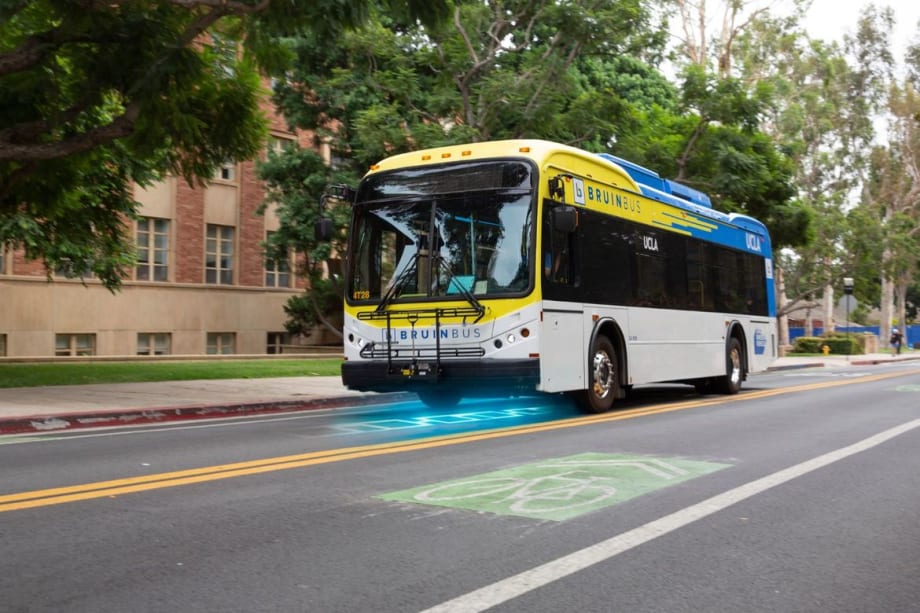
One opportunity to make this happen came in the form of funding from the California State Transportation Agency’s Transit and Intercity Rail Capital Program. The $19.85 million grant received in collaboration with CALSTART and wireless charging provider Electreon will enable UCLA’s BruinBus fleet to transition to 100% electric and expand service. The grant will also fund California’s first in-road electric charging system.
The city will add eight all-electric buses to UCLA’s current fleet, which currently includes seven all-electric buses and three all-electric paratransit vans.
In addition, funds will be used to build a new transit hub between the UCLA bus depot and the UCLA/Westwood station now under construction. This hub, set to open in 2028, will connect local and commuter bus services directly to L.A. Metro’s D-Line heavy rail subway extension. The extension will bring riders to the southern edge of the UCLA campus and be the first-ever direct rail connection from downtown Los Angeles to Beverly Hills, Century City and Westwood.
Looking at Charging from a Different Angle
The UCLA fleet has been monitoring inductive charging (wireless charging), and how it could affect future operations, leading to the pilot that will be funded by the grant.
“One big piece is that it allows us to reduce the battery size that we need to spec into our buses because it gives us opportunity charging over the course of the day,” Bench said. “That means we have less of a need for in-depot, overnight charging.”
Bench explained that, in addition to smaller batteries, there would also be an opportunity to install less infrastructure in the depot. Wireless charging will help the fleet out during the day at layover locations for the static chargers.
In addition to the static wireless chargers, the fleet will test out dynamic chargers, which would be installed below the road and be able to charge the buses while they are in motion.
And how will the fleet plan for the additional electrical capacity? It’s a challenge that’s already making for some interesting conversations, according to Bench.
“There’s going to need to be sufficient energy delivery capacity from either our on-campus power generation plant or from the Los Angeles Department of Water and Power,” he explained. “Happily, LADWP does have sufficient grid capacity in the region.”
So, the question for fleets, especially large institutional fleets, is how to ensure that the infrastructure necessary to serve them is present where they plan to install these inductive chargers and feed power from the grid.
“We did our best to try and identify parts of campus where we feel confident that we can make that work,” Bench said. “But as we move forward, that's going to be one of the challenges in this pilot.”
UCLA must ensure that the vendor chosen can collaborate with Electreon, which will supply the inductive charging technology.
Photo: Government Fleet
Discussions with other fleets led to solution suggestions such as putting chargers in depots but also understanding that if fleets can't draw enough power from utilities or don’t have the right equipment, for example transformers and switchgear, that a major investment will need to be made up front.
And this planning has to be done knowing that equipment can take time to be delivered, which can cause backlog.
“We're excited about being able to demonstrate this technology, and we have developed an aggressive timeline,” said Bench. “Of course, we'll run across some barriers, but that'll be part of the learning process for our industry."
Strategic Planning for 2025 and Beyond
With plans to finalize this electrification initiative in time for the 2028 Olympic and Paralympic Games, the first step of the process is ordering the buses. However, due to the time it takes North American manufacturers to build buses, Bench doesn’t expect to have the vehicles on property for at least 18 months.
UCLA must ensure that the vendor chosen can collaborate with Electreon, which will supply the inductive charging technology as part of the grant.
The permitting process also needs to be finalized. Because of the new technology, everyone from the fire marshal to the electrical engineers and the capital programs unit will need to learn about the new technology and understand the risk factors in order to develop a template for swift future acceptance and permitting of this type of installation.
“Making sure that we engage and consult with those folks who are going to be handling permitting is very important,” Bench said. “It's not just going to be a demonstration of technology, it's going to be a demonstration of a process of implementation and laying out a set of best practices and what we learned.”
Components to Go from Acquisition to Implementation
Bench advised that fleets planning vehicle electrification should go beyond acquiring vehicles and have the necessary analytical capacity within the organization to develop a plan for EV implementation.
“That means partnerships with your local utilities and, if you're going to be owning EV infrastructure, having a relationship with charging management providers,” Bench said. “Being able to use load management technology is important, and that goes for inductive charging as well. In other words, have a plan.”
Bench added that fleets should not immediately purchase electric vehicles and expect the commercial marketplace to provide the necessary charging in the surrounding area.
“Most fleets are going to need to decide on a purpose-built solution for themselves,” he said.
This could mean working with a major charging manufacturer or provider and relying on them to provide the capital or finding creative financing mechanisms for the chargers. It might require an institution to buy and manage the chargers themselves.
“You have to have that plan in place and likely have some chargers that are dedicated to your operation,” Bench explained. “You can’t just say ‘there are commercial chargers nearby, we can just rely on those. That's not a viable solution for a fleet.”

Drivers will receive training on battery-electric buses, which will focus on maximizing the benefits of regenerative braking and avoiding harsh acceleration that drains the battery too much.
Photo: Government Fleet
Implementing Training for Electrification
As a large university, UCLA has extensive in-house capacity, including a design and project management unit. A capital program unit can also provide construction expertise.
“They will apply their own protocols for training and learning about this new technology to be able to support us in the future,” Bench said.
Drivers will also receive training on battery-electric buses, which will focus on maximizing the benefits of regenerative braking and avoiding harsh acceleration that drains the battery too much. Excessive or harsh braking can reduce the efficiency of regenerative braking, limiting the energy recovered and sent back to the battery. Finally, drivers will need to understand opportunities for opportunity charging.
“For instance, if you have 12 minutes of recovery time between trips and you’re near a transfer station with an available charging berth, you might head there for a quick charge,” Bench said adding that similarly, if there’s charging at the layover location at the start of a route, that could be another option. “It’s all about ensuring operators know where these opportunities are and using them effectively.”
Operators will also need training on the nuances of wireless charging, including precise vehicle alignment over charging pads. While these systems are more forgiving than a phone on a charging pad, proper alignment remains critical to maximize efficiency. Similarly, for dynamic in-road charging, drivers must stay in designated lanes during charging stretches.
“At first, we won’t have the entire one-mile stretch equipped with these charging pads,” Bench noted. “So, drivers will need to understand exactly where charging is available and adapt accordingly.”
Measuring Success Through Data
As with any pilot program, evaluating success will require robust data collection and analysis. UCLA’s charger management system will play a pivotal role in tracking power delivery from both static and inductive chargers. The system will also provide insights into how much battery capacity is saved and the associated cost reductions over the vehicles’ lifecycles.
“Each charger will interact with vehicles through near-field communication or wireless protocols to track power utilization, costs, and savings,” Bench explained. “This data will inform our future procurement decisions and help us refine the life cycle cost analysis for these technologies.”
The data generated will support UCLA’s fleet operations and provide valuable research opportunities. The university’s engineering and planning units will use the findings to explore further applications of inductive charging technology, contributing to the broader adoption of clean transportation solutions.
Community and Regional Benefits
Beyond operational efficiency, the electrification project aims to improve the transportation experience for the entire UCLA community. With new buses offering enhanced reliability, comfort, and connectivity, students, faculty, staff, and visitors will benefit from more seamless commutes.
The new subway line connecting downtown L.A. to Westwood in just 25 minutes is a bonus. It also connects directly to Union Station, providing the community with access to commuter railroads throughout the region. This integration is expected to make daily commutes more convenient while reducing congestion.
UCLA also envisions the project as a catalyst for the broader regional adoption of inductive charging. Seven transit agencies serve the campus, and there is potential for them to implement similar technologies on their fleets.
Bench said they hope these efforts will encourage other operators to explore inductive charging, not just for buses but potentially for light-duty vehicles as well. While the immediate benefits for the community are clear, there is excitement about the long-term possibilities.
“The reliability of brand-new buses is something that's really going to be reassuring for all of us, that comes with the ability now to be able to provide better connectivity from the new subway line that will be coming to campus,” Bench said. “There are going to be a lot of great opportunities and we're excited about being able to provide a higher level of service to our students, faculty, and staff, who are using our buses every day to get to and from classes and do their jobs.”