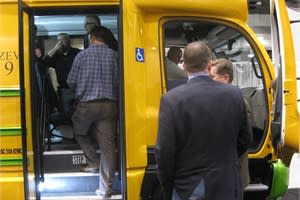
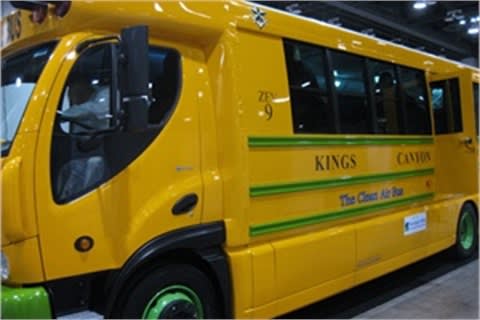
CINCINNATI — Industry professionals got their first in-person look at Trans Tech Bus’ all-electric school bus, the eTrans, during a special event at the National Association for Pupil Transportation (NAPT) Summit.
The Type A bus is built on a Smith Electric Vehicles zero-emissions Newton chassis. The bus features a 120-kW electric induction motor that is powered by two 278-volt lithium-ion batteries. A regenerative braking system helps to recharge the vehicle's batteries when it is in operation. A small auxiliary power unit fueled by compressed natural gas (CNG) or propane powers the bus' heating and air conditioning systems.
Users will be able to travel approximately 100 to 120 miles on a charge, depending on the load and driving conditions, and the bus can reach speeds of up to 60 mph.
During the unveiling, officials revealed that Kings Canyon Unified School District in Reedley, Calif., will receive the first eTrans unit.
John Clements, director of transportation for the school district, attended the event. He told School Bus Fleet magazine (another publication at Bobit Business Media, parent company of Government Fleet magazine) in an interview that he’s excited that his district was chosen as the flagship operation to try out the bus.
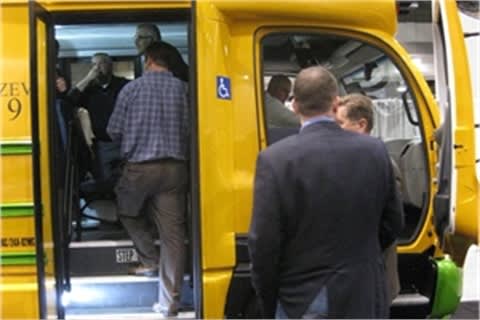
Clements is a longtime advocate for using alternative fuels to power school buses (his fleet contains CNG-powered buses, and he is slated to receive several hybrid buses). He said that last year, he met with the staff from Trans Tech dealer Creative Bus Sales and posed this question: What if we could marry the Smith Electric Vehicles chassis to someone’s bus body?
“I had driven a smaller Smith electric product at a clean air event at the San Joaquin Air Pollution Control District several years prior and had been tracking their website,” Clements explained. “Creative Bus Sales contacted me in March, and I met with the Smith folks and the Trans Tech folks and had a discussion with them [about the eTrans bus].”
Clements said this led to his operation being the first to receive the eTrans. Although he has yet to drive the bus, he expects it to run quietly and emit “virtually zero emissions.”
Moreover, he said he is looking forward to the fact that it does not require a petroleum-based fuel to operate, and in keeping with his goal to run buses with the lowest emissions possible, he has requested the auxiliary power unit fueled by CNG.
The bus will primarily be used to transport special-needs students on a home-to-school route, so it will be equipped with some integrated child safety seats and accommodations for several wheelchairs.
“I anticipate that the bus is going to go roughly 50 to 55 miles a day initially based on the route that it’s scheduled for, but I can also see it being used for small activity trips that are 25 or 30 miles in one direction,” Clements said. “The home-to-school route that it’s going to run on will be a 10-mile stretch to get from our facility to a neighboring community that’s within my district, and then it’s going to do door-to-door pickups within a community that’s about two miles across.”
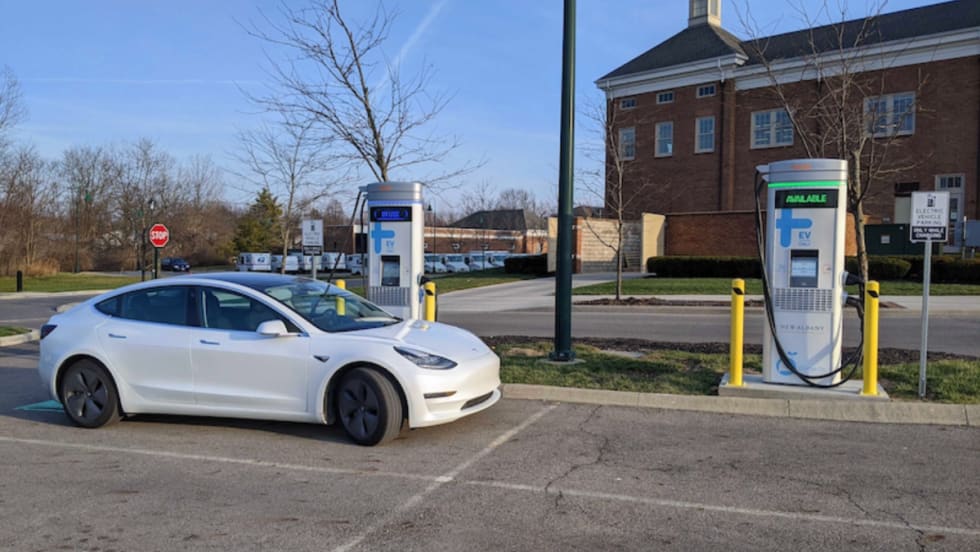
Clements already has an assigned space for the bus at his facility, and he said that the school district and the city of Reedley are set to receive $180,000 for electrical charging infrastructure through the California Energy Commission’s 2011 investment plan.
“The timing for this bus is great. The city of Reedley is the only community working with Kings Canyon Unified to receive electrical infrastructure dollars in the entire central valley of California,” Clements said.
He added that he is grateful to the staff at the San Joaquin Valley Air Pollution Control District, who worked with him to use one of his old, heavily-polluting school buses to qualify for money from the California Air Resources Board’s (CARB) Lower Emissions School Bus Program and other CARB initiatives to put toward funding for the eTrans school bus.
“Together, we are working closely with CARB staff in Sacramento and Creative Bus Sales in Chino, Calif., to qualify this school bus for Assembly Bill 118 Hybrid Truck and Bus Voucher Incentive Project funds and San Joaquin Valley Air Pollution Control District hybrid-electric voucher funds,” Clements said.
Article courtesy School Bus Fleet magazine