



Red Government Fleet with star logo
MenuMENU
SearchSEARCH

Study: Comprehensive Alt-Fuel Approach Better Than Single Technology Focus

Analysis of Texas and California transportation subsidy programs reveals an electric-only focus fails.

October 27, 2020
Study: Comprehensive Alt-Fuel Approach Better Than Single Technology Focus


3 min to read


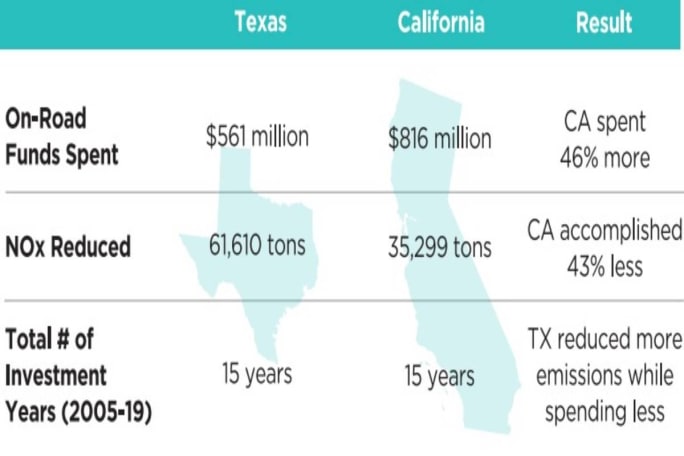
California regulators spent 46% more public money while accomplishing 43% less than Texas.

Photo: NGVAmerica

At its NGV20 Annual Industry Summit last week, NGVAmerica released the results of a multi-month study of public transportation subsidy programs in the States of Texas and California.

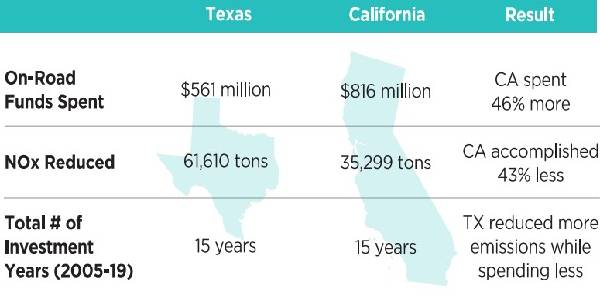
Over a fifteen-year time period from 2005 to 2019, the State of Texas spent $561 million in public resources to assist in the transition to cleaner vehicle technologies. During the same time period, the State of California spent $816 million, or 46% more. However, in terms of reducing harmful criteria pollutants to improve air quality, California achieved only a 35,229-ton reduction in NOx emissions despite its increased investment while Texas tallied reductions of 61,610 tons of NOx. Effectively, California regulators spent 46% more public money while accomplishing 43% less than Texas.

“This analysis presents a stark reality for state and federal policymakers to consider,” said NGVAmerica President Dan Gage. “Compared to California’s ZEV-only focus, the Texas approach results in less money spent, deploys more clean heavy-duty trucks and buses on the road, and achieves greater emissions reductions. The public is best served if state and federal regulators concentrate less on imposing single technology purchases and more on establishing realistic emissions reduction goals while allowing fleets the flexibility to choose the powertrain technology that best meets their needs.”

In completing its analysis, NGVAmerica collected data from the Texas Commission on Environmental Quality (TXCEQ) and the California Air Resources Board (CARB) and California Energy Commission (CEC). California focused its funding on medium- and heavy-duty battery electric vehicle test projects. In contrast, Texas focused on replacing older, dirtier medium- and heavy-duty diesel trucks with newer, cleaner, CNG, LNG, LPG diesel, and diesel hybrid alternatives. Overall, Texas spent 31% less money on more heavy-duty vehicles and reduced 75% more harmful NOx emissions than California.

Since 2000, Texas has reduced its NOx emissions by 69% while its total population has increased by 35%. Meanwhile, from 2006 to 2013, California reported annual NOx emissions of 160,000 tons per year. Since that time – and despite its increased Zero Emission Vehicle (ZEV)-focused investment – California’s annual emissions have increased to about 175,000 tons per year.

Texas continues its clean air achievement by supporting vehicle choice and an “all of the above” approach to alternative fuel vehicle technologies. As Texas begins to add renewable natural gas (RNG) to its natural gas vehicle investments, Texas is creating actual carbon-free fleet solutions today.

While supportive of increased RNG production capacity, California is moving to limit the best use of this captured biomethane – as a transportation fuel – by supporting only ZEV purchases that require massive amounts of public funding to subsidize.

NGVs fueled with RNG are the most immediate and cost-effective carbon-free transportation solution available now. According to CARB’s own data, RNG holds the lowest carbon intensity of any on-road vehicle fuel, including fully renewable electric.

“Now more than ever, communities need affordable, available, and easily scalable clean transportation solutions that address pollution while ensuring that public funding is put to its best use,” added Gage. “Natural gas vehicles fueled by RNG is the best carbon-free, zero now solution.”

More Green Fleet

SponsoredFebruary 6, 2026

Hybrids: Electrification Without the Challenges

Hybrids bridge the gap between ICE vehicles and EVs, making them a smart choice for fleets that want to reduce emissions but aren’t ready to fully electrify. Hybrids, which are powered by internal combustion engines and electric motors, capture the benefits of electric power without the barriers many organizations find challenging.

Read More →
Green Fleetby Bob StantonJanuary 21, 2026

Flavor of the Decade: What if BEVs Aren’t the Answer?

A look at the present state of play in the EV market, plus a 2027 heavy truck emissions update.

Read More →
Ad Loading...
SponsoredJanuary 19, 2026

3 New Ways Fleet Software Pays: ROI opportunities for modern fleet managers

Public fleets face constant pressure to do more with limited budgets. This eBook outlines how modern fleet software helps agencies extend asset life, reduce unplanned downtime, and improve safety by automating maintenance, using smarter video insights, and unifying fleet data. A practical look at how technology can drive measurable ROI for taxpayers.

Read More →
Off-grid Beam Global EV ARC charging systems installed at the City of Fresno Municipal Service Center Yard, featuring solar canopies and EV chargers used by the city’s electric vehicle fleet.
Green Fleetby News/Media ReleaseJanuary 12, 2026

City of Fresno Deploys Beam Global EV ARC Off-Grid EV Charging Systems to Support Municipal Fleet Electrification

The City of Fresno deployed off-grid EV charging systems to support municipal fleet electrification without relying on utility grid connections.

Read More →
Green Fleetby Staff WriterDecember 8, 2025

City of Quincy Partners with Cero Global to Launch Pilot to Reduce Emissions, Fuel Costs

The pilot will use Cero Global’s technology on city-owned vehicles to evaluate its impact on emissions and fuel consumption, as well as potential savings in municipal operating costs.

Read More →
Ad Loading...
SponsoredDecember 5, 2025

The Road to Smarter Electric Van Transitions: A practical roadmap for integrating electric vans into your fleet

Electric vans are becoming a strategic tool, not just a sustainability move. Get a roadmap that breaks down costs, charging planning, upfit compatibility, and what fleets should evaluate before making the switch.

Read More →
Small blue car with a green leaf and an electric plug.
Green Fleetby Staff WriterDecember 1, 2025

New Mexico Signs Agreement Advancing Electrification and Grid Resilience Efforts

The City of Socorro signs a new agreement to accelerate electrification and infrastructure development.

Read More →
UGI Energy Services logo over an image of a CNG trash compactor truck, representing Philadelphia’s move to fuel refuse vehicles with renewable natural gas.
Green Fleetby News/Media ReleaseDecember 1, 2025

UGI Energy Services and The City of Philadelphia Announce Biofuel Agreement

Philadelphia is shifting its trash collection fleet toward cleaner operations with a new partnership that will power 35 CNG compactors using renewable natural gas sourced from regional landfills.

Read More →
Ad Loading...
An electric vehicle charges at a public EV charging station outside a municipal building.
Green Fleetby News/Media ReleaseNovember 17, 2025

Sourcewell Awards ChargePoint New EV Charging Contract

ChargePoint secures a new Sourcewell contract to expand access to EV charging for public agencies across the U.S. and Canada.

Read More →