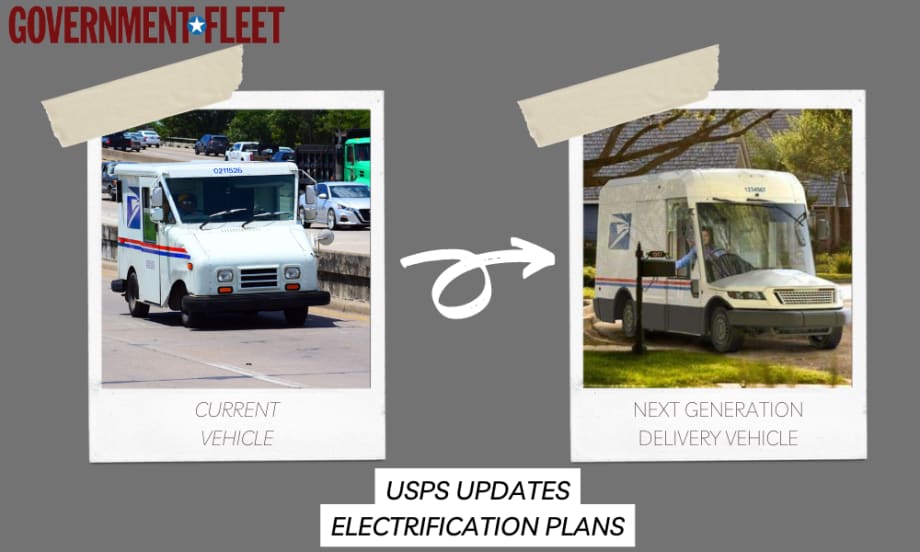
The United States Postal Service (USPS) announced it expects to acquire at least 66,000 battery-electric vehicles (BEVs) to be used for deliveries as part of its 106,000-vehicle acquisition plan for deliveries between now and 2028. The vehicles purchased as part of the anticipated plan will begin to replace the Postal Service’s aging delivery fleet of more than 220,000 vehicles. The USPS operates the nation's largest fleet. It intends to be one of the largest electric vehicle (EV) fleets in the nation by 2028.
The announcement comes about a month after a group of U.S. lawmakers penned a letter to the Postal Service, calling for it to ramp up its efforts to electrify the nation's mail delivery fleet.
ICE Delivery Vehicles Still in the Mix
In its updated plan, the USPS anticipates increasing the quantity of next-generation delivery vehicles (NGDVs), built by Oshkosh Defense, to a minimum of 60,000, with at least 45,000 of them being battery-electric by 2028. However, the Postal Service also intends to purchase more internal combustion engine (ICE) delivery vehicles, which it deemed "necessary to meet immediate vehicle replacement needs," according to a press release. The plan also includes a total of 21,000 additional battery-electric commercial off-the-shelf (COTS) vehicles, depending on market availability and operational feasability.
NGDV acquisitions delivered in 2026 or later are expected to be entirely electric.
The Postal Service has faced criticism since initially announcing its purchase plan, with legislators and advocacy groups saying it did not include enough BEVs in the plan. Earlier this year, the USPS announced its plan to acquire up to 165,000 NGDVs over a 10-year period, with at least 10% of them being battery electric vehicles (BEVs) and the rest being internal combustion engine (ICE) vehicles. The plan was meant to be flexible to allow the USPS to add more BEVs if funding became available. After facing pushback, the USPS then announced its initial purchase of 50,000 NGDVs from Oshkosh Defense, with 20% of them being BEVs.
In June, the USPS announced it was publishing a Notice of Intent to supplement its environmental impact statement (EIS) after accounting for expected changes following a recently announced plan to improve its delivery network. The following month, the USPS announced at least 50% of the initial 50,000 NGDVs it purchased will be BEVs.
This updated purchase plan was enabled by the USPS' network modernization efforts, which allows for a more rapid deployment of EVs, as well as more funding which includes $3 billion in congressional funding appropriated under the Inflation Reduction Act (IRA).
The Postal Service will continue to evaluate and procure vehicles over shorter time periods to, "be more responsive to its evolving operational strategy, technology improvements, and changing market conditions, including the expected increased availability of BEV options in the future," the press release continued.
Last December, President Joe Biden issued an executive order asking the U.S. government to buy only EVs for the federal fleet by 2035. While the USPS was exempt from the order, a spokesperson has previously told Government Fleet that the Postal Service hopes to follow the same precedent.
Funding Issues Still at the Forefront
Despite the additional Congressional funding, the Postal Service still points to funding as its reason for not expanding on the amount of BEVs in the mix. The agency generally receives no tax dollars for operating expenses and relies on the sale of postage, products, and services to fund its operations.
A Postal Service representative further explained that as the agency has continually assessed its capacity, financial position, and vehicle mix within the last year, it has been able to expand its procurement of EVs due to the network modernization initiative, as well as the additional Congressional funding. The representative went on to explain that the Postal Service will continue to explore the feasibility of achieving 100% electrification for its delivery vehicle fleet.
“We have a statutory requirement to deliver mail and packages to 163 million addresses six days per week and to cover our costs in doing so – that is our mission. As I have said in the past, if we can achieve those objectives in a more environmentally responsible way, we will do so," Postmaster General Louis DeJoy said.
The Congressional funding, "has significantly reduced the risk associated with accelerating the implementation of a nationwide infrastructure necessary to electrify our delivery fleet," DeJoy explained. "While most of the electric vehicle funding will continue to come from Postal Service revenues, we are grateful for the confidence that Congress and the Administration have placed in us to build and acquire what has the potential to become the largest electric vehicle fleet in the nation.”
Enhancements in the New Vehicles
Unlike the vehicles they are replacing, the NGDVs will feature air conditioning and advanced safety technology, and are more suited to modern day operational requirements, according to the USPS.
The new vehicles are expected to start servicing postal routes in late 2023.