Virginia County Moves Forward with ZEV Fleet Plans
Loudoun County conducted a study on transitioning to zero-emissions vehicles alongside a study on electric vehicle charger installation at county facilities.
Loudoun County is moving forward with its zero-emissions fleet transition plan, which starts with the transition of county administrative vehicles that travel about 100 miles or less on a daily basis.
Photo: Canva/Loudoun County/Government Fleet
5 min to read
The Loudoun County, Virginia, Board of Supervisors’ finance committee moved forward with plans to install electric vehicle (EV) charging stations at county facilities, as well as begin the transition of part of the county’s fleet to zero-emissions vehicles (ZEVs). According to Loudon Now, the committee approved votes on the charging station plan, as well as the ZEV transition plan, at its September 13 meeting.
The committee reworked its plan for charging station installation to prioritize installing them first at public facilities like libraries, community centers, and park-and-rides, sending that plan to the full board for approval. The plan previously emphasized facilities mainly trafficked by government employees, until supervisors asked county staff to prioritize publicly utilized facilities.
Setting the ZEV Adoption Plan into Motion
The county’s Department of General Services (DGS) contracted with Mercury Associates to develop a ZEV Fleet Feasibility Plan. Mercury has performed the county’s fleet replacement plan review since 2013 and compressed natural gas (CNG) conversion studies since 2016. Additionally, it has developed ZEV conversion strategies for private and public entities across the country.
The ZEV feasibility plan focused on what it considered the most viable segment of the county fleet: the administrative vehicles – sedans and small SUVs. In coordination with the Department of Transportation and Capital Infrastructure Electric Vehicle infrastructure study, the administrative fleet was identified as a high priority for eventual replacement with EVs based on the use of those types of vehicles, as well as the vehicle options currently on the market.
Out of the 1,551 vehicles in the county fleet, 814 are considered small vehicles. Of those small vehicles, 330 are associated with the sheriff’s office and would not be a high priority, due to special requirements of pursuit-rated vehicles, leaving a total of 484 fleet vehicles. Of the 484 remaining non-pursuit-rated vehicles, 128 did not have data to ensure no operational impact if switched to ZEVs. The remaining 356 vehicles were identified as having high potential for replacement with EVs. Those identified vehicles to be initially considered for replacement with EVs do not require special configuration for public safety or other operational demands that might be negatively impacted by the conversion. As technology advances, other vehicle types will be evaluated and included in the plan.
ZEV Transition: Budgetary Impact
The ZEV feasibility plan shows a cumulative gross cost increase of $6,800,000 during the first 10 years of implementation to replace the identified conventional fuel vehicles (CFV). The 20-year gross replacement cost is $21,900,000 for an approximate annual cost $1,100,000.
Phasing in ZEVs
The Mercury feasibility plan recommends the first phase of 123 electric vehicles being purchased in 2026. Subsequent EVs will be purchased incrementally until 2033 for a total of 356 administrative vehicles. New vehicles purchased as part of new positions being added to the county work force were not considered directly as part of the feasibility plan, because they are not purchased from the replacement plan. New purchases would be prioritized for ZEV, subject to operational compatibility.
Due to the high demand of EVs, supply availability could be limited. The phased approach allows for the vehicle replacement purchases to be in sync with the existing replacement plan and allow for sufficient infrastructure to be in place to charge the ZEVs. Additionally, due to the expected demand for ZEVs, this will ensure adequate time to identify and purchase the vehicles in a timely and systematic manner.
The annual amount of fuel consumption for the administrative vehicles in the study was 103,743 gallons. Calculated at the current contracted price of unleaded fuel of $3.73 per gallon, the annual cost is $386,961. The 356 vehicles identified for the ZEV conversion collectively traveled 2,142,256 miles over the last operational year. The average EV requires 30 kilowatt-hours to travel 100 miles. Based upon Dominion power cost of .13 cent per kwh, the cost to charge the administrative vehicles would be $83,547. That equates to a net savings of $303,414 in fuel costs for the first year. That would equate to a savings of $6,100,000 over the 20-year period.
The administrative CFV annual maintenance and repair cost is $236,438. The administrative ZEV estimated maintenance and repair cost is $186,481, for a savings of $49,957 annually in maintenance and repair costs. That would equate to a savings of approximately $1,000,000 over the 20-year period.
Up-Front Costs Considered
Based on the Mercury plan, the transition for the identified administrative vehicles will require an estimated $21,900,000 to offset the costs of replacing CFV with electric vehicles over 20-year period, beginning in fiscal year 2026. However, if the fuel and maintenance cost savings are applied against the average annual $1,100,000 replacement cost increase, the annual replacement cost increase is reduced to approximately $750,000 and the cost over the 20-year period is reduced to $15,000,000.
Choosing the Right Vehicle
Mercury Associates worked alongside Loudoun County to find the appropriate ZEV replacement for administrative vehicles, landing on the Hyundai Ioniq 5 AWD, pictured here.
Photo: Hyundai
Mercury worked with the county to choose an appropriate ZEV candidate, ending up with the Hyundai Ioniq 5 AWD. It checked the daily miles driven by the administrative vehicles, comparing it to half of the Ioniq's range: 256 miles total, 50% = 125 miles. All administrative assets were eligible, with all but two of them driving under 100 miles daily. The highest mileage on the administrative vehicles was 103 miles.
Ultimately, the finance committee approved the ZEV plan, but agreed to keep it in committee to allow for revisions to possibly include hybrid vehicles or other low-emissions vehicles in the mix.
EV Charging for Loudoun County
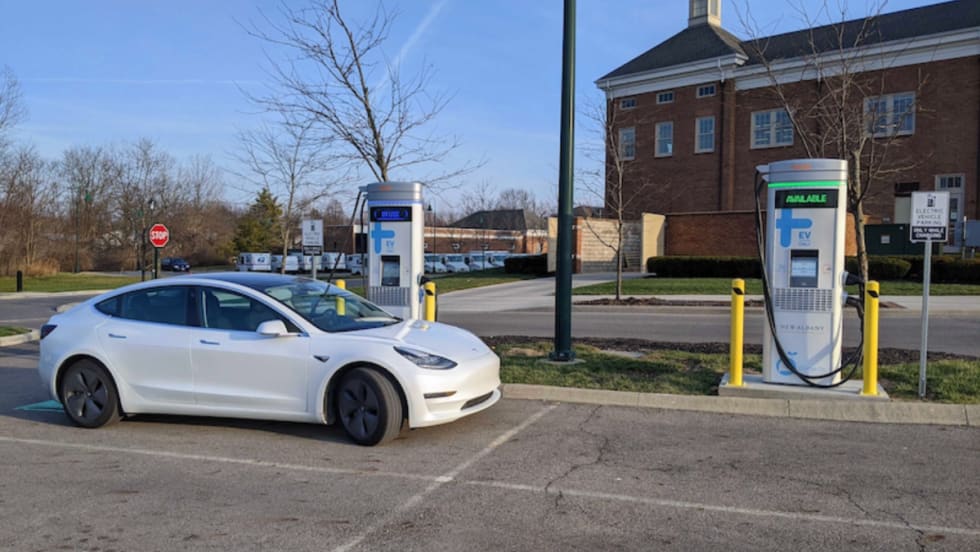
The county plans to install Level 2 chargers. Worrest told Loudon Now most of the chosen facilities that will house the chargers could not currently support the heavier electrical load of rapid chargers.
The plan would bring chargers to county facilities in three phases. The first phase would include 85 charging stations with two heads each.
Facilities that are primary parking locations for county fleet vehicles will be considered in the second phase of charger installation, which will be completed before the arrival of the first batch of EVs in 2026.
Editor's Note: Government Fleet reached out to the Board of Supervisors for independent confirmation of the votes, and did not hear back. This story will be updated once we receive further confirmation.
Hybrids bridge the gap between ICE vehicles and EVs, making them a smart choice for fleets that want to reduce emissions but aren’t ready to fully electrify. Hybrids, which are powered by internal combustion engines and electric motors, capture the benefits of electric power without the barriers many organizations find challenging.
Public fleets face constant pressure to do more with limited budgets. This eBook outlines how modern fleet software helps agencies extend asset life, reduce unplanned downtime, and improve safety by automating maintenance, using smarter video insights, and unifying fleet data. A practical look at how technology can drive measurable ROI for taxpayers.
The pilot will use Cero Global’s technology on city-owned vehicles to evaluate its impact on emissions and fuel consumption, as well as potential savings in municipal operating costs.
Electric vans are becoming a strategic tool, not just a sustainability move. Get a roadmap that breaks down costs, charging planning, upfit compatibility, and what fleets should evaluate before making the switch.
Philadelphia is shifting its trash collection fleet toward cleaner operations with a new partnership that will power 35 CNG compactors using renewable natural gas sourced from regional landfills.