




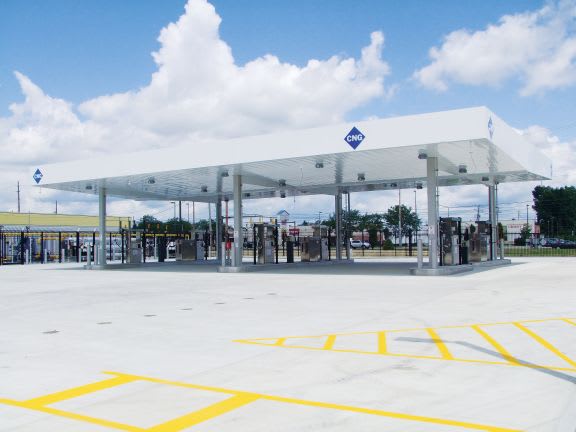
Taking the right steps when embarking on a CNG fleet project can lead to success and a return on investment. The site pictured here shows a well-designed fueling station.
The use of compressed natural gas (CNG) is becoming more common, and many government fleets are choosing to switch to this alternative fuel for their vehicles and build fueling stations. While CNG can be a great alternative fuel, it’s also an expensive investment that needs to be implemented correctly.
This is a true story about a city that made just about every mistake that can be made in its migration to CNG. This is a case study in what not to do when planning the adoption of CNG.
In 2007, this city’s solid waste director decided to implement CNG by acquiring CNG-powered replacement trucks for household refuse collection. He ordered 30 CNG trucks and contracted for the construction of a CNG fuel station. The 30 trucks represented 26% of the household collection fleet, so this migration to CNG was a significant financial and operational commitment, and risk.
1. Not Following Staff Recommendations
The city commission was called on to approve a CNG fuel site contractor. Instead of accepting the contractor recommended by staff, the elected officials chose an alternative supplier that staff hadn’t recommended, a decision that had critical future implications.
2. Not Relying on Someone Experienced with CNG
Before the new CNG trucks were delivered, the initiator and champion of the CNG project, the solid waste director, left the city. He left his replacement with the implementation of the new trucks and technology, a role for which the new director was unprepared, having no prior experience with CNG.
3. Not Thinking About Vehicle Maintenance
Beyond the actual vehicle order and the construction of a CNG fueling site, no further preparations were made. Fleet technicians did not receive training in the repair and maintenance of CNG-powered trucks. Consequently, the solid waste department instead entrusted the care and maintenance of 26% of its household collection fleet to local contract vendors that had few resources and/or available personnel trained and certified to repair CNG powertrains. Further, no safeguards or other alterations were considered for the fleet garage at which all 30 units would be based and maintained.
Not having knowledgeable technicians on staff to perform repairs led to much higher downtime. The refuse application is extremely difficult on equipment. As the CNG trucks aged, breakdown frequency and subsequent downtime increased. The CNG trucks languished at a local contract vendor, sometimes for weeks at a time. The city failed to manage the vendor contract, and its own cumbersome contract requirements prevented sourcing locally available alternatives. Daily unit availability deteriorated, often reaching double digits, resulting in the shifting of trucks from other locations, crews running double routes, and delayed service to citizens.
4. Not Ensuring Continued System Operation
Although the contract called for system redundancy at the fuel site, the city also didn’t manage this contract and that feature wasn’t included in the installation. As a motor fuel, CNG is created through the compression of natural gas from 40 to 3600 psi. The compressor the city used is a large machine with an internal combustion engine used for the compression process. The compressor and fuel delivery system requires regular and routine maintenance, which is expensive and prone to maintenance-related downtime. To ensure an uninterrupted supply of CNG, systems like this require a secondary, redundant compressor system to allow for maintenance-related downtime or unexpected breakdowns of the primary compressor system. Unfortunately, the city failed to administer the contract in many areas, including holding the contractor accountable for ensuring the contractually obligated redundancy existed.
Not having a redundant compressor led to major problems. On Friday of Thanksgiving weekend, the compressor engine suffered a catastrophic and fatal failure. The city scrambled to locate an alternative CNG source. Fortunately, the city’s transit service had a small CNG dispensing facility and agreed to assist. Because the bus and refuse truck fuel inlets were different, staff members had to make the seven-hour round trip to secure the correct parts in order for the trucks to make the 16-mile trip to fuel at the transit site each day. It took one week for the contracted CNG fuel site vendor to install a new compressor.
A further recommended failsafe to ensure an uninterrupted fuel supply is the installation of a stand-by generator to ensure compressor operation during a utility power failure. The city’s solid waste department installed a 750Kw generator, but it failed to have automatic transfer capability. When utility power failed, either a contractor or city staff member was required to travel to the site and manually transfer the power.
5. Not Thinking About Fuel Contamination
The new CNG dispensing system wasn’t equipped with a filtration system to ensure the CNG supplied to the vehicle tanks was free of contamination. It was only after experiencing frequent vehicle breakdowns related to contaminated CNG that the purity of the CNG was tested and found to be contaminated with oil originating from the compressor cylinders. The city then added a robust filtration system.
6. Not Worrying About Tank Inspection
The city learned the state regulatory authority required tri-annual inspections of vehicles mounted CNG tanks. The city’s trucks had not been inspected for six years.
7. Not Expanding CNG Use
Although the city had invested considerably in the initial CNG vehicle purchases and the fueling system, that commitment wasn’t reinforced in succeeding years, as no additional CNG vehicles were added to the city’s fleet. Consequently, the initial trucks, in addition to their own high costs, also carried the capital and maintenance cost of infrastructure. After such a large CNG investment, additional CNG vehicles would have expanded the benefits of CNG and spread the infrastructure costs across a broader spectrum of vehicles.
8. Not Anticipating Higher CNG Vehicle Costs
The city’s CNG program continued in this stagnated and finite state for five years, at which time the “wheels” began to come off. Although the CNG trucks were considerably more expensive to purchase than their diesel counterparts, no allowance for the higher capital cost had been made in the depreciated lifecycles of the CNG units. Consequently, the residual values on the city’s CNG trucks exceeded that of their diesel counterparts by more than $50,000 per unit. The city’s trucks were both overvalued in a potentially non-existent market because there were no public CNG stations in the area. The closest public CNG station was 70 miles away.
9. Not Understanding the Reasons Behind the Problem
City management began questioning the city’s CNG future. In their view and not recognizing their own culpability, neither the trucks nor the dispensing systems were reliable. In spite of the lower fuel cost, the city’s total cost of CNG truck ownership was shown to be equal to or higher than comparable diesel units, a calculation forecast to worsen considerably when the CNG trucks were sold. Solid Waste, the department absorbing the brunt of these problems, was fed up with being the city’s CNG guinea pig and vowed never to purchase another CNG unit in spite of the obvious successes their counterparts in public and private refuse collection services elsewhere were having. The city’s CNG program was being condemned for all the wrong reasons.
Not recognizing its CNG challenges were self-inflicted, the city was at an impasse over investing further in this increasingly popular and environmentally friendly technology. A stronger commitment to CNG would mean adding more costly CNG vehicles and expanding the city’s infrastructure by adding a second expensive CNG dispensing facility, which had already proven costly and unreliable. The city wrestled with embracing a technology for which it had been ill prepared but couldn’t ignore the huge cost of its CNG investment thus far. That decision has yet to be made.
Learn from Others’ Successes & Mistakes
These are lessons anyone interested in adopting CNG should heed. Do your homework thoroughly; include all stakeholders in the discussions and decisions; study and learn from your peers who have traveled this road already; be overly diligent in your preparation; be a good steward of the funding by considering the present and future cost implications; reach out to and partner with vendors, regulatory agencies, and environmental interest groups whose resources and experiences are vital to success; and protect the investment through technical and safety training along with including requisite facility modifications.
The adoption of CNG has been successful throughout the country. Model the successes and learn from the failures.
Related: