
Around the beginning of each year, the President of the United States gives his annual "State of the Union" address to tell the country how we are doing. Likewise, companies and government agencies look at the past calendar or budget year to produce an annual report to tell those with a vested interest what significant financial and operational activities took place. Similarly, it makes sense for fleet managers to develop an annual "State of the Fleet" report to inform management and employees about what took place in the past 12 months that could impact the fleet organization's ability to operate effectively and efficiently in the future.
A shortcoming we often observe when conducting fleet operations reviews is that the fleet manager is too passive about "tooting his or her own horn." Many folks in this industry tend to be modest and hardworking - and far too hesitant about seeming to boast about their accomplishments. But this is an opportunity lost, and we need to get over such modesty and tell those who may impact our ability to fund our operation, and vehicle user groups who see only their part of the fleet picture, how and why we have done a good job. In addition, fleet employees deserve to see key operational metrics to better understand the challenges faced by fleet management that might impact their lives and their jobs. For example, less work might mean layoffs, and more work might mean overtime or increased outsourcing.
Showcasing Accomplishments
An annual State of the Fleet report is fleet's opportunity to showcase the organization's accomplishments and enhance its image as an important contributor to the overall success of the government agency or company. Rather than boasting, it represents sound and smart business communication, a chance to tell the "fleet story" and lay a foundation for a budget submission or strategic changes to the program, such as greater use of alternative fuels and how that will be implemented.
Writing the First Report
Once a fleet manager decides a State of the Fleet report is a good idea, how does he or she begin? Let's get right to the point with some suggestions.
First, decide who will view the report. Certainly the person to whom the fleet manager reports would be highly interested, but others up the management chain may also want to see it. Fleet employees will certainly want to see it, but will it become public information? If so, design it for those who may not understand fleet operations but need to know key facts. Keep in mind that those outside the fleet profession are often unaware of most aspects of fleet costs and activities because they don't understand the science of fleet management. Indeed, fleet management may have to explain the significance of the numbers it presents. The rule is this: Be aware of the audience, and don't assume they understand the meaning or significance of the fleet facts the report presents.
Next, create the overall plan for the report. Consider beginning with a brief narrative describing events and factors that affected the organization's performance during the past year. For example, did fuel costs rise unexpectedly? Did a severe winter drive up costs? Also describe factors that may affect future fleet operation performance, such as pending legislation or the introduction of GPS tracking systems.
Appearance counts, so strive to give it a professional look; get help from a graphic designer (or an internal marketing or public relations office) if necessary. Some choose to use Microsoft PowerPoint to write the report so it can be used for live presentations, as hard copy, or sent via e-mail.
Finally, decide what is important to communicate. A good place to start is by asking: "Why did costs go up, or down, or stay the same?"
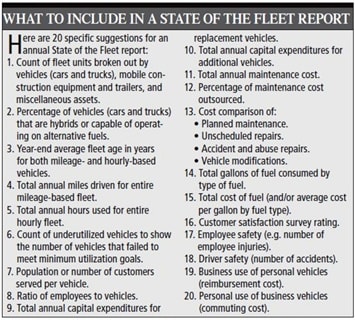
While some factors that affect cost may seem obvious to the fleet manager, to many others they are unknowns that impact the bottom line. Fleet managers should communicate basic information including the size and age of the fleet; utilization; fuel consumption and cost; labor, parts, and overhead cost; and the impact of regulatory requirements.
Charts or graphs "track and look back" and are almost always more effective to display data over a multi-year period than tables full of numbers. Try to make them colorful and interesting. Locate and use known standards for comparison purposes. For example, the report can compare annual change in total fleet cost over several years to changes in the Consumer Price Index or the IRS business mileage rate over the same period.
If fleet management already tracks some key performance measures, it already has a great start - just be sure to track performance consistently year over year. Otherwise, trends have little meaning, so define performance measures carefully and establish documented formulas for calculating results.
Keep the report short enough to retain the reader/viewer's attention but long enough to explain the facts that impact costs and operational success.
Tell the Fleet Story
An annual State of the Fleet report is meant to tell an important story. It enables the fleet manager to proactively get the message out instead of becoming defensive in response to budgetary questions. Those who control the money in most organizations love to see numbers and graphs showing historical trends and future projections. Measures that consistently have meaning and value from year to year can be tremendous aids to support fleet funding requests and to enhance a fleet manager's professional image.
About the Author
Gary Hatfield is director of Public Fleet Consulting Services at Mercury Associates, Inc. He can be reached at ghatfield@mercury-assoc.com.