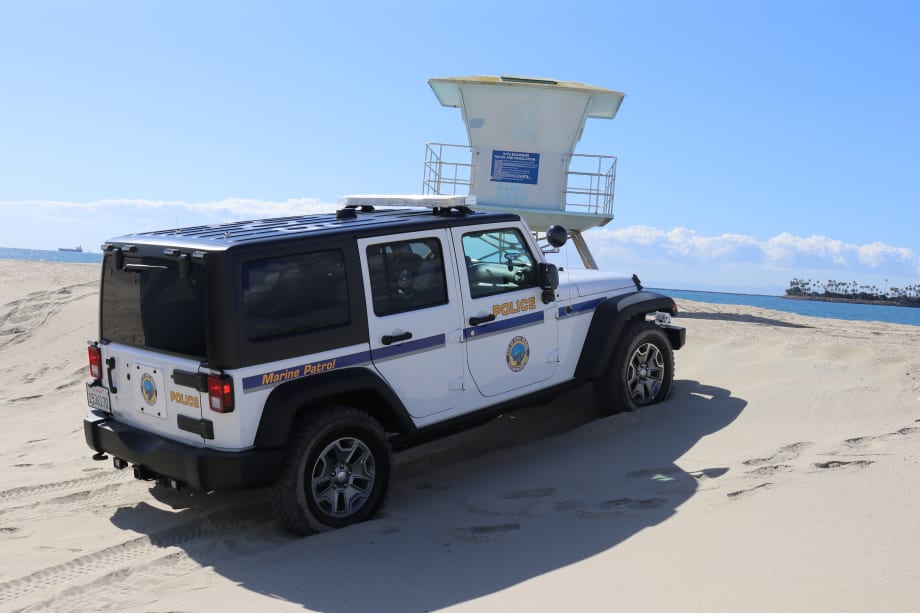

In the City of Long Beach, beach patrol vehicles and washed every day and inspected regularly. Photo courtesy of City of Long Beach
The environment can drastically change how a fleet operates. For beach patrol fleets, saltwater and sand can affect everything from the lifespan of service vehicles and maintenance practices, to the power needed to operate the fleet.
Robert Gilmore, operations manager for Volusia County's Fleet Management Department (Fla.), and John Seevers, superintendent of acquisitions for Long Beach's Fleet Services Bureau (Calif.), share their advice for running effective beach patrol fleets.
Getting the Right Vehicle for Beach Patrols
There are no hard and fast rules for purchasing beach patrol vehicles, Gilmore said. Salt from the ocean creates a rough environment for vehicles of any size, so beach fleets should access their specific needs.
"We've tried different things in the past," said Gilmore. "We've tried smaller vehicles and Jeeps. We've come back to the crew-cab, full-sized pickup truck. It meets their needs the most, because not only are they beach patrol, they're also law enforcement. They need to be able to detain people they arrest in the back of the vehicle, and carry surfboards and all their rescue equipment."
Seevers said that four-wheel drive is essential in running a beach fleet. The city's beach patrol is comprised of two fleets: a marine patrol division and a lifeguard division. The marine patrol division runs six Jeep Rubicons while the lifeguard fleet has six Ford F-150s.
"Anything that has a four-wheel drive capability is an option to look at," Seevers said. Other considerations include visibility, vehicle length, and power distribution. While vehicles with other applications may shift to alternative fuel options, beach fleets require more power in the sand. Three of Long Beach's F-150s run on compressed natural gas, Seevers said, and they are more challenging to operate on the beach.
Prioritizing Safety for Beach Patrol Vehicles
Safety is the key to equipping beach patrol vehicles. Standard pieces of equipment for beach fleets include forward- and backward-facing cameras.
"We have one forward-facing camera [on each vehicle] so it shows the whole blindspot down the passenger side of the vehicle," Gilmore said. "Then we have standard backup cameras. It's really just to prevent them from accidentally running over someone on the beach who might have laid beside them."
New vehicles can also be equipped with collision detection systems as an extra safety measure when driving near civilians.
Traversing over sandy, uneven terrain also means that vehicles in the Volusia County and Long Beach fleets are equipped with winches to pull themselves and other vehicles out of the sand.
Law enforcement vehicles also have specialized equipment to consider. Alongside standard police gear such as light bars, computer systems, and partitions for detainees, beach patrol vehicles also include surfboard racks and gun storage boxes, for when officers go on ocean rescues.

Beaches are harsh environments for vehicles, so maintenance is an important aspect of managing a beach fleet. Photo courtesy of Volusia County
Making the Most of Your Fleet
Perhaps the most critical aspect of operating a beach fleet is maintenance. Because a beach is a harsh environment for vehicles, upkeep is essential in maximizing fleet usage. Both Volusia County and Long Beach keep vehicles in service for three years before retiring them.
"At the end of a three-year life cycle, they're completely rusted away, no matter how hard you wash them or try to coat them," Gilmore said.
Just to keep the fleets running on a three-year cycle, Seevers said the vehicles are washed and cleaned every day. Even then, vehicles are closely inspected regularly.
"The system will rust out very quickly," he said. "The calipers will get sticky and freeze up, and the rotors are rusted out. We have a lot of brake line issues. So you just have to keep your inspections very thorough, a little more often, and replace more parts because it's a serious safety concern."
Hypothetically, beach fleet vehicles can be used through a fourth year, but repair costs mount with larger maintenance projects such as replacing an engine or fixing transmission failures. It can also take as much as a third of the value off the vehicle at an auction, compared to salvaging the vehicle after its third year, Gilmore noted.
According to Gilmore, the most important part of maintaining a fleet for beach use starts before the vehicle begins being used. In Volusia County, every new vehicle goes through a process where it gets "beacherized," where it is taken apart so technicians can apply an anti-seize compound and heavy undercoating before the vehicle begins service to make future repairs easier. Factory undercoats tend to be inadequate and can sometimes hide rusting on vehicles. Gilmore recommends using a local vendor who is familiar with how a beach environment affects vehicles to get proper undercoating treatment.
"That's one thing we've learned over the years. The biggest thing is to prep before you put it out on the beach," Gilmore said. "If you don't take the tires and wheels off of it and add anti-seize to all the lug nuts and all that kind of stuff, the first time you'll bring it in for service you can't even get the wheels off of it. They're frozen, and then you've got a real mess because now you've got $2,000 worth of wheels that you're going to ruin trying to cut the lug nuts off if you can't break the studs."