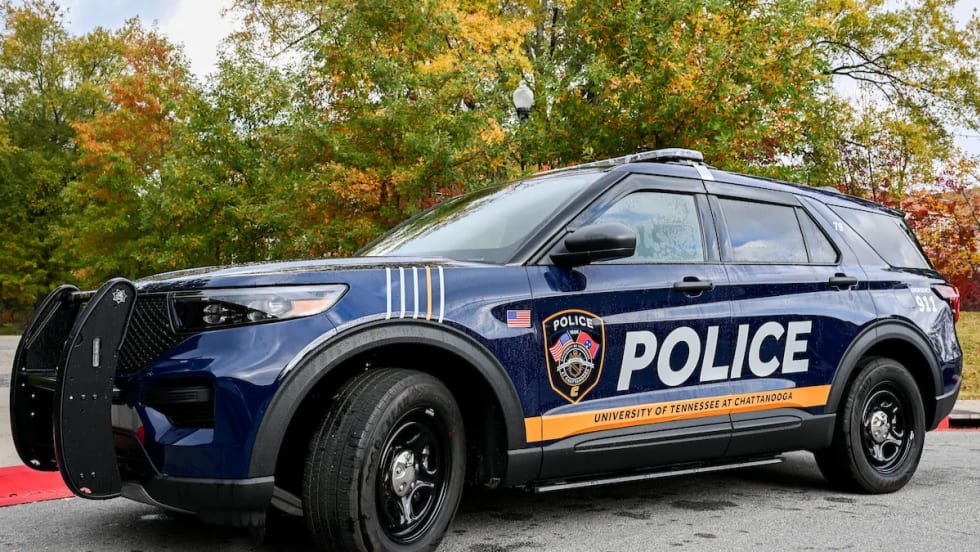





A police officer can’t do their job well if they don’t have the proper tools needed to do so. That starts with their police car, which often acts as their office on wheels.
For the Fayetteville, Arkansas, Police Department, this means finding innovative ways to improve vehicle availability, creating strategies to speed up the vehicle procurement process, and coming up with new ways to address common maintenance problems.
These are aspects that made the city of Fayetteville stand out as one of three inaugural Police Fleet Innovators in 2024.
Fleet Operations Superintendent (right) Ross Jackson manages a team of 22 employees who service city fleet vehicles. He is pictured here with Setina Manufacturing Vice President Judy Setina receiving the award.
T2 Systems
Enhancing Productivity to Speed Up Vehicle Maintenance Turnaround Times
Reducing vehicle downtime begins with an efficient fleet shop. In fiscal year 2022, the 12-month average for police vehicles turned in for repairs was a 56.13% rate within 24 hours, a 5.58% rate within 24-4 hours, and 38.29% rate within 48+ hours.
Compare that to the following year, where the team was able to increase that to a fiscal year 2023 high of 81% of vehicles repaired and returned within 24 hours, an average monthly rate of 71.43% returned within 24 hours, about 7.61% of vehicles returned within 24-48 hours, and 20.97% returned in 48 hours.
To put it simpler, the fleet began fiscal year 2022 with a 73.43% monthly 24-hour availability, and ended the following fiscal year with a 98.45% monthly availability.
These numbers were determined using the department’s fleet management software, something Fayetteville Fleet Operations Superintendent Ross Jackson, CAFM, calls crucial.
“Garbage in, garbage out. If you don't have your frontline employees accurately recording their time and repairs or using the right repair types in the work order, you're not going to get good data. It's up to training them well on what the expectations are and what your goals for the team are,” Jackson said.
The team was also able to reduce build times significantly, thanks to some staff shuffling and through bringing the upfitting process in-house.
Previously, the fleet had been known to sit on new patrol vehicles for two years, causing the warranty clock to tick before the vehicles were even fully built. The old upfitter took up to nine months on each individual build.
Fleet management focused on training and reshuffling technicians to work on builds. The team also expanded, hiring technicians whose work is delegated only to building and repairing police vehicles.
Additionally, the team brought on an in-house installer, who is also the department’s lead automotive mechanic. He is ASE Master Certified and an Emergency Vehicle Technician (EVT) Certified Police Upfitter. His leadership helped the team drop build times to 36-40 hours for each build.
The same technician placed in the top five for NAFA’s Fleet Technician of the Year award in 2024.
Jackson’s team hired a new vendor and outside upfitter with the police department’s recommendation and good references from other agencies to work alongside the lead upfitter for two weeks. This was done to teach the vendor the fleet department’s exact upfitting needs and keep upfitting standardization.
The outside upfitter worked through and built nine frontline patrol vehicles in two and half weeks — about one car every two days — to remove the immediate backlog and delay in expansion vehicles that previously sat for up to 10 months.

Previously, the fleet had been known to sit on new patrol vehicles for two years, causing the warranty clock to tick before the vehicles were even fully built. Fleet management focused on training and reshuffling technicians to work on builds.
Once the builds were caught up, the team returned to in-house upfitting, training the other police department automotive mechanics to upfit patrol vehicles.
They were able to triple team builds after the vendor removed the initial backlog, allowing the department to focus on patrol vehicle repairs while the vendor worked on upfitting. Two of the department’s upfitters can now complete a build in as little as 32 hours.
Jackson was able to figure out which employees worked best where by observing their strengths when he first joined the team in December 2022.
“What I try to do every single day is walk the floor: see what people are doing, pay attention to work orders, and know and understand what their strengths are, and then apply those strengths where I need them,” Jackson said. “We have received a lot of support and have an awesome
team and relationship with our police liaisons and police administration.”
Jackson also holds regular staff meetings with shop staff and police department leadership to build relationships and listen to challenges the teams are facing in order to brainstorm solutions. Communication is huge, he said.
Making Changes Under the Hood to Keep Vehicles Running Smoothly
The engines on some of Fayetteville PD’s Chevrolet patrol vehicles are prone to problems caused by excessive idling and oil degradation.
The stress these two factors puts on the Displacement on Demand (DOD) systems often leads to hydraulic camshaft lifter failures and engine damage, Jackson noted from experience. This often resulted in replacing engines under and outside warranty, affecting budget and police vehicle availability.
The solution Jackson’s team came up with to avoid this was twofold: reducing idle times and using additives during regular preventive maintenance.
Excessive idling can lead to more wear and tear on the vehicles. Every hour of idle time is equivalent to about 33 miles driven.
Because many of the vehicles in the fleet are hot seat vehicles, some were driven or idled between calls and shifts for up to 24 hours or more.
The fleet team and its police fleet liaison, a lieutenant within the police department who works to bridge the work between the two departments, worked to educate officers about the impact idling was having on their vehicles, in order to decrease idle times.
“[We’ve worked on] getting them to understand the cost factor that goes with engine wear and tear, the downtime that goes with it, and the lack of vehicles that will come from it. Our liaison was very on board with communicating that, and he was able to go back and express to the officers why this is important,” Jackson said.
The fleet department is also piloting Whelen’s telematics software in eight vehicles, which will provide an even more accurate look at idle times and further increase PM compliance, a big push for the city in 2024.
Under the hood, Jackson ended up experimenting with additives to keep the engines healthier and increase oil life through this severe-duty application.
“I’m not a believer in snake oil — that’s what I call most of this stuff,” Jackson laughed.

To reduce a pattern of engine trouble on some of Fayetteville PD's vehicles, Jackson's team began using additives during regular PM services.
POLICE
However, a vendor visited his fleet shop and demonstrated an additive that decreased engine wear on metal-to-metal components. After seeing it with his own eyes, Jackson and staff made the decision to invest in the additives and include them as part of regular PMs, which are currently completed at 4,000-mile intervals.
Prior to making these changes, engines had been known to put vehicles out of service for up to a year due to long wait times for replacement engines amid the global supply chain crisis.
Working with Stakeholders to Accelerate Vehicle Procurement
Navigating shorter vehicle order windows brought on by the global pandemic has led many fleets to adjust their procurement processes. Previously, the city required competitive bidding, which would make the process take up to two months.
With order windows only staying open for as short as one day, this made it nearly impossible to purchase vehicles to replace those that were up for replacement or were intended to be expansion units.
Fleet leadership worked with the city’s purchasing division, legal department, ordinance review and creation committee, and city council to create an ordinance to waive competitive bidding and authorize the purchase of new vehicles through various manufacturers’ authorized dealer networks, both speeding up the process and expanding the pool of available vehicles.
The ordinance entails an informal requirement to solicit bids or quotes for budgeted-for vehicles, allowing the team to expedite the purchasing speed by going directly to signing the paperwork after the informal bids were placed.
Now, leadership can solicit quotes and move to purchase order creation in as little as a few days.
After first implementing this ordinance, leadership was able to purchase an additional 12 vehicles in a single order as soon as they found inventory. The department has utilized the ordinance to purchase police vehicles for the last several years.
If leadership was forced to stick to its original purchasing process approvals, it would not have been able to compete against neighboring states, leaving gaps in the police fleet.
Working closely with the police department helped Jackson to communicate the needs of the department with stakeholders.
“Be open and be truthful. It really goes back to understanding what your law enforcement agency’s mission is. What do they need? You have all these different missions that different officers need to accomplish within the main mission, and each one is going to require thought given to each vehicle,” he said.
Fleet leadership has also been able to assist other city agencies in utilizing the same ordinance to purchase vehicles.
Finding Innovative Ways to Put Needed Vehicles on the Road

Five members of Jackson's team, including (from left) Asher North, Brock Warren, Kyle McDougal, Michael Jackson, and Ashley Smith were responsible for doing the repair and upfitting work needed to get SRO vehicles on the road in record time. Three SRO vehicles are shown here.
Recalls of popular fleet vehicles can often throw entire departments for a loop. This was the case in spring 2023, when the entire fleet of leased student resource officer (SRO) patrol vehicles was suddenly recalled and its long-standing lease closed with 30 days’ notice. The agency could not be without its entire fleet.
Police and city administration gave approval for nine unbudgeted, upfitted SRO purchases to go to city council for approval. An informal quote went out four days after the fleet team was initially notified of the need for vehicles. Leadership was able to locate and order the vehicles, getting them delivered in 30 days.
Through collaboration, fleet leadership was able to quickly source parts, get the vehicles painted and decaled, and upfit them in-house.
The first vehicle went into service about a month and a half after the previous ones were taken off the road. For a department that used to take up to two years to get a police vehicle out to its officer, this was a huge accomplishment, Jackson said.
The vehicles are built the same as patrol vehicles, with the exception of partitions and bio-seats.
He stressed that this would not have been possible without good planning and communication between the departments.
“It’s really about communication and getting everyone in a room together, keeping them updated, having every stakeholder available, and understanding what everybody else needed,” Jackson said.
Across the board, the fleet department prioritizes its police vehicles so officers can meet their mission of protecting their community — whether in schools or on roadways and beyond.
“Being in service for 24 hours a day, they have a mission and a need to stay in their vehicles. The vehicles provide not only officer safety, but public safety. We want to make sure the public has what they need to be able to sleep safe at night,” Jackson said.