
Becoming the No. 1 fleet is quite an accomplishment — after this recognition, the fleet is ineligible to compete in the 100 Best Fleets program for five years and is named an Elite Fleet. Fleet managers are often asked to become judges for this award, giving back to the award they earned. Being an Elite Fleet brings additional recognition from neighboring fleets and national agencies as well.
However, that doesn’t mean the Elite Fleets are leaning back — they’re continuing to lead the way in innovative and efficient fleet management. This year’s Elite Fleets focus on saving taxpayer dollars, increasing operation efficiency, and contributing to new technologies and products that benefit the industry.
Hillsborough County – Maximizing ROI
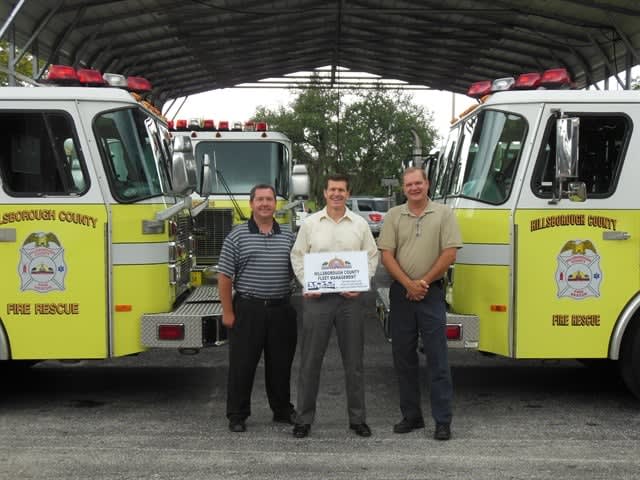
The fleet management leadership team is just one element of the City’s successful fleet. Pictured (l-r) are: Ross Meslin, fleet services manager; Robert Stine Jr., director; and Ernie Hutman, operations/maintenance manager.
Photo courtesy of Hillsborough County
The Hillsborough County, Fla., Board of County Commissioners (BOCC) Fleet Management Department has been focusing on maximizing vehicle return on investment (ROI). With a large County fleet, disposal of more than 300 vehicles annually can lead to substantial savings due to higher resale prices, according to Robert Stine Jr., CPFP, fleet management director. Stine joined the County fleet in January.
To do so, the fleet considers resale ROI during initial vehicle acquisition, using a “teaming and common sense” approach. One example is specifying vehicle options that add value to the vehicle’s eventual resale price. The County’s vehicles are normally painted white with tinted windows to help fight the extreme summer heat. Adding something as simple as a truck bed liner enhances the condition of the vehicle after years of service and is viewed favorably at auction. These lifecycle cost decisions might seem minor in nature, but they can quickly add up to large savings and substantially increase ROI, Stine said.
At the time of resale, fleet staff members ensure they provide the “Midas Touch” to every vehicle. Ernie Hutman, CPFP, operations and maintenance manager, said the days of “painting over or scraping off” existing County decals and miscellaneous markings are long gone. Fleet staff quickly discovered that taking the time to properly remove decals and stickers and doing a general cleanup of the unit led to a positive effect on its resale price. As a result, it is not uncommon for local buyers and other counties to call the County fleet asking for projected future vehicle disposals, Stine said. The average ROI for the past several fiscal years has been more than 25% of acquisition price, up from an average of 15% in 2008, Hutman said. For the past calendar year, the ROI is averaging at more than 31%, which further reduces the amount of budgeted funds required to support the replacement program.
Hillsborough County, Fla. No. 1 Fleet in 2008 & 2009 | |
Fleet size: | 1,650 on-road, 1,200 off-road |
Fleet staff: | 50 |
Maintenance facilities: | 4 |
Operating budget: | $18.8 million |
[PAGEBREAK]
City of Troy – Rightsizing the Fleet

The City of Troy, Mich., fleet completed the second part of a vehicle utilization study that allowed it to decrease its fleet by 15% and right-size its vehicles.
The fleet had already reduced its vehicle count during a prior utilization study. Sam Lamerato, CPFP, fleet maintenance superintendent, explained that budget constraints had previously forced the City to reduce its staff through attrition and the reduced fleet size reflected the decreased number of drivers.
Lamerato’s team completed the second study in March. “The utilization study told us which vehicles were being used and how many miles or hours per month they were being used. Where there were underutilized vehicles, department heads were notified. We met with the [user] department and talked about it. If they could not justify need for the vehicles, [the vehicles] were sold at auction,” he said.
The study also allowed the fleet to better match vehicle sizes with their applications, taking into consideration the services the City had chosen to outsource. This will allow the City to right-size some of its vehicles.
“The overall results were positive,” Lamerato said of the utilization study. City Council passed the 2013-14 capital replacement budget with no objections — Lamerato had reduced it to $1.4 million, down from $1.6 million the prior year.
For those conducting their own utilization study, Lamerato advised they begin with monthly utilization reports in advance to department heads to make them more aware of their departments’ vehicle usage. He added that the fleet manager needs to go into any meeting about utilization with an open mind. The user department may have a legitimate reason to keep the vehicles, such as a temporary setback because a specific operator is out sick. “Work with your customers,” Lamerato said. “Treat them as a customer.”
City of Troy, Mich. No. 1 Fleet in 2010 | |
Fleet size: | 400 on-road, 65 off-road |
Fleet staff: | 16 |
Maintenance facilities: | 2 |
Operating budget: | $4 million |
Insourced maintenance revenue: | $700,000 |
City of Portland – Developing Maintenance Partnerships

The City of Portland, Ore., fleet has been partnering with local government agencies to perform fleet service work for years, and in 2012, CityFleet added three new intergovernmental agreements (IGAs). The IGAs increased revenue from outside agencies by 376% over the same time last fiscal year, bringing outside revenue to 2.6% of the fleet’s overall operating budget. At a time when City departments had been ordered to cut their budgets, John Hunt, CPFP, fleet manager, said increasing external revenue and putting the money toward operations allowed the fleet to “cut our fleet budget by less than what we would have had to without the additional revenue.”
Hunt said the partner agencies in turn receive fleet services at a great value, whether that’s repair services, less downtime (due to a 24/5 shop), or receiving parts at a lower price — a benefit of Portland’s ability to make volume purchases. The partnerships began with information sharing between local agencies. An interest in IGAs emerged through the discussions, and the agencies launched pilot projects to explore the feasibility of CityFleet acting as a regional fleet service provider.
These partnerships allowed CityFleet to retain key elements of its budget, maintain service hours, and provided the justification for retaining current staffing levels. In addition, CityFleet gained approval to hire an additional technician to meet the new workload.
Hunt is proud of how the team has gone above and beyond to meet the new challenges. “They rose to the occasion and continue to work really hard,” he said.
City of Portland, Ore. No. 1 Fleet in 2011 | |
Fleet size: | 2,350 on-road, 600 off-road |
Fleet staff: | 77 |
Maintenance facilities: | 7 |
Operating budget: | $18.3 million |
Number of intergovernmental fleet agreements: | 18 |
[PAGEBREAK]
City of Seattle – Advancing EV Technology

The City of Seattle’s investment in its green fleet is clear. It was named one of the greenest fleets in the nation, invested in 44 Nissan Leaf electric vehicles (EVs), hired a dedicated green fleet coordinator, and most recently, in May set a City goal to reduce fleet petroleum fuel use by 1 million gallons by 2020.
For a fleet department so devoted to alternative fuel, helping design an EV is right up its alley. The fleet (with parking enforcement staff and engineers) worked with Good Earth Energy Conservation to provide suggestions on design improvements to the Firefly purpose-built EV for parking enforcement. City staff began working with Good Earth in 2011, purchasing the first two vehicles the company ever sold.
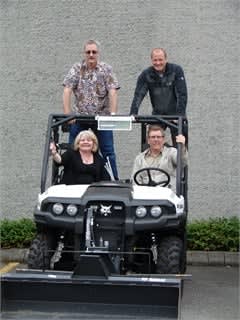
The Seattle fleet management team consists of (standing l-r) Michael ‘Vini’ Vincent, vehicle maintenance manager; Chris Wiley, fleet operations manager; (seated l-r) Nanci Lien, fleet administration manager; and Dave Seavey, director.
Photo courtesy of City of Seattle
Chris Wiley, CAFM, fleet operations manager, explained, “Through using those two vehicles, we collected a lot of feedback from drivers and our engineers on improvements that could be made.” These range from the kind of heater on board, to door types, to drivability improvements.+
Eric Burmeister, regional sales director at Good Earth, manufacturer of the Firefly, said that although various municipalities helped contribute to the vehicle’s final design, no agency contributed as extensively as the City of Seattle. “They were prepared to pull the trigger and get them in the fleet quicker than other agencies,” he said.
Wiley said the City is currently in the final round of evaluations with two new models with various improvements before approving the purchase for more vehicles.
Dave Seavey, CAFM, fleet management director, said what makes this experience unique is the idea that “a government agency can help [companies] design a new technology” and help bring these vehicles to market.
City of Seattle No. 1 in 2012 | |
Fleet size: | 3,061 on-road, 370 off-road |
Fleet staff: | 126 |
Maintenance facilities: | 6 |
Operating budget: | $51 million |
Number of active operators/drivers: | ~10,000 |
Fuel used annually: | 2.4 million gallons |
Equipment purchases annually: | 250-300, totaling $15-18 million |
Sources:
Robert Stine Jr., CPFP, fleet management director, Hillsborough County, Fla.
Ernie Hutman, CPFP, operations and maintenance manager, Hillsborough County, Fla.
Sam Lamerato, CPFP, fleet maintenance superintendent, City of Troy, Mich.
John Hunt, CPFP, fleet manager, City of Portland, Ore.
Eric Burmeister, regional sales director, Good Earth Energy Conservation
Dave Seavey, CAFM, fleet management director, City of Seattle
Chris Wiley, CAFM, fleet operations manager, City of Seattle