Many people do their best to avoid driving in bad weather. They do it only when they get caught in a storm or if they absolutely have to be somewhere like work or school. As law enforcement officers, you rarely have the option of staying at home and waiting out the storm.
And there is evidence that driving in dangerous weather conditions is one of the reasons so many officers are killed in patrol vehicle accidents. In most years, more officers are killed in vehicle crashes than in felonious attacks. So far 2018 is an exception, with more than twice as many officers killed by felonious gunfire than in on-duty crashes. Still, one of the big differences between accidental death and murders is that accidents can be prevented more easily because there is by definition no malicious intent involved in an accident.
The best way to prevent accidents is to learn to recognize the hazards and train on how to prevent them from causing a tragedy. And if any law enforcement agency knows how to train officers how to drive in dangerous weather it's a state highway patrol.
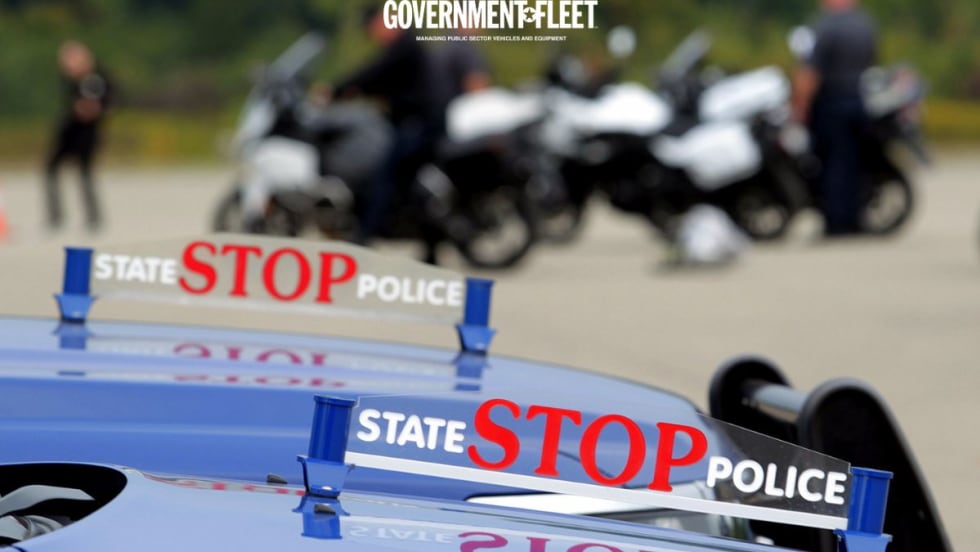
Consider the Michigan State Police, an agency that is charged with performing patrol and investigative duties in much of the state while also serving as the highway patrol. Recruit training in the MSP academy requires each student to complete 50 hours of driver instruction, including 40 hours behind the wheel and 10 hours of classroom work. In addition, working officers often return to the academy for in-service emergency vehicle operations courses (EVOC), which includes instruction in what to do when driving during dangerous weather conditions. "We encourage commanders to rotate their people through," says Lt. Michael McCarthy, MSP's precision driving unit commander.
Losing Traction
Ice and snow, especially black ice, are some of the most dangerous road conditions faced by MSP officers. McCarthy sums up the primary hazard presented by the state's slick roads when he says, "The problem is that you tend to break traction and become involved in a skid."
MSP makes sure its officers know how to survive when their vehicle's tires break traction. The academy has a full-size skid pad, and each recruit gets 1.2 hours of training on it. In order to pass, they have to recover from three out of four skids.
McCarthy, a 24-year veteran of the MSP, says people tend to complicate the skid recovery process. The most important thing is not to accelerate or brake. Then you have to bring the vehicle back under your control. "You hear about counter steering, you hear about steering into the skid, but we teach a little bit differently," McCarthy says. "We tell our students to look where the car wants to go and steer to that spot. It's basically the same thing as steer into the skid but a lot of people don't realize what steer into the skid means."
Your car goes where you look applies to all driving, according to McCarthy. "Even in a simple exercise like the serpentine maneuver, if you look at the cones instead of the space between them, you will hit them," he explains.
The 80% Rule
The skid pad teaches MSP officers what to do if they get in trouble, but the most important lesson they learn is how not to get in trouble. They are taught to never exceed 80% of their skill level and the vehicle's capability even in emergency driving conditions, answering shots fired calls, responding to officer needs help calls, or pursuing suspects. "You always need to have a little bit of your skill and the vehicle's capability to recover if anything happens," McCarthy says, adding that regardless of the type of call, "You have to get there safely before you can do anyone any good."
Speed is the primary reason law enforcement officers exceed 80% of their driving skills. McCarthy says it's particularly important that officers understand the difference between their patrol SUVs and smaller vehicles. "The faster you go with a heavier vehicle, the more inertia it has and the less it wants to do anything other than go straight. The faster a vehicle goes the harder it is to turn or brake," he explains, adding that slick roads from ice, snow, or rain means you have to slow down to safely operate your vehicle in the 80% parameter.
That 80% rule is based on good weather conditions. When the weather turns nasty and road conditions deteriorate, so do both the skill level of the driver and the capabilities of the vehicle.
McCarthy uses this example to explain how the driver's skills can even go to 0%. If a driver can't see from rain, fog, or a whiteout blizzard, even if that driver is highly trained and highly skilled, then any movement exceeds 80%, he says. "What you should do when the weather turns so bad that you can't see is turn your hazards on, work your way to the shoulder, come to a stop, and remain stopped until conditions improve."
Flash Flooding
One of the least understood dangerous road conditions that imperils both first responders and civilian drivers is the flooded roadway. A good rule of thumb for you to remember is that if you can't see the curbs, the water is too deep. A fast current of less than a foot is enough to wash most passenger cars off the road and carry them away. An SUV is higher and can probably run through up to two feet of water, but don't bet your life on it.
In 2018 alone, two officers were killed when their vehicles were washed off the road, one in Kentucky and one in Missouri. McCarthy says the hard-and-fast rule is that no one should attempt to drive across a flooded roadway or bridge. And he rejects the mindset that officers have to charge through to get to calls, no matter the dangers they face. "If you don't think you can get there safely, then you need to weigh your options," he says.
What often happens when a vehicle is flooded off a roadway is that it comes to rest in water deep enough to submerge it. And a vehicle can also crash into water and sink. This is why Michigan State Police officers are offered optional training in underwater escapes.
The underwater escape course is some of the most involved training the MSP offers. It actually requires officers to rescue others from a vehicle underwater and escape from a submerged vehicle themselves. The academy has a submersible car that it dunks into a deep pool. The "car" was built by Rousch Performance for the MSP, and it's constructed of stainless steel so it won't rust.
In the class, officers are trained how to escape from the vehicle while high and dry, then they are sent into the pool to demonstrate their understanding of the concepts. Divers take each officer down to the submerged vehicle with scuba. The officer is then fitted with a blacked out dive mask because visibility in Michigan's bodies of water can be minimal, belted into the driver's seat, and then they have to escape.
Escaping from a vehicle that has crashed into water requires a clear head. You can't panic. If you can escape before the vehicle goes down, then do it. If you can't, you need to get out of your seat belt and get a window open. The seat belt release button should work because it's not electric. The same is not true of the driver and passenger side windows. It's likely that the windows will not operate once the car is under water. This is why the MSP issues a glass breaker to its officers. Once the window is open, you should let the vehicle fill with water to equalize the pressure in and out and open the door. The final step is to leave the vehicle and swim to the surface and hopefully to safety.
Strap Yourself In
Accidents happen. Regardless of how skilled you are, you can still make a mistake. Or more likely somebody else will make a mistake in a vehicle around you. So wear your seat belt. McCarthy says MSP policy requires officers to use seat belts any time their vehicles are moving.
Many officers ride around without buckling up because of an archaic law enforcement myth that a seat belt will trap you in your vehicle during an ambush. Experts who study such incidents say they can find no evidence of that ever happening. They say officers should always wear their belts when driving. The alternative is to be seriously injured or killed should you be involved in a serious crash.
About the Author: David Griffith is the editor of POLICE Magazine. This article was originally published in POLICE.