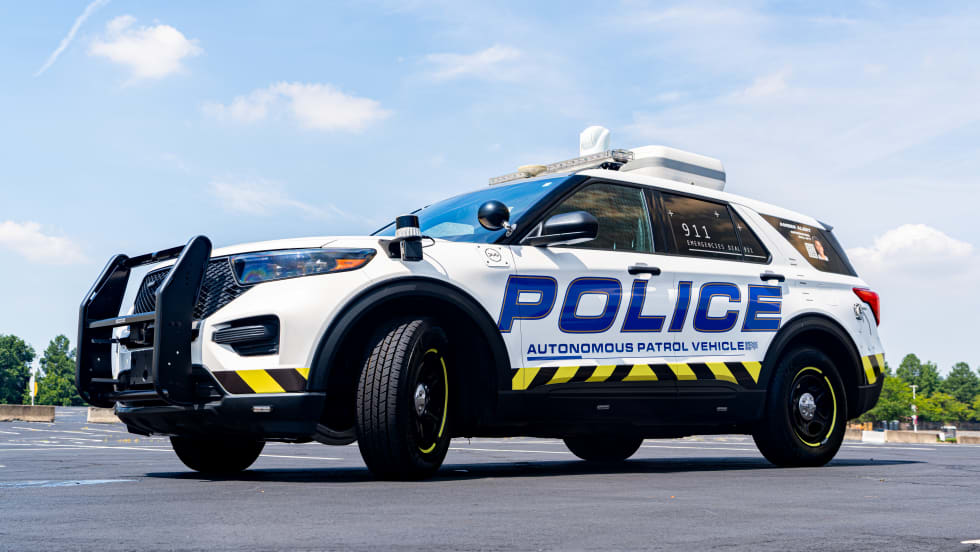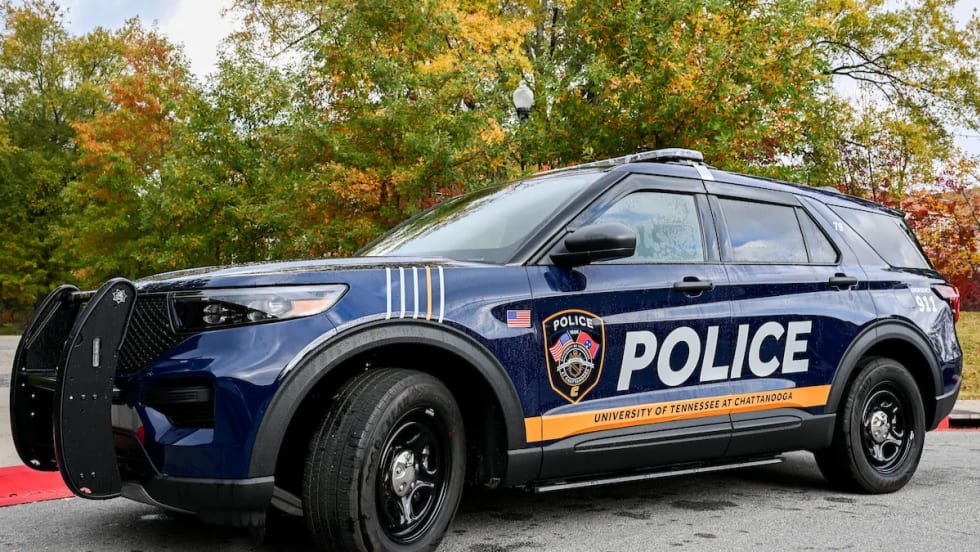
This summer Ford is going to roll out the most innovative police vehicle ever produced, the 2020 Ford Police Interceptor Utility with hybrid powertrain. Based on the 2020 Explorer SUV, the pursuit-rated 2020 PI Utility is not the first purpose-built hybrid patrol vehicle — Ford introduced its Police Responder hybrid sedan in 2017— but it is the first one big enough to accommodate all the gear needed in contemporary police operations.
And if the 2020 PI Utility hybrid proves as popular with agencies as Ford expects, it's likely to usher in an era of hybrid patrol vehicles for the next decade or so until most law enforcement vehicles become fully electric.
Despite widespread acceptance of hybrid gas-electric vehicles in the consumer market, the police market is different. Some officers and agencies are reluctant to give up their gas-powered V-8s for this 21st century engine tech. These officers want Ford to prove its hybrid can go fast, stop even faster, and do the job. And their agencies want proof of performance plus economic benefits to offset the additional cost of the hybrid powertrain.
Hitting 137 MPH in a Police Vehicle
To prove the 2020 PI Utility hybrid's performance to the police audience, Ford took the new SUV to last September's Michigan State Police evaluations. And it made quite an impression.
It goes real fast. The hybrid SUV hit 137 mph in the top speed testing. The only pursuit-rated sedans that hit faster top speeds during the test were the Dodge Charger 5.7-liter Hemi at 149 mph and the Dodge Charger 3.6L at 141 mph. The only pursuit-rated SUV that topped the PI Utility hybrid was the Ford 3.0-liter EcoBoost PI Utility at 150 mph.
Of course top speed is not the most important performance issue for a patrol vehicle that is going to be driven in environments ranging from major city streets to rural highways. Most agencies are more concerned with the acceleration and closing speed of the vehicle.
The PI Utility hybrid, which comes standard with all-wheel drive (AWD), had a 0-60 mph time of 7.27 seconds at the MSP test. That's better than most standard gasoline engine patrol SUVs. The only patrol-rated SUV that accelerated quicker in MSP's 0-60 mph testing was Ford's PI Utility 3.0-liter EcoBoost SUV with AWD. EcoBoost engines achieve their impressive performance with turbos and direct injection.
The closing speed performance of the PI Utility hybrid as measured by its 0-100 mph time was also impressive at 17.69 seconds. That's not as fast as a Hemi Charger, but it outmatches every pursuit-rated SUV other than that blistering fast 3.0-liter PI Utility EcoBoost, which can hit 100 mph from a standing start in just under 14 seconds.
There was a time when hybrid meant great gas mileage but less than stellar performance and not a lot of cargo space. Not anymore, says Steve Tyler, Ford police brand marketing manager. "With hybrids people are used to making some kind of tradeoff. The most exciting thing about the 2020 Ford Police Interceptor Utility hybrid is there are no tradeoffs. You don't lose any interior passenger or cargo room. You also get greater horsepower, torque, and top speed. In addition, you get significant fuel economy."
Ford's 2020 Police Interceptor Utility is the nation's first pursuit-rated hybrid SUV.
Stopping Power
Performance for a patrol vehicle or any vehicle is not just about speed. It's about how quickly the vehicle can be stopped. This is extremely critical for a law enforcement vehicle, which tends to be driven harder than a consumer vehicle.
The new hybrid Ford SUV was also a star in MSP's brake testing. In testing where the vehicles were brought to a stop from a speed of 60 mph, the PI Utility hybrid came to a complete rest at 132.4 feet. That was better than any other pursuit-rated SUVs except the Dodge Durango Pursuit 3.6-liter at 128.8 feet and the Ford Police Interceptor EcoBoost at 131.5 feet.
Hybrid vehicles tend to stop so well because they use a regenerative braking system, which means that the electric motor of a hybrid vehicle reverses its spin, slowing the vehicle when the driver applies the brakes. This braking action turns the motor into a generator that helps keep the vehicle's batteries charged. In addition, the vehicle has anti-lock disc brakes with calipers, pads, and rotors.
Saving Green
One of the reasons that hybrid patrol vehicles will become much more common in the next few years is government environmental (green) initiatives. That's a great benefit of hybrid engine technology. But hybrid patrol vehicles can also be part of another type of green initiative, the type that saves money for law enforcement agencies.
Hybrid vehicles generally cost a little more money at initial purchase. But the economics of running hybrids should more than make up for that initial outlay.
Ford says Fuel savings from the 2020 PI Utility are significant. The combined highway and city MPG is 24 compared with 17 for the 2018, a 40% increase in mileage. But increased MPG is not the only way the hybrid PI Utility can save agencies on fuel costs. The real fuel expenditure in law enforcement patrol operations is leaving the vehicle running while it's parked at a scene so that it can keep the battery charged to run lights, radios, air conditioning, computers, and other stuff that draws current. The PI Utility hybrid can do that without the engine running. It uses the hybrid batteries and if the charge starts to get low on the batteries it will run the engine just long enough to give them a boost. Ford calculates that the savings over idling a gas engine combined with the MPG increase will save agencies that adopt the PI Utility hybrid $3,500 per vehicle per year. Click here for more information.
The New York City Police Department has been running consumer hybrid cars and SUVs as patrol vehicles for almost 10 years. Deputy Commissioner Robert Martinez who commands the NYPD's vehicle fleet operations believes hybrid powertrains are well suited to law enforcement operations because of the amount of time patrol vehicles spend at idle. "Even out in the country, law enforcement vehicles spend as much or more time at idle than they ever do being driven on the highway," he says.
Another way that hybrids save agencies money is that regenerative braking greatly reduces wear and tear on brake components. Martinez says the brake components on the NYPD's hybrid vehicle last the life of the vehicle.
The 2020 Police Interceptor Utility hybrid come standard with all-wheel drive and is suited to urban and rural patrol.
1,800 Hybrids
Martinez is probably the nation's most authoritative expert on the use of hybrids as law enforcement vehicles. Out of the approximately 20,000 vehicles in the NYPD's fleet, 1,800 are hybrids. And the department has been running hybrids for 10 years.
It all started with taxi cabs, according to Martinez. He says he noticed that the city's taxi companies were replacing their Ford Crown Victorias with hybrids and had been doing so for a couple of years. So Martinez, who was then the department's director of fleet services, ordered 60 hybrid Nissan Altima sedans for the fleet. "I figured if they could hold up for years as New York City taxis, they could certainly do the job as NYPD patrol cars," he says.
Of course those first hybrids acquired by the NYPD were not designed to be police cars, nor were they pursuit rated. The pursuit capability was not an issue, Martinez says, because the NYPD has a "no pursuit" policy. The Altimas not being designed as police cars was another matter. They required some work.
Martinez says his fleet maintenance crews had to replace the Nissan's seats with vinyl-covered seats and install the police equipment such as lights and sirens, which required additional wiring. In addition, Setina Manufacturing also made special prisoner cages that fit the NYPD's Altimas.
Soon after those first NYPD hybrid Altimas hit the street, Ford started making a hybrid sedan for the consumer market, the Fusion hybrid, that Martinez thought would be a better police car than the Altima. "We started using hybrid Fusions both as marked and unmarked cars," he says.
The NYPD's hybrid fleet grew from there. Martinez says he has acquired Toyota Priuses, hybrid Chevrolet Tahoes, and a wide variety of other hybrid vehicles for the department. He even says his success with the hybrid Fusion in the NYPD's fleet helped convince Ford that the time was right for true pursuit-rated hybrid police vehicles. "I started some dialog with Ford's engineers about the benefits of the hybrid as a patrol car. 'It can do the job, and it can do it well,'" he says he told them.
That discussion has now come full circle as Martinez is acquiring Ford's new pursuit-capable hybrid vehicles for the NYPD fleet. He's even driving a 2019 Police Responder hybrid (based on the Fusion hybrid) sedan that Ford has loaned to the department. "We brought it down to our test track and training facility where one of the trainers drove it and came back with great results," he says.
The NYPD is now buying 160 of the new Police Responder hybrid sedans, and Martinez says he is very excited about the 2020 PI Utility hybrid with AWD. "We get a lot of bad weather here in New York City," he says. "We had Super Storm Sandy, big snowstorms, ice storms, flooding. Years ago during snowstorms I had to open our maintenance shops and call in crews to put chains on the vehicles. Now with all-wheel drive SUVs, I no longer have to do that. The vehicles can handle the weather without chains."
Even though consumer vehicles might be a little cheaper to buy than pursuit-capable patrol vehicles, Martinez has no plans to continue the practice of buying retail hybrids and customizing them into police vehicles. "I haven't really done a price comparison," he says. "These task-built vehicles meet our mission better because they were designed to do so." He points out that purpose-built patrol vehicles already have the wiring for police equipment, vinyl seats, cages, and even their computers are "tweaked for police driving."
The NYPD has 13 fleet shops and 400 employees and it is fully capable of upfitting the new hybrids it has ordered from Ford. But Martinez says it's the department's practice to have its vehicle delivered ready for duty. "We have the upfitter do everything, including the lights, and the markings," he says.
Martinez foresees an NYPD fleet that becomes more and more hybrid and electric in the coming decade. Asked how the officers who use the vehicles feel about that, he tells the following story: "Shortly after we introduced hybrid patrol cars about 10 years ago, the Mayor's Office had staff go out and ask the officers driving them what they thought about driving hybrids. They did not know they were driving hybrids. And that's the way it should be, the hybrid vehicle should perform the same or better than the gas patrol vehicle."
Editor's Note: David Griffith is the executive editor of POLICE Magazine. This story originally appeared in the April issue of POLICE.