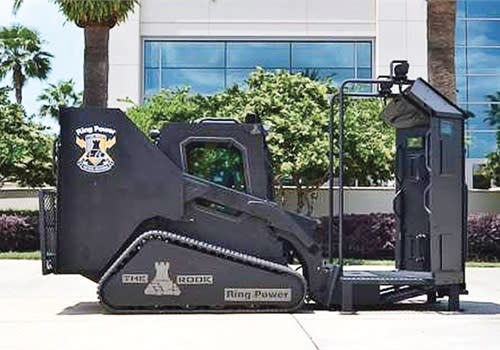
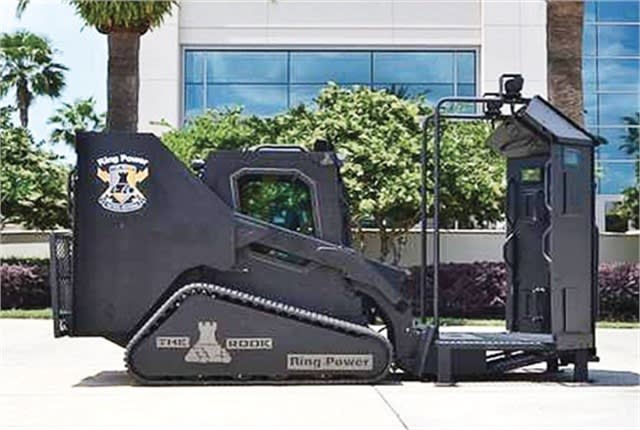
Photo of Rook vehicle courtesy of Ring Power.
The headline from an August 2015 article on the Mother Jones magazine's website reads: "Documents Reveal the Fear-Mongering Local Cops Use to Score Military Gear From the Pentagon."
The article itself includes research that uncovered more than 450 police department requests for armored vehicles from the Pentagon and references a "furious debate over billions of federal dollars that have helped local police forces amass combat-style weapons, trucks, and armor." The article argues that military equipment and especially armored vehicles have no place in law enforcement operations.
Law enforcement officials, however, say armored vehicles are essential to officer and public safety during critical incidents.
Police chiefs, sheriffs, and other law enforcement brass argue that no community—even the smallest one—is safe from mass shootings, hostage scenarios, or terrorist attacks. They maintain that what opponents call the "militarization of police" has had a substantial and positive impact on public and officer safety.
In the Mother Jones article, Jim Bueermann, president of the Police Foundation, cited hostage situations, rescue missions, and mass shootings/shootouts as times when armored vehicles come in handy and provide officers and the community with a level of safety they would not have without them.
Major Charlie Caldwell of the Lake County (Ohio) Sheriff's Office agrees. His department added an armored vehicle to its rolling stock in 2005 and a second one this year. This department, which organized the first SWAT team in Ohio in 1974, finds these vehicles both important and necessary for its 28-member, multi-jurisdictional SWAT team.
"This is as important a piece of equipment for our police officers as our patrol vehicles," Caldwell says. "But we in the law enforcement community need to keep in the back of our minds that the use of this specialized equipment has to be done very carefully. It's not meant to intimidate the public or anything like that; it's meant to keep officers and the community safe."
Show and Tell
Community involvement and education is the primary means of warding off some of the negative perceptions surrounding adding armored vehicles to a law enforcement fleet.
Shaun Mitchell, tactical solutions assistant vice president and general manager for Ring Power Corp. (makers of the Rook armored critical incident vehicle), shares the following scenario with communities and the agencies he works with: "There's a man barricaded in a house. He's acting crazy and he has a high-powered rifle. Officers could run up to that man with a shield that will stop a handgun bullet but not one from a rifle. Are they supposed to go in there under-protected and get shot?" he asks. "The answer should be no, but it happens all the time. This piece of equipment eliminates that risk.
"What about if officers go into a house blind? They go up with a ram to knock down the door and the suspect starts shooting through the door?" Mitchell continues. "They're dead. The suspect kills all of them or maybe just a few. With this equipment they do not have to expose themselves to get in."
But articles such as the Mother Jones piece put forth that police are exaggerating these needs. For this reason, Caldwell maintains it's important that departments educate the community as they add armored vehicles. He warns this is critical to do before and after the vehicle is purchased.
"An armored vehicle has to be very carefully introduced into the public arena," he says. "Law enforcement are the guardians assigned to keep an eye on society and to take care of society. We need to be user-friendly to the public. These vehicles can make it difficult to appear user-friendly."
Community education helps departments maintain their user-friendly image within the community. Caldwell says Lake County takes its vehicles to festivals, fairs, and other community functions. Officers man the equipment and do a show and tell of their capabilities. "We allow children and adults to get into the vehicle and see what it's like," he says. "Then we tell them why we have it, when it's necessary to use it, and the ways we use it. It's necessary to talk about this and that's how we try to do it here."
Law enforcement officials also say such demonstrations and exhibits for the public help the people an agency serves see that the capabilities of the local agency's armored vehicles are defensive only, dispelling any rumors that they have mounted guns like their military counterparts.
Ask the Right Questions
Lenco Armored Vehicles of Pittsfield, Mass., has been manufacturing armored vehicles since 1981, when it started building armored bank trucks and personal protection vehicles. In 1999 the company saw a need for armored vehicles for federal, state, and local law enforcement and manufactured its first purpose-built tactical vehicle for law enforcement. Its primary offering today, the BearCat, was first introduced in 2000, and it is the most widely used purpose-built armored vehicle for law enforcement operations.
Lenco Vice President and General Manager Lenny Light says that when the applications for these vehicles are fully considered most departments find them appropriate for agencies and communities of all sizes.
Ring Power's Mitchell agrees. "We've done more than 250 demos and every police department we talk to says they have a need for this type of equipment. They need the protection. The problem is funding," he says.
Armored vehicles are not a tool that's only for the big guys. "We've sold to the largest agencies—the Los Angeles Police Department, Los Angeles Sheriff's Department, Boston Police Department," Light says. "But we've also sold them to very small agencies. There was an agency in Henderson County, Texas, that purchased a unit for their 20-man police force. They bought a used Bearcat after they had an incident where they borrowed another agency's armored vehicle and ended up taking 40 rounds from an AK-47. No one was injured, but it made them realize this sort of thing could happen anywhere, even in a rural county."
Light recommends agencies ask themselves a few questions, however, before embarking on a journey with armored vehicles. How does the department plan to deploy the vehicle? What types of incidents might occur in their community? Do they have large stadiums, military bases, or nuclear power plants to protect? Is the community plagued by drug problems or other violent crimes? He says the answers to these questions help agencies determine if they need such a vehicle, and then to figure out which options they might want on them, be it a thermal camera, chemical detection capabilities, a battering ram, or other tools.
Options and Capabilities
Major Caldwell agrees, noting the Lake County SO added its first armored vehicle to transport team members to scenes instead of having officers walk up to them. "The vehicle enables us to deliver officers safely to the scene; in some cases right to the door," he says.
Other options made sense for Lake County SO as well. Radiation and chemical detection was needed because the county is home to a nuclear power plant. Winches and rams were also added to allow officers to take down doors and open up walls to gain entry to a building.
The second vehicle added to the capabilities the Ohio team already had. The multi-jurisdictional team, which includes the Geauga County Sheriff's Office, the Ashtabula County Sheriff, and the Painesville Police Department in addition to Lake County, added this vehicle in order to transport two teams at the same time to a scene. "Before we could only deliver one team at a time," Caldwell explains.
The new vehicle also features a probe that allows officers to break through walls if necessary, a hydraulic ram to go through doors and walls, a listening device, cameras, and a gas injection delivery system. "Instead of throwing grenades in like we usually do, which can create problems with heat and things like that, we can inject gas where we want it," Caldwell says.
The Ring Power Rook is an armored Caterpillar 287C multi-terrain loader that was modified for law enforcement operations. Like other armored vehicles it offers a number of options to meet the needs of officers. Buyers can choose from four mission-specific attachments:
An armored deployment platform that can hold up to four law enforcement officers behind an armored steel plate. The platform elevates on the loader arms to give officers access to rooftops or second-floor windows without a ladder.
A hydraulic breaching ram that extends from six to 10 feet and can knock down doors, walls, and other obstacles with 6,500 psi of power.
A vehicle extraction tool that can push or pull a vehicle from the front or rear or just fork it up off the ground from the side.
A grapple claw that is great for tearing off eaves and busting into attics where criminals might be hiding.
"There is a gap between an armored truck and the barricades where officers have to get out of the armored car. Our machine bridges that gap," says Mitchell.
He points out that the tracked Rook puts less ground pressure on the ground than a human (5 psi versus a human being at 7 psi) and far less than most armored vehicles at 100 psi. Too much psi and a vehicle can get hung up and become stuck, according to Mitchell.
Use Them Wisely
Hostage negotiations have become one of the primary means of using armored vehicles. "Before teams would have gone to the front door with just a few cops in a cruiser," says Light. "Now they are using their armored vehicles and bringing negotiators with them. They defuse the situation but are protected within the vehicle and communicate with the suspect via a PA system. They are using the vehicles in a less-lethal way because they are no longer in a position of vulnerability."
Caldwell agrees, noting that Lake County SO has used the vehicles for this purpose a number of times. "We can talk to the perpetrator and successfully get them to come out, and when they do, we are right there rather than 50 yards away," he says.
Rescue operations are another use for these vehicles. The Vacaville (Calif.) Police Department recently added an armored rescue vehicle for just such a purpose. This department has begun training with the local fire department to simulate what officers would do in an active shooter situation if an officer or paramedic were injured. This vehicle allows them to transport help into "hot zones" under the protection of the vehicle and armed officers.
"We are seeing a lot more departments operating with EMS," Lenco's Light says. "When there is medical personnel needed on the scene, they can bring doctors in the vehicle, and they can tend to the downed officer or citizen from the safety of the vehicle."
Caldwell says officer safety is the main reason for an armored vehicle, which allows them to safely deliver officers to the scene. But Lake County SO also practices downed officer drills where officers learn to use the vehicle to safely approach a downed officer or firefighter and then transport that person to safety.
Train, Train, Train
To fully utilize armored vehicles to their maximum capabilities, Light, Caldwell, and Mitchell agree that training is a must.
"Training has been a learning curve for us," Caldwell admits.
He explains the Lake County SO once converted fire and EMS vehicles for SWAT use, and those vehicles were only used for transport. The BearCats they have offer much more. As a result, Lake County SO trains specific officers to drive them, maintain them, and keep their appearance up.
"They go through driving courses to learn what the vehicles are capable of and what they are not capable of. How much mud and snow can they go through, for example," he says.
Other training teaches officers what armored vehicles should be used for, how they should be used, and when. "SWAT practices regularly with the vehicle, learning to deliver personnel, extract personnel, and use the tools on it," Caldwell says. "We incorporate this tool into our SWAT training just like we do the other tools we have. We train at least once a month for eight hours on this vehicle."
With the correct officer training and community education these vehicles are a mainstay that departments will find they do not want to live without.
"I can't believe some of the things we used to do without a vehicle like this," says Caldwell. "These are high-stress, difficult situations, and there is a tremendous comfort level when you're transporting 10 guys and you realize the safety factor you now have."
Leigh Hunt is a freelance writer based in Fort Atkinson, Wis. This article first appeared in the September 2015 issue of Police Magazine.