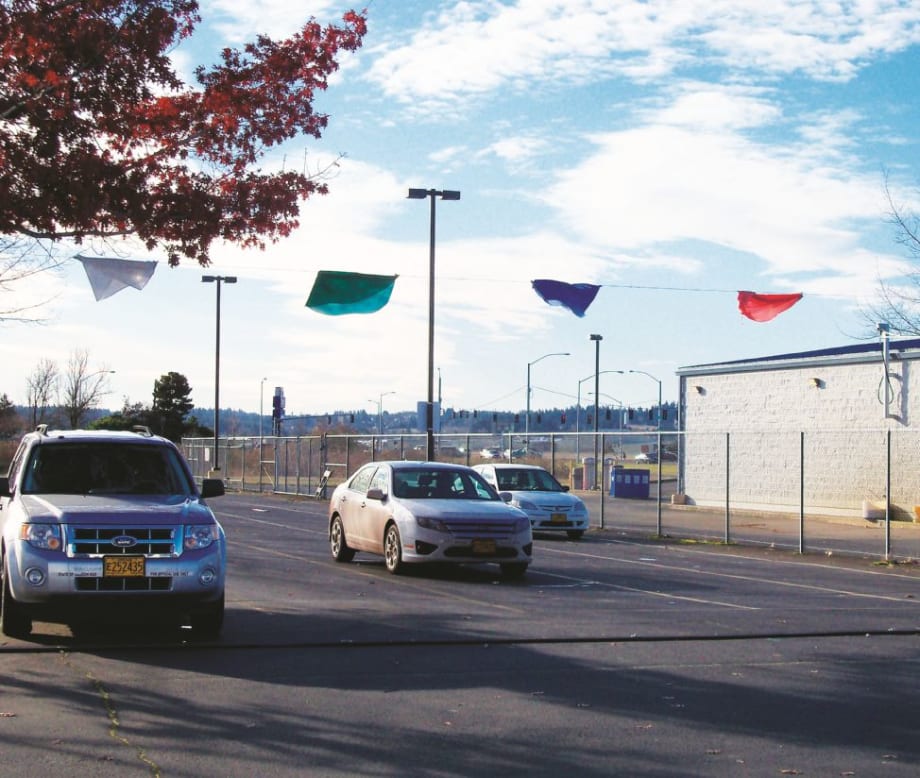
Vehicle return lanes have color-coded flags, pictured here during a "lean event." Vehicle dispatch packets are color coded so customers know in which lane to return the vehicle, which speeds vehicle return and detailing. Photo courtesy of the State of Oregon.
At a Glance
In the wake of severe budget cuts, Oregon's state fleet operations strives to maintain service levels through:
An entrepreneurial management approach.
Lean management principles.
Relationship building with customer agencies, executive management, and legislative decision-makers.
Oregon State Fleet Manager Brian King faced the same tough shrinking-budget versus service-level-retention challenge plaguing other public sector fleet managers in April 2009. Oregon’s legislators, confronting drastically falling revenues as U.S. economic woes deepened, had carved $10 million from the state’s fleet vehicle acquisition budget and $3 million from fleet operations. Two fleet service facilities were shuttered. Stunning, across-the-board staffing cuts were implemented.
Today, King’s fleet operations serves 69 agencies and 40-50 intergovernmental agreements and manages a 4,000-vehicle fleet, motor pool, and service shop — all with a bare-bones two-year budget of $35.7 million and, most startling, a staff of just 27, more than 50 percent fewer than five years ago.
How does a public sector fleet organization balance the mandates of an extreme budget weight loss with maintaining viable, responsive, and professional services? For King and his management team, which includes Kent Fretwell (operations), Ken Liedtke (business), and Carl Crowe (shop supervisor), progress has come with new management approaches, continual operational analysis, and strong relationship building with customers and decision-makers.
Management Approach Looks to Customer-Focused Solutions
“Our department is venturing into entrepreneurial management, emphasizing a customer-focused business approach and ROI-based cost management strategies,” King explained. “It’s all about what we can do for the customer.”
An entrepreneurial management approach values proactive enterprise leadership, collaboration, and innovation.
According to King, this management approach prompted an important Department of Administrative Services (DAS) initiative to establish customer boards to collaborate on and review fleet services, pinpointing the essential and most useful.
Another significant result of this approach for Oregon’s fleet organization has been changing the rate structure to a “true charge-back model” to determine the actual costs of a service to a customer, King said.
The department’s 2013-2015 staggered rates for permanently assigned vehicles are based on monthly mileage and an eight-year-or-less depreciation schedule. “The higher and faster the vehicle usage, the higher the charge rate,” King said. The goal is accurate recovery of the cost for a replacement vehicle.
Under the staggered schedule, for example, a customer agency operating a permanently assigned compact sedan with expected 2,709 average monthly mileage will pay $436 per month for the unit.
Individual monthly long-term vehicle charge rates are determined based on the customer vehicle usage pattern. However, the fleet reviews vehicle use routinely, and the rate may be adjusted if the usage pattern history changes, King said.
Lean Events & Data Analysis Improving ROI and Efficiencies
Fleet operations was one of the first programs in the DAS to implement lean management principles, “looking at areas where return on investment is not there,” King said.
Through closely examining specific tasks, procedures, and policies, “lean events” thus far have streamlined the motor pool vehicle return process, eliminated unnecessary inspections, and simplified accounts payable processes. The results have opened up more time for team cross-training and reduced the motor pool by 30 vehicles. Other recent improvements have trimmed another 20 motor pool units. “We now meet more than 95 percent of customer requests for vehicles with the remaining 124 units,” King said.

Brian King is the fleet services manager for the Oregon Department of Administrative Services (DAS) State Services Division.
When feasible, staff member-generated change opportunities are also implemented. For example, King noted, the billing coordinator eliminated nonessential — and generally unread — departmental reports, saving time and expense.
King and his team are also focusing on data and operational analysis to improve productivity and cost efficiencies. One critical area — improving vehicle utilization — is an ongoing process, King said. With the support of utilization data and cost-benefit analysis, Operations Manager Fretwell works with customers to evaluate what size and model vehicle is required for its functional mission, King explained.
The downsizing efforts have eliminated 79 fleet vehicles and helped customer agencies reassign more than 150 units for improved utilization, King reported.
[PAGEBREAK]
Engaging & Educating Customers and Decision-Makers
Vital to continuing service levels while managing tight budget restraints is “engaging customer agencies and leadership as much as possible,” King maintained. “Use data to help guide decisions and to help illustrate vehicle use and associated costs. We work together to make sure leadership really knows what vehicles and services are truly needed and what budget planning steps are required.”
An important message to both customers and legislators, King said, is that “making the right investment now will mean greater long-term savings.” A case in point, he noted, are more fuel-efficient vehicles.
“Every time we increase mpg by two miles per gallon, we generate more than $700,000 in savings per year,” King said.
He promotes executive support through appearances before legislative hearings. “It’s important to get the experts in front of the people who develop policies and make decisions and who may not have the right information. You can write great reports, but if they don’t hear the facts from your mouth, they may never get heard,” King said.
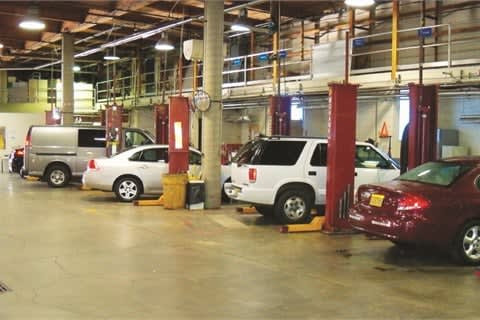
The State of Oregon Department of Administrative Services fleet operations manages a 4,000-vehicle fleet, motor pool, and service shop with a total staff of 27. Photo courtesy of the State of Oregon.
During the last legislative session, King worked with a State senator on a bill requiring use of the federal government’s tiered reimbursement rate for private vehicle use. Previously, Oregon employees were compensated at the highest federal rate even if a state vehicle was available for their use.
“While we are not sure if this action will result in increased use of state-owned vehicles, the overall goal was to control costs and ensure employees were compensated at a lower rate when appropriate,” King said.
He also plans to educate legislators “who may only look the spending side to understand and appreciate the realities of self-funding agencies, which are required to cover all their costs. It’s hard to manage our budget with money being taken out that I can put back,” he said.
Facing Continuing Waves of Change
King and 20 other state agency officials participated in an Enterprise Leadership Team meeting in January to help in the budget vs. service challenge. “Part of the idea of entrepreneurial management — a vision of the current governor [John Kitzhaber] — is that we need to be more coordinated and collaborative with across-the-board issues,” King said.
The group examined and approved policy changes recommended by the State’s Fleet Management Advisory Council to further tighten control of underutilized vehicles and implement a non-idling policy.
“This method of broader executive leadership involvement means it’s not just us [DAS] handing down a policy mandate; it is vetted by the executive leaders of the agencies impacted,” King said. “As we move into budgeting for the fleet needs of the agencies over the next ten years, the Enterprise Leadership Team will be pivotal in setting long-term goals and providing the support for moving fleet funding initiatives through our Legislative Assembly in these tough economic times.”
He advised other public sector fleet managers, “You can let the waves of change pound you into the sand or learn how to ride them the best you can. You still might fall, but you’ve got to get up and still do what’s best for the agencies and service them the best you can.”
[PAGEBREAK]
About the Oregon DAS Fleet
Below is a snapshot of the Oregon Department of Administrative Services' (DAS) fleet stats.
Fleet numbers: 4,000 total vehicles: 1,900 sedans; 960 pickups; 500 minivans, cargo, and passenger vans; 530 SUVs; and 110 miscellaneous pieces of equipment.
"Green" vehicles: 420 hybrids, mostly Toyota Prius and Honda Civic models; 122 CNG Honda GX sedans and a few CNG cargo vans.
Replacement schedule: Police vehicles: 100,000 miles; light-duty vehicles: 130,000 miles; hybrid and CNG vehicles: 175,000 miles.
Facilities: One Salem-based service shop with a fuel island, 700-space parking lot, 124-vehicle motor pool; 45 remote fuel sites.
Staff: 27 including four technicians, two service writers, parts specialist, operations analyst, business manager, five-member motor pool crew, and office staff.
General Services: Provide permanently assigned and short-term
(daily and seasonal rental) vehicles, servicing, and fueling.
Source:
Brian King,
fleet services manager, Oregon Department of Administrative Services (DAS) State Services Division.