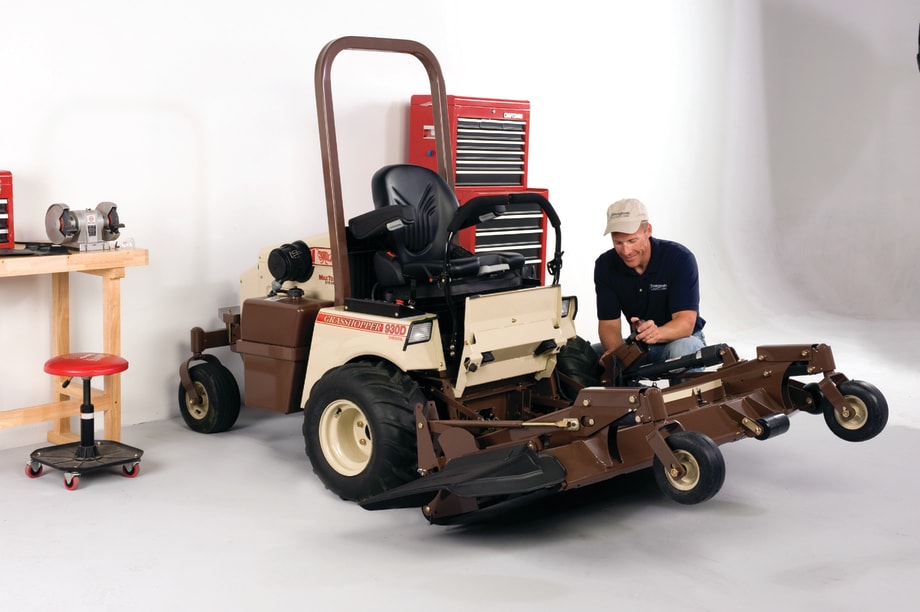
A power lift on Grasshopper front mount mowers facilitates accessibility to the underside of the deck for simplified maintenance, as well as space-saving portability and storage.
Grass-cutting time is coming anew to those parts of the country where there are seasons, so government fleet managers in those regions are doing what their peers in Florida and Arizona do year round: aiming a critical eye at their fleet of grounds maintenance equipment.
At A Glance |
General maintenance of grass-cutting equipment should include:
|
"Like most equipment, if you take care of it, it's going to pay off in less downtime and it's likely to last longer," said Craig Horstick, product support specialist with the agriculture and turf division of John Deere.
Manufacturers recommend maintenance schedules and key maintenance procedures for the pieces they sell to government fleets, and some offer software programs or online support to help monitor usage, track costs, and budget for replacement.
Maintenance of this type of equipment is based on hours of operation, and "it's going to vary depending on where you are in the country," Horstick said. "Down in Florida, I know there are machines that put on a thousand hours every season," whereas in Illinois "a machine might put on just 300 or 400 hours a year," he said.
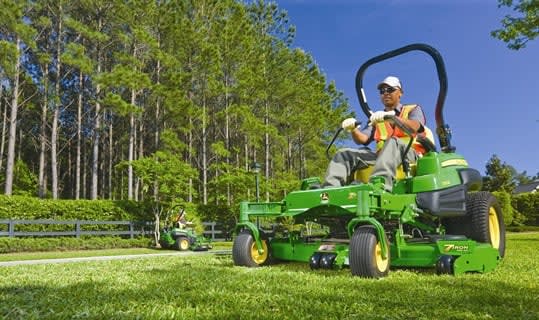
The John Deere Ztrak Pro 950A features a two-cylinder, 31 hp engine with onboard diagnostics and forward travel speed of up to 12 mph.
Proper Maintenance is Key
Service life of a machine can vary too, from perhaps 1,500 hours to twice that, or even more. "We've seen machines with up to 3,000-plus hours on them," Horstick said.
According to Ray Garvey of the marketing division of The Grasshopper Co., prior to first use in the spring, general maintenance should include: a thorough cleaning of the machine; starting out with fresh fuel; changing engine oil (as well as plugs and carburetor maintenance on non-diesel models); checking and replacing air and fuel filters; lubricating all wear points; sharpening mower blades (and replacing bent or worn out blades); and verifying tire pressures (and mower deck pitch).
Cleaning. "We recommend using low-pressure compressed air and a cloth for cleaning the machine," Garvey said. "Avoid use of high-pressure washers, as they can force water into electrical components or engine orifices, which can cause problems later." A thorough cleaning of the machine not only extends service life, but also helps uncover service issues that may create downtime later. For example, wiping down the machine will help identify any loose fittings or worn hoses that might need replacing. Belt tensions can also be checked while cleaning, and adjusted if necessary.
On liquid-cooled units with radiators, make sure cooling fins are clean and free of obstruction in addition to checking anti-freeze quality with a refractometer. Don't apply any force to radiator fins that might damage them.
Fuel. Fresh fuel is critical to engine performance. Fuels are reformulated throughout the year, and fresh fuel will be formulated for the current season. This may be even more critical with use of high ethanol fuels and biodiesels.
Engine oil. Clean engine oil will extend engine life by reducing wear and will potentially reduce fuel consumption as well. Always refer to the engine owner's manual for recommended service intervals, oil viscosities, and quantities.
Filters. Air and fuel filters should be replaced at the beginning of the season and then at intervals recommended by the engine operator's manuals.
Lubrication. When lubricating equipment, follow the equipment maker's recommended guidelines, with careful attention made to wiping off all excess grease. Excess grease is not only hard on bearings, it also acts as a magnet to dirt and grit, which can work its way into the wear points and cause rapid wear.
Blades. Sharp, well balanced mower blades have a major impact on performance as well as improving quality of cut. A sharp blade requires less power to cut, thus helps realize fuel savings. Balanced blades also reduce vibrations, increasing operator comfort.
Tire pressure. Tire pressure on riding equipment is an often overlooked service item, Garvey said. It should be checked daily. Tire pressure affects traction, quality of ride, wear and tear on the machine, and the deck pitch of mowers. Mower decks should always be level, or slightly higher in the rear, to avoid double-cutting and excessive horsepower demand, as well as to produce the best quality cut.
Garvey singled out some variables affecting service life of commercial mowing equipment: liquid-cooled versus air-cooled engines; commercial pump and wheel motor drive systems versus planetary gear systems; and fabricated construction of the mower deck versus stamped steel.
Different organizations have different philosophies for determining when to replace equipment, Garvey noted. Some entities rotate equipment every two or three years in order to maintain product warranty coverage and to obtain highest trade-in values. Other entities believe in using a piece of equipment for the entire length of its useful service life. Budgetary issues such as ease or difficulty of obtaining funding also play a role. One helpful step is to estimate projected service costs for the upcoming year and compare that to quotes received on leasing or purchasing new equipment.[PAGEBREAK]
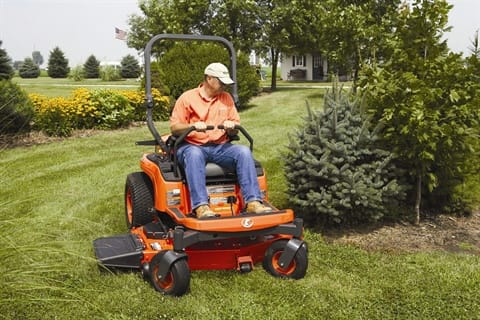
Available in 48- and 54-inch options, Kubota's ZD221 offers a 21 hp Kubota diesel engine in a compact zero-turn frame.
New Technology Facilitates Maintenance
Technology and obsolescence should be factored into the decision to replace older equipment. New engines are more fuel efficient, and drive systems more robust with less maintenance requirements.
Machine design can also facilitate care of the equipment. Kubota's ZD221 has an optional front lift designed to allow quick, simple maintenance without removing the mower deck, and the manufacturer's ZD323 features an integral lift.
John Deere has introduced technology features to support maintenance. "Our dealers have the capability to hook up a laptop to [some of] the machines to help them diagnose problems, which leads to cheaper and quicker repairs," Horstick said. The proprietary John Deere software program is called Service ADVISOR and is available only to dealers, he noted. The diesel-powered 1600 Wide Area Mower (WAM) can be diagnosed with the software.
On the gasoline-powered Z950 Zero Turn Radius Mower (ZTR), an LED display on the machine's hour meter provides alerts to help with troubleshooting. For example, if the power take-off clutch is drawing too much electrical current, a code will flash to indicate that; there is also a diagnostic trouble code that shows in the event that the battery is not charging properly. "While that machine doesn't have the ability to connect to the laptop, it does give the operator or technician some feedback," Horstick said.
"Fleet management has always been done in a very old-fashioned way," said Carlos Calderón, senior marketing manager with The Toro Co., noting maintenance shops typically use a whiteboard to list all equipment, along with model, serial number, and how many hours it has. "And if they can squeeze it into the whiteboard," he added, "they put in the last time the oil change was done and they try to go from there."
But it is sometimes inconvenient, not to mention time-consuming, to go out and get the machine hours and write down the model and serial number, then go back and look at the whiteboard to see what's due for a service. To speed execution of that chore, and facilitate related ones, Toro created an online service a couple of years back, myTurf.com, which Calderón called "an electronic whiteboard."
Entering information on each piece of equipment is done through a simple point-and-click process in which the user clicks on a manufacturer, a model, types in the serial number of the unit, and gives it a name. (The system covers competitors' pieces as well as Toro's.) Thereafter, that equipment item is linked to its service manual, service bulletins, training materials, and the like so that they are instantly available when the user clicks on that piece of equipment.
"It's almost like it's served to them on a tray," Calderón said. Each piece of equipment is also linked to the Toro distributor's parts pricing database. The Toro system can generate reports showing costs, unit history, hours, and so on. Further, recording of hours can be facilitated via wireless meters that can be installed on existing machines. The wireless meters record usage hours until the machine drives within 250 feet of a wireless base station, whereupon the information is transmitted to the online fleet database, and usage hours for that machine are updated automatically. A red circle appears on screen next to the unit when it needs maintenance.
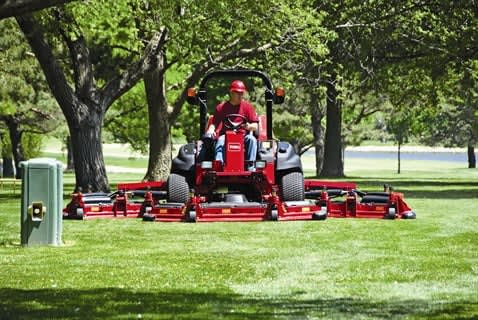
The Toro Groundsmaster 5900 features a 99 hp turbo-diesel engine with factory-installed climate-controlled cab.
Realizing Financial Benefits
On the fiscal side, the Toro system helps government fleets understand their costs, said Paul Danielson, finance marketing manager for the equipment manufacturer. It becomes possible to answer the question, "How much are you spending on that mower?"
"In the past, people knew in aggregate, but no one really knew down to the machine level," Danielson said.
It's typical for tax-supported fleets to have a substantial budget for repair and maintenance, but a limited capital budget, Danielson observed. That means when the engine blows out on an eight-year-old mower, there might not be funds in the capital budget to replace it. But the repair and maintenance budget might have the funds. This could lead to a questionable purchase of a replacement engine for $10,000. "You've got a piece of equipment that's worth $5,000 even with the new engine in it," Danielson said. "You do it because you can, but is that really in the best public interest?"
On the distributor side, Toro provides a fleet management software program that enables distributors to build a customer's budget years ahead, said Danielson.
If a fleet manager wants to replace a unit or units at the end of five or six years, for example, the program helps the distributor forecast the impact on the fleet's budget. The distributor can run variables, such as different interest rates and equipment prices, for comparative purposes, Danielson added.
Sources
Carlos Calderón, senior marketing manager, The Toro Co.
Paul Danielson, finance marketing manager, The Toro Co. www.toro.com
Ray Garvey, marketing division, The Grasshopper Co. www.grasshopperdiesel.com
Craig Horstick, product support specialist, John Deere. www.deere.com/usa