At a Glance |
When stocked with up-to-date information, your FMIS can maximize cost recovery after disaster strikes. Key data includes:
|
When Hurricane Sandy struck in late 2012, storm surges caused severe flooding in New York and New Jersey. Among the hurricane’s victims were the facilities for the Port Authority of New York and New Jersey, many of which were located near water.
As a result, the agency’s fleet took a hit. It lost more than 130 vehicles ranging from light-duty equipment such as police cars, pick-up trucks, and maintenance trucks, to heavy-duty snow plows and emergency response vehicles. Not many could be repaired.
“Salt water is terribly corrosive to engines and electrical components,” explained Jim Reinish, manager, Central Automotive Division, Port Authority of New York and New Jersey. “Vehicles that looked perfectly fine from the outside were lost due to destroyed mechanical and electrical components.”
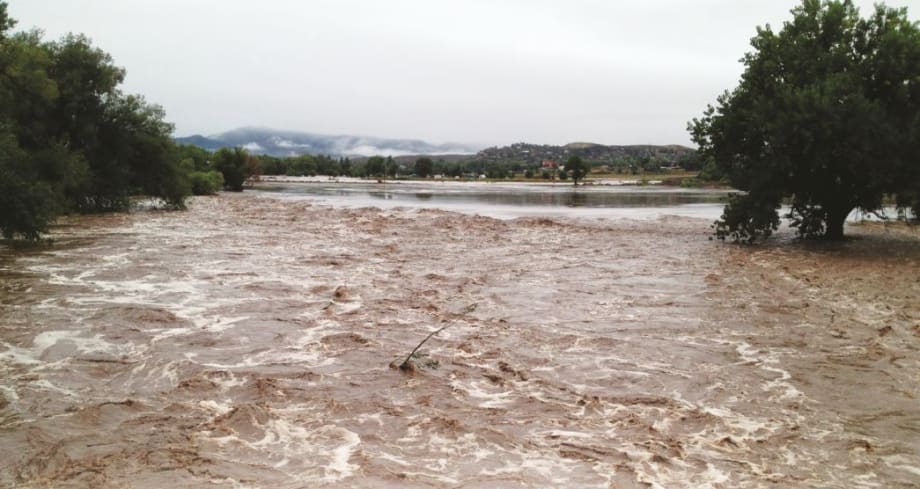
The Big Thompson River, located 80 yards from the City of Loveland, Colo., fleet facility, normally flows at 100 cubic feet per second (cfs) — during the September 2013 floods, this increased to 12,000 cfs. Photo courtesy of City of Loveland
While the fleet couldn’t control the impact of the floodwaters, with help from its fleet management information system (FMIS), the division was able to better control its recovery efforts. “A fleet management information system is invaluable during recovery efforts,” Reinish said. “Our FMIS was used to quantify data that was used to develop claims that were filed with FEMA.” With those claims to the Federal Emergency Management Agency (FEMA) in the millions of dollars, the fleet’s FMIS — AssetWorks M4 — was instrumental in the agency’s recovery efforts.
When fleets put an FMIS strategy in place, they, too can be prepared to recover from the worst by taking these key steps ahead of time.
Leveraging an FMIS for Recovery
More recently, the City of Loveland, Colo., also encountered mass flooding, but this wasn’t the city’s first tangle with Mother Nature. In 1976, the Big Thompson flood killed 144 people — and the fleet learned from the experience.
After flooding hit in early September 2013, the fleet relied on its FMIS to provide prompt information to FEMA in order to recoup costs for damage.
“The Emergency Operations Center asked for a vehicle class/type master list. We provided this through the reporting structure in less than one minute,” said Steve Kibler, ACFM, fleet manager, City of Loveland, Colo. “Before the emergency project number was established, we had a code for any declared emergency repairs. Engine horsepower seemed to be a major requirement for FEMA forms. We have this recorded in our FMIS.”
The city uses FASTER Asset Solutions to manage its vehicles. Based on his experience, Kibler strongly recommends every fleet keep its FMIS stocked with relevant information that will help recover assets in the aftermath of a disaster.
[PAGEBREAK]
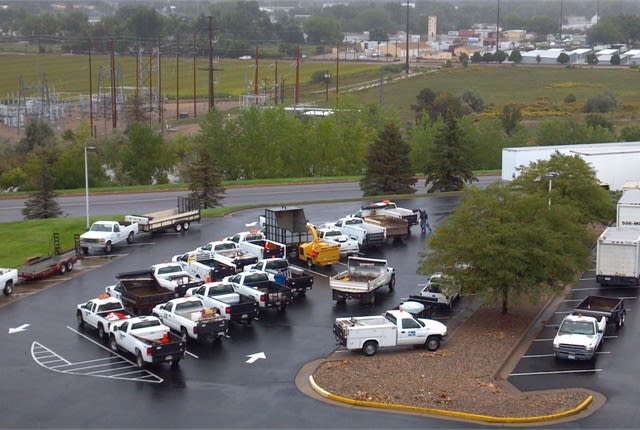
By immediately evacuating all vehicles stored in the flood plane, the City of Loveland, Colo., was able to prevent vehicle damage. Photo courtesy of City of Loveland
● FEMA Equipment Codes: For starters, Kibler suggests keeping equipment codes up to date to easily track the reimbursement costs for equipment replacement. “FEMA reimbursement codes are vital to quick data collection,” he said. “Fleets should identify each piece of equipment with a FEMA code, as they are essential for completing financial reimbursement forms. National Incident Management System (NIMS) vehicle-type codes should also be recorded so assets/resource sharing is easily accessible in the event of a regional emergency.”
● Work Action Codes for Repairs: When equipment isn’t completely destroyed but has incurred damage, it’s also important to create work action codes specific to disaster-related repairs so they can easily be distinguished from normal, scheduled maintenance and repairs. Kibler suggests using just one code for everything related to a disaster.
“Our agency immediately set up a project reference number to link to any flood-related work or cost. Using the code ‘FEMA Repairs’ gave us fast and easy cost reports,” Kibler said. “If you don’t create a project number, you need a way to separate the emergency-related work from the normal operational work.”
● Updated Costs Per Hour: In addition to equipment codes, fleets should also keep on record up-to-date costs per hour for their equipment and personnel. Without them, fleets must make an educated guess as to their costs. This can cause FEMA to question the credibility of the figures, in turn threatening to delay federal compensation.
“FEMA provides a schedule of equipment rates, which is a list of four-digit codes that correlate with the reimbursement rates they pay,” Kibler said. “These should be put into the FMIS somewhere finance people can easily access them or where you can print out a master list.”
After the Recovery
With the help of their fleet systems, both the Port Authority of New York and New Jersey’s Central Automotive Division and the City of Loveland are recovering.
“It’s been a year, but we are doing very well,” Reinish said. “Most vehicles were replaced or have replacements on order. In addition to replacing vehicles, we have purchased additional generators and arranged for an emergency fuel contract to be used if fuel becomes unavailable.”
The City of Loveland is still in the early phases of recovery, but expects positive results. For one, because of its previous experience with the Big Thompson flood, the fleet didn’t lose a single vehicle. “We evacuated vehicles and equipment from the flood plain upon first warning,” Kibler said. “Recoup cost are pending, but FEMA did mention that the equipment records we submitted were ‘an example how to do it right.’ If you’re prepared by having a good contact network, you can get equipment fast and save your agency tons of money. People actually do think you have a magic wand.”
[PAGEBREAK]
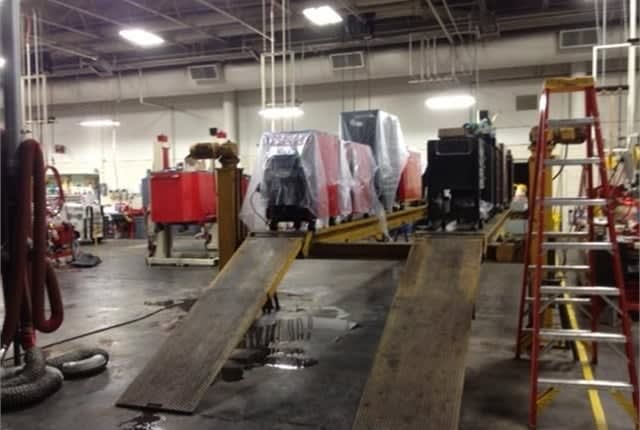
In the shop, City of Loveland, Colo., technicians placed their toolboxes on higher ground to prevent damage during the flood. Photo courtesy of City of Loveland
Preparing for Disaster
When disaster strikes, fleets face a number of challenges: fuel availability, power availability, getting staff to work, getting equipment back into service, and maintaining emergency response equipment.
In order to be ready to respond in the hours after a disaster, Steve Kibler, ACFM, fleet manager at the City of Loveland, Colo., has a disaster preparedness plan and notebook in addition to the fleet management information system. This includes:
● A well-maintained alternate resource contact list, including after-hours contact information
● Rental equipment vendors with pre-negotiated pricing discounts and an emergency priority agreement
● Mobile refueling services
● Backups to the backups
● A plan for how families of employees will be cared for during a disaster — if the family isn’t safe, the employee isn’t coming to work.
The Port Authority of New York and New Jersey also has emergency plans in place. “Our first and foremost priority is to ensure fuel is available. We work with our fuel supplier to ensure that on-site fuel tanks [we have 22 tanks at 12 fuel sites] are topped off and to develop contingency plans in case deliveries are interrupted. We also ensure generators are fueled and ready,” said Jim Reinish, manager of the Central Automotive Division. “In addition, we re-prioritize workload to ensure that out-of-service emergency and mission-critical vehicles are available. Also, typically, in response to an emergency, staff ‘sleeps in’ and is on call 24/7.”
Remarketing Company Helps FEMA During Colorado Flood
By Stephane Babcock
While Colorado fleets were dealing with the flooding in September 2013, remarketing company Flexco Fleet Services was working to aid the entity that would be helping these fleets — the Federal Emergency Management Agency (FEMA).
Flexco Fleet Services President Chad Shoemaker received a call at his Commerce City, Colo., office from the U.S. General Services Administration to stop prepping cars for resale and start getting them ready to assist FEMA representatives in evacuating victims and assessing flood damage.
“The request for units came in waves but was updated almost daily over six days,” Shoemaker said. “Our first request for 10 units was an easy order to fill; even during the floods, we loaded the vehicles into our normal work flow. The following day we received a request for an additional 30 to 40 units, and then a couple days later they had a proposal for another 100-plus units.”
That’s when Shoemaker and his employees had to shift into overdrive. The team at Flexco began preparing the units exclusively through the shop. Shoemaker extended work hours and days as well as restructured the shop’s workflow, turning it into an assembly line. Every vehicle had to be detailed inside and out, all fluids checked and changed as needed, all service or trouble lights diagnosed, and safety issues resolved or repaired.
After the initial flooding hit, a request came in for large trucks and vans with the capacity to move people and supplies. The largest request — a call for more than 100 units — was mainly for sedans, which were used to get FEMA representatives in the field to assess the damage brought on by the flooding.
With his team unified by both their efforts and their exhaustion, Shoemaker knew that the mission was both personal and professional. In the end, the staff’s hard work and determination helped FEMA reach those in need and respond to the devastation experienced by their neighboring communities.
Sources:
Steve Kibler, ACFM, fleet manager, City of Loveland, Colo.
Jim Reinish, manager, Central Automotive Division, Port Authority of New York and New Jersey
Chad Shoemaker, president, Flexco Fleet Services