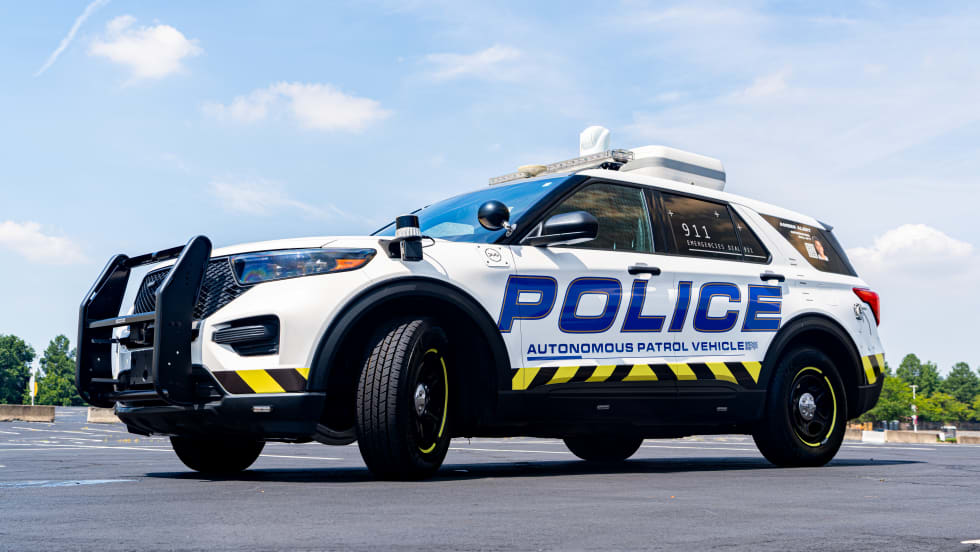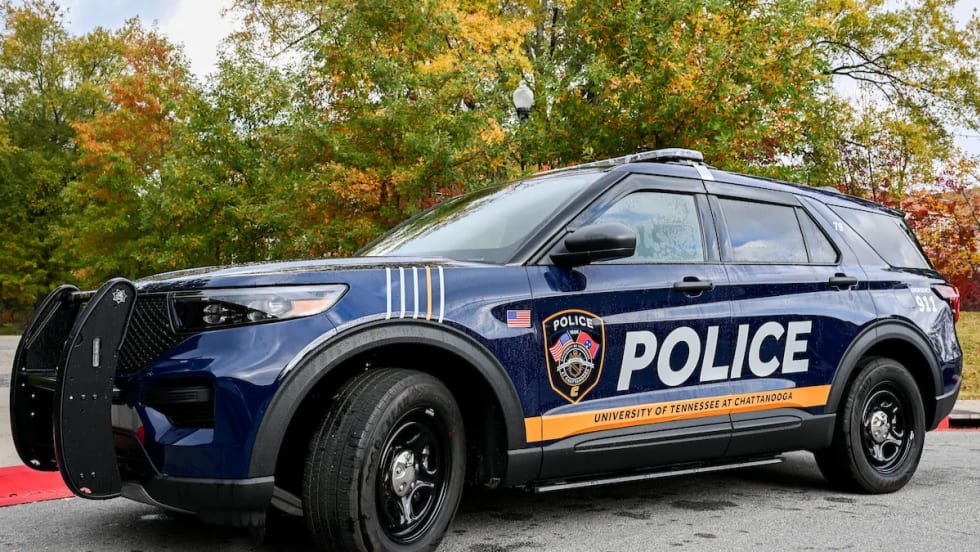
Police officers often refer to Ford’s Police Interceptor Utility as the “Ford Police Explorer,” but this label for the police vehicle misses the mark. The automaker calls the vehicle Explorer-based, and further details about the array of differences between it and the civilian Explorer reveal why.
In the early build stages at Ford’s Chicago Assembly plant, the vehicles could be easily mistaken for each other, but once the SUV heads across the street to Ford’s Troy Design and Manufacturing (known as TDM), all bets are off.
“In Chicago, you’ll find two separate manufacturing facilities because there are really two different vehicles being produced,” said William Mattiace, Ford’s SUV spokesman. “Chicago Assembly builds the Police Interceptor and TDM makes them into exactly what the department ordered.”
A closer look at the two vehicles reveals differences in five categories that provide the P.I. Utility with its law enforcement DNA, including safety, durability, performance, its purpose-built interior, and upfit-friendly features.
Added Safety Benefits
When Ford first offered the Police Interceptor Utility for the 2013 model year, the automaker touted the vehicle’s 75-mph rear crash rating that protects occupants from high-speed rear-end collisions.
This feature benefits highway patrol officers making traffic stops at night or on rural routes who may be susceptible to drunk or inattentive drivers.
The P.I. Utility and Explorer both get an aluminum hood, magnesium seat frame, and boron A and B pillars. Technology baked into both vehicles helps absorb the energy of a collision and direct impact forces away from the occupants.
The 2016 P.I. Utility offers optional Level III panels that can stop higher-caliber rifle and shotgun rounds as well as Level IV ballistic panels that stop armor-piercing rounds.
The 2017 P.I. Utility will offer a stealthier model with an interior visor light mounted to the top of the windshield for surveillance that provides greater brightness when activated.
Higher Durability
In addition to required crash testing, the P.I. Utility undergoes several additional tests, including a rear crash test, 30-mph frontal barrier test, and reverse J-turn test.
The P.I. Utility gets a heavier duty cylinder lock, heavier duty alternator, and door handles with high-strength tethers that reduce stress on hinges of doors that can fly open especially while the vehicle is in motion.
Wheels and tires get upgrades. While both SUVs offer 18-inch wheels, the P.I. Utility includes steel wheels. Explorer offers aluminum alloy wheels and 20-inch wheels as an upgrade. Ford worked with Goodyear to develop the Goodyear Eagle RS-A 245/55R18 V-rated all-season radial as a unique tire. The Explorer offers three tires, including the standard Michelin 18-inch radial, Hankook 20-inch radials, or Conti Sport Contact summer tires for 20-inch wheels. Larger brake rotors include improved lining material.
The P.I. Utility’s upgraded 220-amp alternator charges a 78-ampere battery with 750 cold-cranking amps.
Meeting Performance Needs
Engine offerings differ. The P.I. Utility is powered by a 3.7L base V-6 that makes 304 hp and 279 lb.-ft. of torque, while the Explorer offers a 3.5L base V-6 that makes 290 hp and 255 lb.-ft. Ford offers the optional 3.5L EcoBoost V-6 with both vehicles that makes 365 hp and 350 lb.-ft. of torque. The 2016 Explorer offers a third engine — the 2.3L EcoBoost inline-4 that makes 280 hp and 310 lb.-ft. of torque.
Both SUVs offer intelligent all-wheel drive, but the P.I. Utility gets police calibration that operates uniquely for police use and gives the vehicle better traction and acceleration to account for more dynamic driving by officers. Ford calibrates power delivery and transmission shifting differently for each vehicle.
The P.I. Utility is limited to a top speed of 131 mph with the base V-6 and 148 mph for the EcoBoost V-6. Agencies can ask for the 131-mph governing on the higher-performance engine at no extra cost. The civilian Explorer with the 3.5L engine is limited to 120 mph.
The SUVs get helical coil springs and nitrogen gas pressurized shocks; however, the P.I. Utility adds stiffer springs and shocks. This reduces body motion and improves handling.
The P.I. Utility gets a unique cooling system with a larger radiator, additional transmission cooler, engine-oil cooler, a larger grille to provide greater air flow, and a water-cooled all-wheel-drive system.
A Look at Vehicle Interior
The P.I. Utility offers a column-mounted shifter, while the Explorer provides a floor shifter. The P.I. Utility gets vinyl flooring and different seats with more durable cloth. While Explorer seat bolsters wrap around the driver, P.I. Utility seats are flatter to accommodate an officer’s utility belt and sidearm. The Explorer offers optional captain’s chairs instead of a second-row bench, and the P.I. Utility deletes the third-row bench.
The P.I. Utility also offers an overhead task lamp that gives white or red light, locking bins, and a supplemental switch that locks out the rear liftgate. This switch would operate the moon roof in the Explorer.
Policy Vehicle Upfitting Options
The P.I. Utility is designed to allow agencies to add lightbars, radios, consoles, and other police equipment. It includes a recessed universal top tray in the center of the dashboard to mount equipment where the Explorer would offer a speaker.
A heavy metal plate a few inches off the floor runs from under the dash to the front of the second row seating to allow technicians to run wiring and mount a console. An optional mounting plate runs from the second row to the cargo area so technicians can run wiring to trays of police radios in the rear. The dashboard includes a pass-through for wiring and a grommet to protect against chafing.
Under the cargo load floor, the power distribution lug provides two 50-amp circuits and a ground strap for upfit equipment, and two 12-volt power points in the front row. The Explorer provides four 12-volt power points (two at the first row, one at the second row and one in the cargo area). A 110-volt outlet is available at the center row with the Limted, Sport, and Platinum trims.
Lastly, government agencies can add a Telogis-powered telematics package to the P.I. Utility.
Editor's note: This article incorrectly reported that Ford first offered the Police Interceptor Utility in the 2012-MY. Ford introduced it in 2012 as a 2013-MY vehicle.