For the city of Wichita, Kansas’ fleet management team, being a police fleet innovator looks like being adaptable and keeping safety at the forefront.
The city of Wichita was named one of three inaugural Police Fleet Innovators by Government Fleet in 2024 for its work to keep officers and prisoners safe, thinking outside the box to keep patrol vehicles on the road, helping officers respond more quickly to developing scenes, and promoting technician training and education opportunities to keep the shop staffed.

Fleet Superintendent (right) Megan Stuart manages a team of about three dozen employees who service city fleet vehicles. She is pictured here with Setina Manufacturing Vice President Judy Setina receiving the award.
Safariland
Protecting Officers and Their Transports Without Breaking the Bank
Law enforcement officers are tasked with protecting and serving their communities. That includes keeping transports safe.
When an unrestrained transport was killed in Connecticut in 2022, it made national headlines and forced agencies to rethink their transport safety strategies. When the city of Wichita’s risk management staff faced pressure to make changes to its own transport vans, the fleet team got to work.
“The goal was to not only better protect passengers, but officers as well,” Wichita Fleet Superintendent Megan Stuart said.
Initially, package inserts were estimated to cost nearly $20,000 each, and would make for a challenging install on the city’s older model year vans. These challenges led the fleet team to consider alternative options.
Ultimately, the team was able to install lap belts that met all regulatory requirements. Additionally, seat dividers were placed methodically to ensure officer safety, as well as to accommodate various sizes of passengers.
Expenses totaled nearly $400 per van. Because these vans are expected to be replaced in the next three to five years, staff will look at what is available on the market and industry at that time to further ensure safe transport.
“In a perfect world, we would have just shipped these transport vans off to have complete package inserts retrofitted by an outside vendor,” Stuart said. “The fact that we were able to make modification in-house at minimal cost and quick turnaround is a testament to our shop staff on the floor.”
The team did extensive research to come up with its own solution and worked alongside the Wichita Police Department. These relatively basic enhancements will provide the team with additional time to further research and plan for the upfitting needs of their next transport vans.
“In their daily operations, [officers] face a myriad of challenges, and their commitment to ensuring the safety and security of citizens is paramount in accomplishing that mission. This includes protecting the lives and safety of officers, the public, and the person in custody. Ultimately, regardless of their legal status, it is a fundamental right for all that a person in custody be transported in a safe and appropriate manner,” Stuart stressed.

The city of Wichita has 314 on-road vehicles and seven off-road vehicles.
Ballistic Armor Co.
Making Incident Response More Efficient and Quicker with Some Rearranging
Time is of the essence when officers respond to developing scenes, and every second counts. One way the agency realized it could save time was by moving its rifle racks from the back of patrol vehicles to the front. For years, the rifle racks were stored at the front, but that last changed in 2017 due to concerns about public appearance and safety concerns.
In 2023, new leadership determined the gun racks needed to be more easily accessible to allow for quicker response times and had the fleet team move the racks between the driver seat and passenger seat.
Technicians were trained on proper installation of the gun racks so that the upfitting could be done in-house. Additionally, shop staff worked with each officer after the install to teach them how to safely operate the rack and keep their weapon secured.
The city has also leaned into new and emerging technologies to protect officers, installing the Whelen CORE system to about one-third of its vehicles. The technology provides advanced automation and remote connectivity capabilities. The synchronization of vehicle lighting with this tech has greatly improved patrol vehicle visibility to better protect officers.
Working Alongside a Third-Party Service Team to Keep Vehicles Moving
Keeping vehicles safely operating on Wichita roadways for police officers can’t happen without technicians. But in recent months, the city has experienced a nearly 30% technician vacancy rate.
Generally, having fewer shop employees can lead to delayed preventive maintenance service, which can in turn increase safety and maintenance concerns.
Initially, the team outsourced some of its PM work to the local dealership. However, transporting vehicles was time-consuming. Coincidentally, the dealership had recently started offering a mobile service option.
Stuart determined the service provider could send at least two staff members to perform PM services onsite one day per week for under $100 per vehicle, with about 15 to 20 vehicles receiving this service each week.
This approach would not work, though, if shop staff did not work well with the service provider. Initially, there were some bumps in the road. But the shop supervisor began better communicating the city’s standards and expectations for its vehicles.

Of the 35 fleet division employees, six work specifically with the police fleet.
Ballistic Armor Co.
Shop leadership spot checks all vendor-completed services and provides direction when further maintenance service is required.
“This has allowed our staff to work on other priority repairs and projects, as well as spending more time on employee training and development,” Stuart said.
This has also allowed the team to maintain its goal of a 95% availability rate, despite its ongoing hiring challenges.
Promoting Technician Education and Growth from Within
One method to attract new techs for the fleet department is partnering with local automotive tech programs to educate students about the industry.
Because this is a subset of the automotive industry many young people don’t know about, promoting it as students are choosing career paths can create a steppingstone for the technicians when they are ready to enter the career field.
The city began working to recruit students from these programs in around 2021 after several retirements greatly impacted its fleet operations.
“We were told by several students that they weren’t even aware that mechanic positions existed with the city of Wichita and had assumed they would have to go the traditional dealership position route. With students being typically younger, we are really able to promote the benefits of a public sector career, which boasts a pension and typically better benefits over the private sector,” Stuart said.
Bringing in younger students can also have a positive impact on the shop as a whole.
“The ability to use technology is becoming one of the most necessary skills to possess in the automotive repair industry. We find that those approaching retirement age tend to have more challenges in adapting to technology, whereas this is an area that younger students excel at,” Stuart explained. “And while the initial lack of experience [in the younger students] may slow repair times, we have to start somewhere.”
When outside recruiting attempts don’t lead to new hires, promoting growth from within can help fill gaps.
Years ago, the team began an ASE employee recognition program to financially incentivize technicians who chose to gain new certifications and expand their industry education and training. The city provides training materials and pays for all fees and/or time associated with taking the exams.
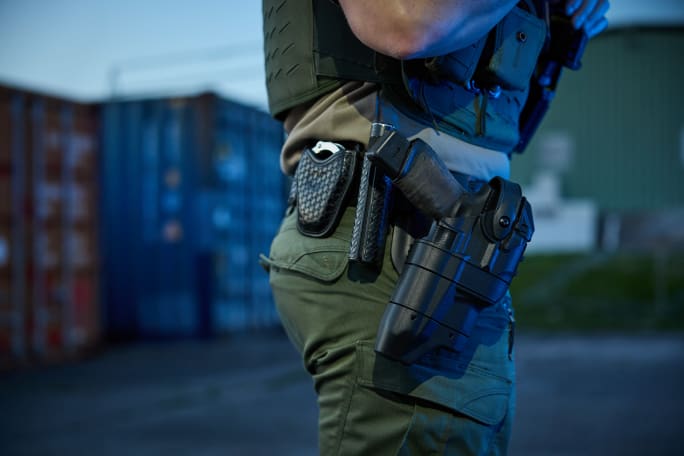
The fleet team encourages growth through an ASE employee recognition program.
Safariland
The department first received the ASE Blue Seal of Excellence in 2015, seven years after beginning its incentive program. Achieving this not only puts the fleet division on par with the best private sector fleet providers, but it also assures fleet users that the services being provided on their vehicles meets the highest industry standards.
Now, 89% of the city’s shop staff are ASE certified. While it’s difficult to clearly or fully credit ASE as the sole factor of efficiency and effectiveness within the shop, Stuart pointed out a correlation with staff productivity since the program began.
Despite a 33% reduction in employees since the program began in 2006, the department has seen a nearly 40% increase in its work order per employee ratio.
“We hope that by investing in our technicians, we are investing in our future. There is a direct return on this investment – knowledgeable mechanics ensure repairs are done correctly, safely, and efficiently,” Stuart said.