



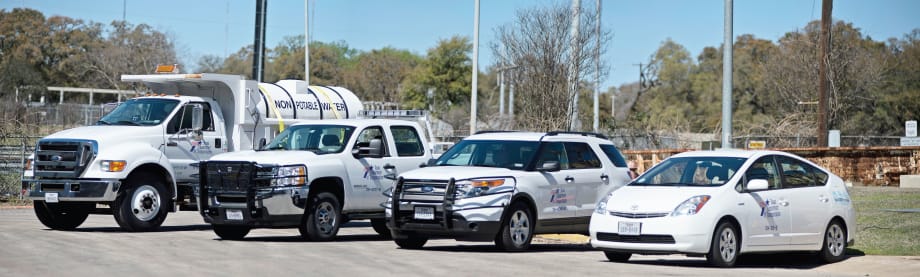
In the past few years, the Texas DOT has restructured its fleet management program, right-sized inventory to about 12,500 vehicles, and launched programs for continuous improvement. Photo courtesy of Texas DOT
Like many fleets, a few years back, the Texas Department of Transportation (TxDOT) was asked to tighten its belt. In an effort to become a leaner, more efficient organization, the fleet program was restructured and the equipment inventory right-sized. That left the organization at a critical juncture: would it suffer with access to fewer resources or could fleet management find a way to work smarter and become stronger?
TxDOT took the latter path.
With a smaller fleet and limited financial resources, TxDOT created the Fleet Excellence (FLEX) program — a continuous improvement initiative intended to elevate fleet practices and expectations.
“Fleet Excellence grew out of our need to work smarter and more efficiently with the resources we have,” said Kevin Fareri, Fleet Operations Division deputy director. “The outcomes we always work to accomplish include improved safety, consistent processes, operating efficiency, and cost savings.”
FLEX program goals include:
Making the Fleet Division a better place to work
Enabling better customer service
Maximizing equipment life and utilization
Ensuring the organization spends taxpayer dollars wisely
Supporting the agency mission to deliver a safe, reliable, and integrated transportation system.
“Each FLEX initiative addresses very specific fleet operations. The common thread with all initiatives is intense one-on-one communication and training,” Fareri said. “Although our goal is to develop consistent processes throughout our fleet program, the approach is not one-size-fits-all. The initiative has to be tailored for the shop or the maintenance section.”
The first phase, FLEX I, began in 2014 and sought to streamline shop operations. Fareri said the initiatives that followed have all stemmed from this first phase.
“When you do a deep dive into one area, you usually uncover other processes to improve,” he said. “The shop improvements highlighted the need to work more closely with our preventive maintenance (PM) and quality assurance staff, and then we wanted to address PM on the operator side. All of this led to our upcoming FLEX initiative to assess PM through a scorecard tool.”
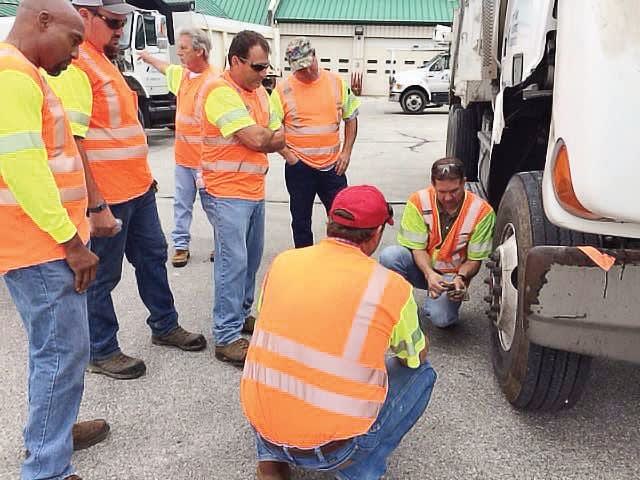
The Texas DOT’s FLEX III program provides equipment operators with intensive, hands-on training in vehicle inspection. Photo courtesy of Texas DOT
A Closer Look at the Improvement Initiatives
FLEX I: Improving Shop Operations and Customer Service
The first FLEX initiative aimed to streamline operations in all TxDOT shops, with the goal of creating efficiencies and making the shops a better place to work.
“We focused on reducing equipment downtime, maximizing wrench time, saving money on outsourcing, and improving the parts ordering process,” Fareri said. The results were tangible. As a result of the FLEX I initiative, TxDOT saw:
a 10% reduction in parts prices
an increase of 1.8 hours per day/per mechanic in wrench time
a decrease of 12 hours per job.
The organization certainly accomplished its goals to improve the workplace and create efficiencies. It also saved a stack of money in the process: Fareri said FLEX I has a projected financial impact of about $11 million.
FLEX II: Improving the Preventive Maintenance Program
Next was a close look at preventive maintenance. FLEX II is a four-week, one-on-one training program for quality assurance coordinators (QACs) and staff in TxDOT’s road maintenance field offices, who are the Fleet Division’s primary customers.
During this program, the fleet team helps QACs set up PM calendars, responsibilities, checklists, and tools to establish fluid communication between the shop and maintenance offices. FLEX II also provides PM training for maintenance office employees.
“Since implementing FLEX II, our QACs have more consistent procedures and tools to stay on track, and they are inspecting more units than they were able to do in the past. We sampled several districts after implementing the program and saw an increase of 11% in PM inspections after the training was introduced,” Fareri said.
FLEX III: Training Operators Across the State
Where FLEX II focused on team members coordinating and performing PM, FLEX III turned the attention to another audience: operators. FLEX III provides equipment operators with intensive, hands-on training in vehicle inspection.
The goal is to help operators know what to look for during pre-trip inspections and what to do if they find something wrong. It also teaches them to properly complete and submit inspection reports. The training combines a classroom presentation as well as hands-on practice in maintenance yards.
TxDOT has trained nearly 3,000 employees and is still working its way across the state.
“We have received overwhelmingly positive feedback from participants and supervisors. Some comment that it is the best training they have ever received,” Fareri said. “Although we are still completing the initial training in several districts, we are already receiving requests for repeat training for new employees in districts that have already completed the training.”
FLEX IV: Piloting a Scorecard
The most recent phase is still in progress. FLEX IV is a scorecard tool for district management to compare PM performance among their maintenance sections. It works like this: After conducting PM inspections at each maintenance section, the quality assurance coordinator completes a scorecard and sends it to district leadership. QACs also compile a summary spreadsheet after all inspections are complete.
Although still in development, the program looks promising. “We expect to see several benefits from the PM inspection scorecard, including decreased equipment breakdowns and better equipment availability,” Fareri said. “This also gives us another opportunity to provide employees with refresher training on pre-trip inspections.”
Collective Outcomes
While each FLEX phase has its own outcomes, together, the phases have resulted in benefits for the fleet, its employees, and the public.
“FLEX is reducing equipment downtime and saving money by detecting small issues and fixing them before they become expensive repairs or safety issues. It is also improving communication and cooperation between fleet staff and our customers,” Fareri said. “All of this benefits the public, because we are using our resources more efficiently and improving equipment safety.”
But it’s not all about taxpayer dollars. Fareri said employee engagement is also a central component of FLEX. “We have personal contact with employees to implement each initiative. This helps employees become more skilled in their jobs and gives them more ownership of the work product,” he said.
Continuous Improvement
Looking ahead, Fareri said TxDOT plans to roll out the FLEX IV scorecard program statewide. It’s likely more improvements and FLEX phases are to come, too.
“There is always something we can do better,” he said. “It is important to constantly move forward to take your program to the next level. Maintaining the status quo is an illusion — you are either getting better or you are falling behind.”